SUBSCRIBE TO OUR FREE NEWSLETTER
Daily news & progressive opinion—funded by the people, not the corporations—delivered straight to your inbox.
5
#000000
#FFFFFF
To donate by check, phone, or other method, see our More Ways to Give page.
Daily news & progressive opinion—funded by the people, not the corporations—delivered straight to your inbox.
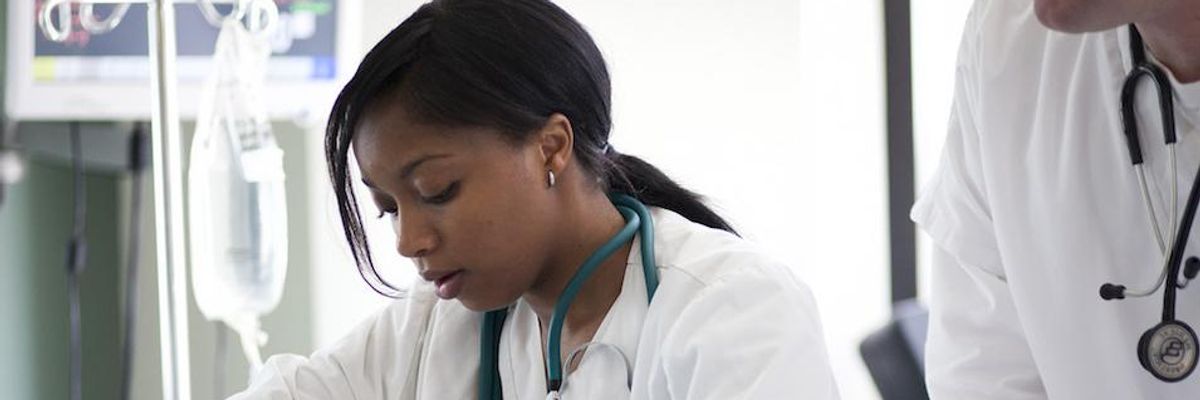
An EMT student stabilizes a patient. (Photo: College of DuPage Flickr)
Americans borrowed $88 billion in 2018 to cover their healthcare, putting yet another number to the argument against the private insurance system as the best provider of care and making the case for universal healthcare even stronger.
That's not all. 45% of U.S. adults fear a health issue could push them into bankruptcy--and 15 million Americans delayed purchasing medication to save money last year.
"Someone is making money off dysfunction," said New York Times editor Patrick LaForge.
A Gallup survey, conducted with the healthcare nonprofit West Health, revealed striking numbers about the American healthcare system on Tuesday as part of a wide ranging report, The U.S. Healthcare Cost Crisis. The key findings include, per the document:
"Sadly, these latest figures do not come as a surprise: this is how we've designed our healthcare system," Dr. Adam Gaffney, president of the group Physicians for a National Health Program, said in a statement. "The privatized, fragmented US healthcare system invariably means patients putting off needed care, avoiding the doctors' office or emergency room, skipping dosages of medications, as well as contending with bills, collections agencies, and even bankruptcies."
"Private insurance is the original sin of our system," said Gaffney, "and a sweeping overhaul of healthcare financing by way of single-payer reform is the solution."
The report found that opinions on healthcare quality in the U.S. vary by partisan affiliation. 67% of Republicans believe the U.S. system is the best in the world, but only 38% of Democrats think the same. What's bipartisan, the research shows, is the cost and outcomes of the system.
"While there may be a great political divide in how highly Republicans and Democrats perceive the healthcare system at large," West Health chief strategy officer Tim Lash said, "there is very little that separates the groups when it comes to the real-life consequences of the high cost of healthcare on their everyday lives."
Gallup senior researcher Dan Witters agreed.
"The impact of out-of-control healthcare costs is indisputable, although Americans' feelings about their healthcare system are complicated and at times conflicted," said Witters. "At a macro level, large numbers think healthcare in America is among the best in the world, but on an individual basis, most agree they are paying too much and getting too little in return, and they are worried not only for themselves but for the country."
The report's data was cited by advocates for universal healthcare.
"This is, again, a crisis that can't be fixed by tweaking private insurance plans that leave patients vulnerable to unscrupulous out-of-network ER doctors and fraudulent hospital billing," advocacy social media account All on Medicare tweeted. "A nation where individuals fear the ER is one at risk of a major public health crisis."
"Americans borrowed $88 BILLION last year to pay for health care," said Rep. Pramila Jayapal (D-Wash.), the lead author of the House Medicare for All bill. "This is devastating for our families and our country."
"#MedicareforAll ensures that NOBODY has to borrow or beg for money in order to cover health care costs," Jayapal added.
Progressive group Justice Democrats said that the report adds to the case for a universal system.
"In the richest country on earth, thousands of people use GoFundMe as their healthcare plan," the group tweeted. "We need Medicare for All."
This piece has updated to include comment from PNHP's Dr. Adam Gaffney.
Dear Common Dreams reader, It’s been nearly 30 years since I co-founded Common Dreams with my late wife, Lina Newhouser. We had the radical notion that journalism should serve the public good, not corporate profits. It was clear to us from the outset what it would take to build such a project. No paid advertisements. No corporate sponsors. No millionaire publisher telling us what to think or do. Many people said we wouldn't last a year, but we proved those doubters wrong. Together with a tremendous team of journalists and dedicated staff, we built an independent media outlet free from the constraints of profits and corporate control. Our mission has always been simple: To inform. To inspire. To ignite change for the common good. Building Common Dreams was not easy. Our survival was never guaranteed. When you take on the most powerful forces—Wall Street greed, fossil fuel industry destruction, Big Tech lobbyists, and uber-rich oligarchs who have spent billions upon billions rigging the economy and democracy in their favor—the only bulwark you have is supporters who believe in your work. But here’s the urgent message from me today. It's never been this bad out there. And it's never been this hard to keep us going. At the very moment Common Dreams is most needed, the threats we face are intensifying. We need your support now more than ever. We don't accept corporate advertising and never will. We don't have a paywall because we don't think people should be blocked from critical news based on their ability to pay. Everything we do is funded by the donations of readers like you. When everyone does the little they can afford, we are strong. But if that support retreats or dries up, so do we. Will you donate now to make sure Common Dreams not only survives but thrives? —Craig Brown, Co-founder |
Americans borrowed $88 billion in 2018 to cover their healthcare, putting yet another number to the argument against the private insurance system as the best provider of care and making the case for universal healthcare even stronger.
That's not all. 45% of U.S. adults fear a health issue could push them into bankruptcy--and 15 million Americans delayed purchasing medication to save money last year.
"Someone is making money off dysfunction," said New York Times editor Patrick LaForge.
A Gallup survey, conducted with the healthcare nonprofit West Health, revealed striking numbers about the American healthcare system on Tuesday as part of a wide ranging report, The U.S. Healthcare Cost Crisis. The key findings include, per the document:
"Sadly, these latest figures do not come as a surprise: this is how we've designed our healthcare system," Dr. Adam Gaffney, president of the group Physicians for a National Health Program, said in a statement. "The privatized, fragmented US healthcare system invariably means patients putting off needed care, avoiding the doctors' office or emergency room, skipping dosages of medications, as well as contending with bills, collections agencies, and even bankruptcies."
"Private insurance is the original sin of our system," said Gaffney, "and a sweeping overhaul of healthcare financing by way of single-payer reform is the solution."
The report found that opinions on healthcare quality in the U.S. vary by partisan affiliation. 67% of Republicans believe the U.S. system is the best in the world, but only 38% of Democrats think the same. What's bipartisan, the research shows, is the cost and outcomes of the system.
"While there may be a great political divide in how highly Republicans and Democrats perceive the healthcare system at large," West Health chief strategy officer Tim Lash said, "there is very little that separates the groups when it comes to the real-life consequences of the high cost of healthcare on their everyday lives."
Gallup senior researcher Dan Witters agreed.
"The impact of out-of-control healthcare costs is indisputable, although Americans' feelings about their healthcare system are complicated and at times conflicted," said Witters. "At a macro level, large numbers think healthcare in America is among the best in the world, but on an individual basis, most agree they are paying too much and getting too little in return, and they are worried not only for themselves but for the country."
The report's data was cited by advocates for universal healthcare.
"This is, again, a crisis that can't be fixed by tweaking private insurance plans that leave patients vulnerable to unscrupulous out-of-network ER doctors and fraudulent hospital billing," advocacy social media account All on Medicare tweeted. "A nation where individuals fear the ER is one at risk of a major public health crisis."
"Americans borrowed $88 BILLION last year to pay for health care," said Rep. Pramila Jayapal (D-Wash.), the lead author of the House Medicare for All bill. "This is devastating for our families and our country."
"#MedicareforAll ensures that NOBODY has to borrow or beg for money in order to cover health care costs," Jayapal added.
Progressive group Justice Democrats said that the report adds to the case for a universal system.
"In the richest country on earth, thousands of people use GoFundMe as their healthcare plan," the group tweeted. "We need Medicare for All."
This piece has updated to include comment from PNHP's Dr. Adam Gaffney.
Americans borrowed $88 billion in 2018 to cover their healthcare, putting yet another number to the argument against the private insurance system as the best provider of care and making the case for universal healthcare even stronger.
That's not all. 45% of U.S. adults fear a health issue could push them into bankruptcy--and 15 million Americans delayed purchasing medication to save money last year.
"Someone is making money off dysfunction," said New York Times editor Patrick LaForge.
A Gallup survey, conducted with the healthcare nonprofit West Health, revealed striking numbers about the American healthcare system on Tuesday as part of a wide ranging report, The U.S. Healthcare Cost Crisis. The key findings include, per the document:
"Sadly, these latest figures do not come as a surprise: this is how we've designed our healthcare system," Dr. Adam Gaffney, president of the group Physicians for a National Health Program, said in a statement. "The privatized, fragmented US healthcare system invariably means patients putting off needed care, avoiding the doctors' office or emergency room, skipping dosages of medications, as well as contending with bills, collections agencies, and even bankruptcies."
"Private insurance is the original sin of our system," said Gaffney, "and a sweeping overhaul of healthcare financing by way of single-payer reform is the solution."
The report found that opinions on healthcare quality in the U.S. vary by partisan affiliation. 67% of Republicans believe the U.S. system is the best in the world, but only 38% of Democrats think the same. What's bipartisan, the research shows, is the cost and outcomes of the system.
"While there may be a great political divide in how highly Republicans and Democrats perceive the healthcare system at large," West Health chief strategy officer Tim Lash said, "there is very little that separates the groups when it comes to the real-life consequences of the high cost of healthcare on their everyday lives."
Gallup senior researcher Dan Witters agreed.
"The impact of out-of-control healthcare costs is indisputable, although Americans' feelings about their healthcare system are complicated and at times conflicted," said Witters. "At a macro level, large numbers think healthcare in America is among the best in the world, but on an individual basis, most agree they are paying too much and getting too little in return, and they are worried not only for themselves but for the country."
The report's data was cited by advocates for universal healthcare.
"This is, again, a crisis that can't be fixed by tweaking private insurance plans that leave patients vulnerable to unscrupulous out-of-network ER doctors and fraudulent hospital billing," advocacy social media account All on Medicare tweeted. "A nation where individuals fear the ER is one at risk of a major public health crisis."
"Americans borrowed $88 BILLION last year to pay for health care," said Rep. Pramila Jayapal (D-Wash.), the lead author of the House Medicare for All bill. "This is devastating for our families and our country."
"#MedicareforAll ensures that NOBODY has to borrow or beg for money in order to cover health care costs," Jayapal added.
Progressive group Justice Democrats said that the report adds to the case for a universal system.
"In the richest country on earth, thousands of people use GoFundMe as their healthcare plan," the group tweeted. "We need Medicare for All."
This piece has updated to include comment from PNHP's Dr. Adam Gaffney.