SUBSCRIBE TO OUR FREE NEWSLETTER
Daily news & progressive opinion—funded by the people, not the corporations—delivered straight to your inbox.
5
#000000
#FFFFFF
To donate by check, phone, or other method, see our More Ways to Give page.

A new national poll of young Democratic voters released Monday shows Sen. Bernie Sanders leading the crowded 2020 field with a double-digit lead over the second most popular candidate, Joe Biden.
According to the survey by the Institute of Politics (IOP) at the Harvard Kennedy School, the U.S. senator from Vermont is preferred by 31 percent of likely Democratic primary voters between the ages of 18 and 29 years old.
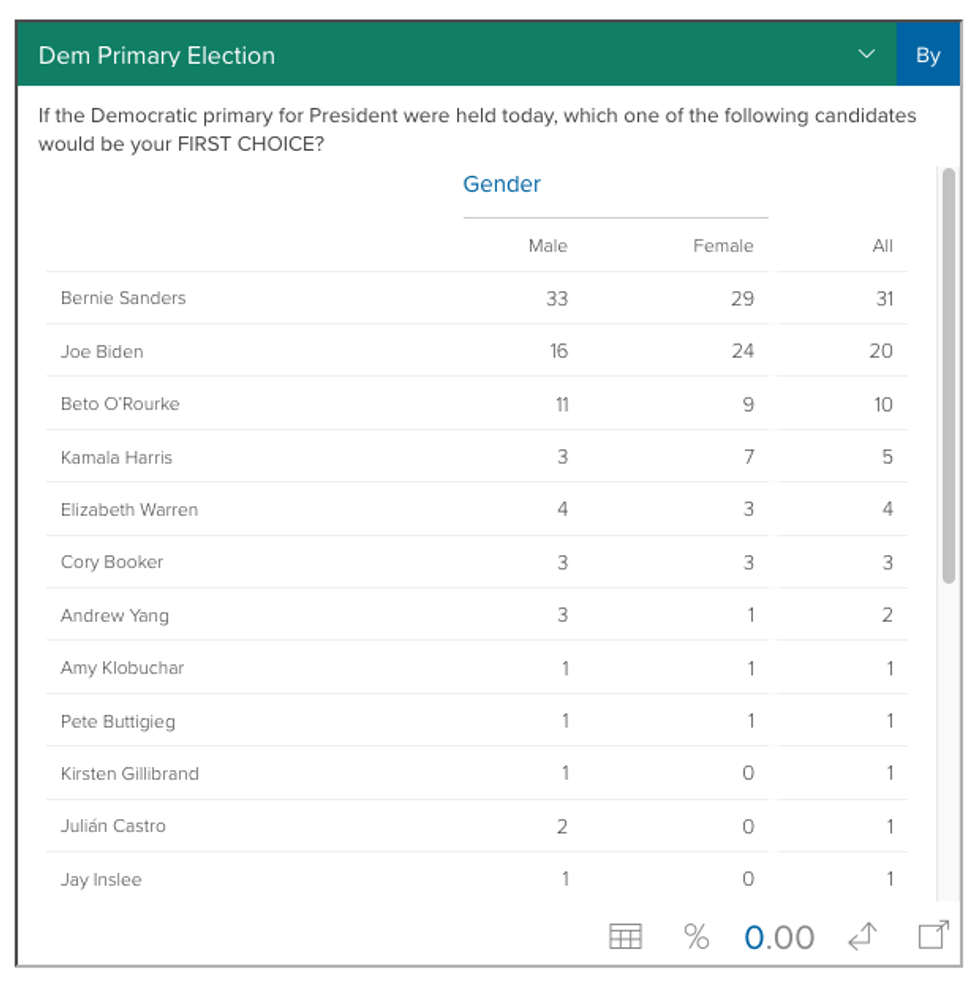
While Biden came in second place with 20 percent and Beto O'Rourke of Texas nabbed the third spot with 10 percent, none of the other candidates garnered more than single digits in the poll. After O'Rourke, IOP noted the following support for the remaining candidates:
Sen. Kamala Harris (5%), Sen. Elizabeth Warren (4%), Sen. Cory Booker (3%), Andrew Yang (2%), Mayor Pete Buttigieg (1%), former Sec. Julian Castro (1%), Rep. Tulsi Gabbard (1%), Sen. Kirsten Gillibrand (1%), Gov. Jay Inslee (1%) and Sen. Amy Klobuchar (1%). Several other candidates polled at less than one percent at this early stage.
While some political commentators have noted that Sanders' age--the candidates is now 77 years old and 79 come election day in 2020--could be a factor in the campaign, the poll suggests that young Democratic voters may not be the ones driving that argument.
"Proving that young voters see more than age, it's notable that the candidates with the most experience in government service are leading a diverse field at this early stage in the process," said John Della Volpe, IOP's director of polling.
"Compared to this point in the last presidential cycle," he added, "young Democratic voters are more engaged and likely to have an even greater impact in choosing their party's nominee."
The IOP poll is part of a series conducted by the group that goes back to the year 2000. Broken down by gender, ethnicity, and level of education, the survey found:
BY GENDER
Among young males in the sample who say they will definitely vote in the primary, Sanders (33%) leads Biden (16%) by 17 points, with O'Rourke at 11 percent, and Harris at 3 percent. Among young women, Sanders' lead narrows to 5 points (29% Sanders - 24% Biden), with O'Rourke in third with 9 percent, followed by Harris with 7 percent.
BY RACE AND ETHNICITY
Sen. Sanders leads former Vice President Biden by 11 points among whites (31%-20%), by 19 points among Hispanics (38%-19%), but is in a statistical tie with young African-American voters, trailing by one point (25% Biden - 24% Sanders). There is no statistical difference in support for O'Rourke.
BY EDUCATION
The race is statistically tied among college students with 25 percent supporting Sanders, 23 percent for Biden, and 25 percent who remain undecided. No other candidate receives more than 8 percent of the share.
In contrast, likely Democratic voters who are not enrolled in a four-year college or university and do not have a degree, favor Sanders by 25 points. The Vermont Senator polls at 41 percent to Biden's 16 percent. O'Rourke polls at 12 percent with this cohort, with no one else receiving more than 4 percent.
Over 3,000 people within the age range were surveyed in the poll that was conducted between March 8 and 20, with a margin error for the total sample noted at +/- 2.64 percentage points.
A new national poll of young Democratic voters released Monday shows Sen. Bernie Sanders leading the crowded 2020 field with a double-digit lead over the second most popular candidate, Joe Biden.
According to the survey by the Institute of Politics (IOP) at the Harvard Kennedy School, the U.S. senator from Vermont is preferred by 31 percent of likely Democratic primary voters between the ages of 18 and 29 years old.
While Biden came in second place with 20 percent and Beto O'Rourke of Texas nabbed the third spot with 10 percent, none of the other candidates garnered more than single digits in the poll. After O'Rourke, IOP noted the following support for the remaining candidates:
Sen. Kamala Harris (5%), Sen. Elizabeth Warren (4%), Sen. Cory Booker (3%), Andrew Yang (2%), Mayor Pete Buttigieg (1%), former Sec. Julian Castro (1%), Rep. Tulsi Gabbard (1%), Sen. Kirsten Gillibrand (1%), Gov. Jay Inslee (1%) and Sen. Amy Klobuchar (1%). Several other candidates polled at less than one percent at this early stage.
While some political commentators have noted that Sanders' age--the candidates is now 77 years old and 79 come election day in 2020--could be a factor in the campaign, the poll suggests that young Democratic voters may not be the ones driving that argument.
"Proving that young voters see more than age, it's notable that the candidates with the most experience in government service are leading a diverse field at this early stage in the process," said John Della Volpe, IOP's director of polling.
"Compared to this point in the last presidential cycle," he added, "young Democratic voters are more engaged and likely to have an even greater impact in choosing their party's nominee."
The IOP poll is part of a series conducted by the group that goes back to the year 2000. Broken down by gender, ethnicity, and level of education, the survey found:
BY GENDER
Among young males in the sample who say they will definitely vote in the primary, Sanders (33%) leads Biden (16%) by 17 points, with O'Rourke at 11 percent, and Harris at 3 percent. Among young women, Sanders' lead narrows to 5 points (29% Sanders - 24% Biden), with O'Rourke in third with 9 percent, followed by Harris with 7 percent.
BY RACE AND ETHNICITY
Sen. Sanders leads former Vice President Biden by 11 points among whites (31%-20%), by 19 points among Hispanics (38%-19%), but is in a statistical tie with young African-American voters, trailing by one point (25% Biden - 24% Sanders). There is no statistical difference in support for O'Rourke.
BY EDUCATION
The race is statistically tied among college students with 25 percent supporting Sanders, 23 percent for Biden, and 25 percent who remain undecided. No other candidate receives more than 8 percent of the share.
In contrast, likely Democratic voters who are not enrolled in a four-year college or university and do not have a degree, favor Sanders by 25 points. The Vermont Senator polls at 41 percent to Biden's 16 percent. O'Rourke polls at 12 percent with this cohort, with no one else receiving more than 4 percent.
Over 3,000 people within the age range were surveyed in the poll that was conducted between March 8 and 20, with a margin error for the total sample noted at +/- 2.64 percentage points.