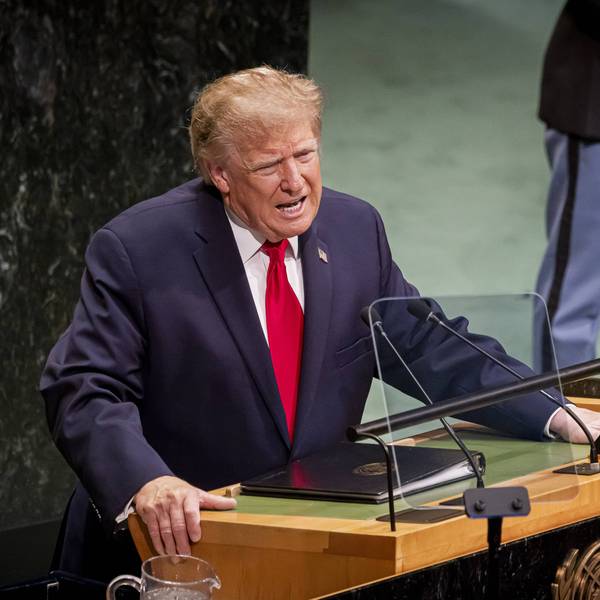

National Security Adviser John Bolton and Secretary of State Mike Pompeo talk before the start of a joint news conference in the Rose Garden at the White House June 7, 2018 in Washington, D.C. (Photo: Chip Somodevilla/Getty Images)
North Korea Warns 'Gangster-Like' Tactics of Bolton and Pompeo Undermining Nuclear Talks
"President Trump: Fire Bolton and Pompeo if you have to. Let's get this process back on track."
Two weeks after U.S. President Donald Trump and North Korean leader Kim Jong Un cut short their second summit with no agreement or clear path forward, a top North Korean official said on Friday the "gangster-like" behavior of Trump's hawkish top officials helped derail the denuclearization negotiations.
At a gathering of diplomats and foreign media in Pyongyang, North Korean Vice Foreign Minister Choe Son Hui expressed disappointment that the summit ended without a deal and threatened to suspend talks. According to The Associated Press:
Choe, who attended the Feb. 27-28 talks in Hanoi, said Kim was puzzled by what she called the "eccentric" negotiation position of the U.S. She suggested that while Trump was more willing to talk, an atmosphere of hostility and mistrust was created by the uncompromising demands of Secretary of State Mike Pompeo and National Security Adviser John Bolton. She said statements by senior Trump advisers since the summit have further worsened the climate.
"On our way back to the homeland, our chairman of the state affairs commission said, 'For what reason do we have to make this train trip again?'" Choe told reporters. "I want to make it clear that the gangster-like stand of the U.S. will eventually put the situation in danger."
While Pompeo said Friday morning that the administration wishes to continue talks with North Korea, Choe's comments fueled mounting concerns that Trump and Kim may not return to the negotiating table anytime soon and followed speculation immediately after the summit that Bolton played a key role in the breakdown.
After the breakdown, critics called the meeting--which was the second time Trump and Kim met face-to-face--a "missed opportunity" to end the decades-long Korean war and pave a path for peace on the peninsula. However, Trump and Kim were also praised for building trust and pursuing diplomacy rather than trading insults and threats, as they had done previously.
Trump claimed the talks ended in Hanoi because Kim wanted devastating economic sanctions "lifted in their entirety, but we couldn't do that." Earlier this month, Bolton said that if North Korea doesn't shutter its nuclear program and everything associated with it, "they're not going to get relief from the crushing economic sanctions that have been imposed on them and we'll look at ramping those sanctions in fact."
Choe claimed Friday that despite the way things ended in Hanoi, personal relations remain good between Trump and Kim. She also said the North Korean leader will soon "clarify his position" on whether to continue talks or restart missile launches and nuclear tests. In terms of sanctions, she pushed back against Trump's explanation.
"I'm not sure why the U.S. came out with this different description," Choe said. "We never asked for the removal of sanctions in their entirety."
"This time we understood very clearly that the United States has a very different calculation to ours," she added. "What is clear is that the U.S. has thrown away a golden opportunity this time."
Duyeon Kim, a senior fellow at the Center for New American Security and columnist for the Bulletin of the Atomic Scientists, responded to Choe's remarks in a series of tweets. As Kim put it, "Choe is like the Bolton of NK during summitry; she talks tough time to time." However, she concluded, there's still hope for diplomacy, and key figures from both countries should focus on that.
We are at a crossroads
This country and this world are at a monumental crossroads. In a few short weeks, US voters will have an opportunity to beat back the forces of fascism and confront the billionaires who are rigging the economy, our media system, and our democracy, making it increasingly impossible for ordinary people to get by. We’re not just talking about the election. We’re talking about what must be done once these fascist elements are vanquished from power. We need a bolder set of solutions than what either major party has so far been willing to offer and a working-class movement ready to fight like hell for it. Trump didn't emerge from nowhere. The conditions that fueled MAGA authoritarianism were created by decades of radical neoliberal economic policies and a corrupt political system dominated by corporate interests. They slashed taxes on the super-rich, promising that the benefits would trickle down. They said giveaways to the corporate titans would make life more affordable for the rest of us. It was all bullshit. And when a bitter, betrayed populace searches for someone to blame, right-wing demagogues have little trouble finding scapegoats. People know when they're being lied to, but you won't hear any of this from the corporate media. Only independent journalism—powered and funded by people who believe in building a better world—can deliver truly trustworthy daily news. Our Fall Campaign is underway, and we need your help. To power our newsroom through the rest of the year, we need to raise $125,000 by midnight on October 31. So if you share our vision, please contribute whatever you can to sustain our work. |
Two weeks after U.S. President Donald Trump and North Korean leader Kim Jong Un cut short their second summit with no agreement or clear path forward, a top North Korean official said on Friday the "gangster-like" behavior of Trump's hawkish top officials helped derail the denuclearization negotiations.
At a gathering of diplomats and foreign media in Pyongyang, North Korean Vice Foreign Minister Choe Son Hui expressed disappointment that the summit ended without a deal and threatened to suspend talks. According to The Associated Press:
Choe, who attended the Feb. 27-28 talks in Hanoi, said Kim was puzzled by what she called the "eccentric" negotiation position of the U.S. She suggested that while Trump was more willing to talk, an atmosphere of hostility and mistrust was created by the uncompromising demands of Secretary of State Mike Pompeo and National Security Adviser John Bolton. She said statements by senior Trump advisers since the summit have further worsened the climate.
"On our way back to the homeland, our chairman of the state affairs commission said, 'For what reason do we have to make this train trip again?'" Choe told reporters. "I want to make it clear that the gangster-like stand of the U.S. will eventually put the situation in danger."
While Pompeo said Friday morning that the administration wishes to continue talks with North Korea, Choe's comments fueled mounting concerns that Trump and Kim may not return to the negotiating table anytime soon and followed speculation immediately after the summit that Bolton played a key role in the breakdown.
After the breakdown, critics called the meeting--which was the second time Trump and Kim met face-to-face--a "missed opportunity" to end the decades-long Korean war and pave a path for peace on the peninsula. However, Trump and Kim were also praised for building trust and pursuing diplomacy rather than trading insults and threats, as they had done previously.
Trump claimed the talks ended in Hanoi because Kim wanted devastating economic sanctions "lifted in their entirety, but we couldn't do that." Earlier this month, Bolton said that if North Korea doesn't shutter its nuclear program and everything associated with it, "they're not going to get relief from the crushing economic sanctions that have been imposed on them and we'll look at ramping those sanctions in fact."
Choe claimed Friday that despite the way things ended in Hanoi, personal relations remain good between Trump and Kim. She also said the North Korean leader will soon "clarify his position" on whether to continue talks or restart missile launches and nuclear tests. In terms of sanctions, she pushed back against Trump's explanation.
"I'm not sure why the U.S. came out with this different description," Choe said. "We never asked for the removal of sanctions in their entirety."
"This time we understood very clearly that the United States has a very different calculation to ours," she added. "What is clear is that the U.S. has thrown away a golden opportunity this time."
Duyeon Kim, a senior fellow at the Center for New American Security and columnist for the Bulletin of the Atomic Scientists, responded to Choe's remarks in a series of tweets. As Kim put it, "Choe is like the Bolton of NK during summitry; she talks tough time to time." However, she concluded, there's still hope for diplomacy, and key figures from both countries should focus on that.