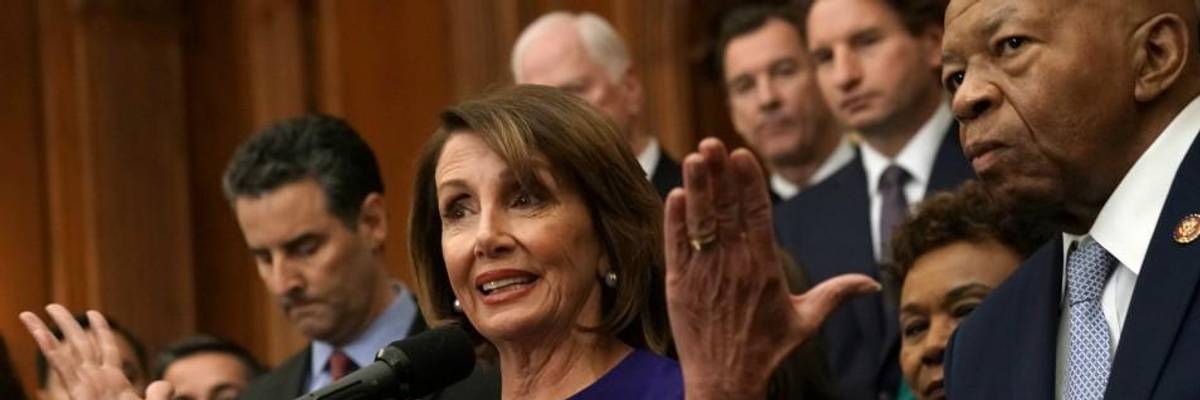
Flanked by other House Democrats, House Speaker Rep. Nancy Pelosi (D-Calif) speaks as Rep. Elijah Cummings (D-Md.) listens during a news conference at the U.S. Capitol on January 4, 2019 in Washington, D.C. (Photo: Alex Wong/Getty Images)
'North Star for Democracy Reform': 70+ Public Advocacy Groups Demand Passage of HR 1
"The reforms in H.R. 1 are necessary to advance racial justice and ensure that our government works for all people, not just a powerful few."
More than 70 pro-democracy groups are backing a sweeping anti-corruption, pro-voting rights bill as the legislation receives its first committee hearing in the Democratic-controlled House on Tuesday.
The House Rules Committee was scheduled to meet Tuesday afternoon to discuss the For the People Act (H.R. 1), the Democratic Party's first legislative proposal in the new Congress, which is aimed at expanding voting rights and limiting the influence lobbyists and corporations have over lawmakers.
H.R. 1 "represents a transformative vision for American democracy," said the Leadership Conference on Civil & Human Rights in a letter it sent to representatives. "It would create a democracy that welcomes every eligible voter's chance to participate in civic life, and a democracy that demands integrity, fairness, and transparency in our nation's elections."
The For the People Act "provides a North Star for the democracy reform agenda," the group added. "It is a bold, comprehensive reform package that offers solutions to a broken democracy."
The Brennan Center for Justice, National Black Justice Coalition, and the NAACP were among the dozens of advocacy groups that joined the Leadership Conference in pledging support for the bill. Progressive organization Indivisible urged Americans to call their representatives in Congress to demand passage of H.R. 1.
The far-reaching proposal would expand access to the voting booth by declaring Election Day a federal holiday; restore voting rights to Americans who have been incarcerated; establish automatic and online voter registration; and require non-partisan committees to redraw congressional districts to combat racial and partisan gerrymandering.
The bill would also call for a constitutional amendment to reverse the Supreme Court's Citizens United decision, which opened the floodgates to corporate campaign donations. The anti-corruption sections of the legislation would also broaden the power of the Office of Government Ethics and require all presidential candidates to release their tax returns.
"Far too many Americans believe their government no longer works for them," said the political action committee End Citizens United in a statement. "They see wealthy special interests dictating policy, politicians setting the rules for their own elections, federal officials profiting off the public interest, and too little interest from those in power in securing our voting systems."
All House Democrats signed on as co-sponsors of the bill, which is expected to pass in the House when it goes to a vote later this week.
Sen. Tom Udall (D-N.M.) is planning to introduce a version of the proposal in the Senate. Republicans have claimed that the legislation would be "costly," although its expansion of voting access and restrictions corporate power are expected to cost $2.6 billion over six years, according to the Congressional Budget Office--about 0.4 percent of what the U.S. government pours into the military in a single year.
Senate Majority Leader Mitch McConnell (R-Ky.) attacked the bill in January, calling it a "power grab"--a label supporters of H.R. 1 have said speaks volumes about the GOP's regard for the American people, whose voting rights would be expanded under the bill.
"Imagine being such an anti-democratic sink-hole of a human being that you consider making voting easier a 'power grab,'" Public Citizen tweeted in response to McConnell.
An Urgent Message From Our Co-Founder
Dear Common Dreams reader, It’s been nearly 30 years since I co-founded Common Dreams with my late wife, Lina Newhouser. We had the radical notion that journalism should serve the public good, not corporate profits. It was clear to us from the outset what it would take to build such a project. No paid advertisements. No corporate sponsors. No millionaire publisher telling us what to think or do. Many people said we wouldn't last a year, but we proved those doubters wrong. Together with a tremendous team of journalists and dedicated staff, we built an independent media outlet free from the constraints of profits and corporate control. Our mission has always been simple: To inform. To inspire. To ignite change for the common good. Building Common Dreams was not easy. Our survival was never guaranteed. When you take on the most powerful forces—Wall Street greed, fossil fuel industry destruction, Big Tech lobbyists, and uber-rich oligarchs who have spent billions upon billions rigging the economy and democracy in their favor—the only bulwark you have is supporters who believe in your work. But here’s the urgent message from me today. It's never been this bad out there. And it's never been this hard to keep us going. At the very moment Common Dreams is most needed, the threats we face are intensifying. We need your support now more than ever. We don't accept corporate advertising and never will. We don't have a paywall because we don't think people should be blocked from critical news based on their ability to pay. Everything we do is funded by the donations of readers like you. When everyone does the little they can afford, we are strong. But if that support retreats or dries up, so do we. Will you donate now to make sure Common Dreams not only survives but thrives? —Craig Brown, Co-founder |
More than 70 pro-democracy groups are backing a sweeping anti-corruption, pro-voting rights bill as the legislation receives its first committee hearing in the Democratic-controlled House on Tuesday.
The House Rules Committee was scheduled to meet Tuesday afternoon to discuss the For the People Act (H.R. 1), the Democratic Party's first legislative proposal in the new Congress, which is aimed at expanding voting rights and limiting the influence lobbyists and corporations have over lawmakers.
H.R. 1 "represents a transformative vision for American democracy," said the Leadership Conference on Civil & Human Rights in a letter it sent to representatives. "It would create a democracy that welcomes every eligible voter's chance to participate in civic life, and a democracy that demands integrity, fairness, and transparency in our nation's elections."
The For the People Act "provides a North Star for the democracy reform agenda," the group added. "It is a bold, comprehensive reform package that offers solutions to a broken democracy."
The Brennan Center for Justice, National Black Justice Coalition, and the NAACP were among the dozens of advocacy groups that joined the Leadership Conference in pledging support for the bill. Progressive organization Indivisible urged Americans to call their representatives in Congress to demand passage of H.R. 1.
The far-reaching proposal would expand access to the voting booth by declaring Election Day a federal holiday; restore voting rights to Americans who have been incarcerated; establish automatic and online voter registration; and require non-partisan committees to redraw congressional districts to combat racial and partisan gerrymandering.
The bill would also call for a constitutional amendment to reverse the Supreme Court's Citizens United decision, which opened the floodgates to corporate campaign donations. The anti-corruption sections of the legislation would also broaden the power of the Office of Government Ethics and require all presidential candidates to release their tax returns.
"Far too many Americans believe their government no longer works for them," said the political action committee End Citizens United in a statement. "They see wealthy special interests dictating policy, politicians setting the rules for their own elections, federal officials profiting off the public interest, and too little interest from those in power in securing our voting systems."
All House Democrats signed on as co-sponsors of the bill, which is expected to pass in the House when it goes to a vote later this week.
Sen. Tom Udall (D-N.M.) is planning to introduce a version of the proposal in the Senate. Republicans have claimed that the legislation would be "costly," although its expansion of voting access and restrictions corporate power are expected to cost $2.6 billion over six years, according to the Congressional Budget Office--about 0.4 percent of what the U.S. government pours into the military in a single year.
Senate Majority Leader Mitch McConnell (R-Ky.) attacked the bill in January, calling it a "power grab"--a label supporters of H.R. 1 have said speaks volumes about the GOP's regard for the American people, whose voting rights would be expanded under the bill.
"Imagine being such an anti-democratic sink-hole of a human being that you consider making voting easier a 'power grab,'" Public Citizen tweeted in response to McConnell.
More than 70 pro-democracy groups are backing a sweeping anti-corruption, pro-voting rights bill as the legislation receives its first committee hearing in the Democratic-controlled House on Tuesday.
The House Rules Committee was scheduled to meet Tuesday afternoon to discuss the For the People Act (H.R. 1), the Democratic Party's first legislative proposal in the new Congress, which is aimed at expanding voting rights and limiting the influence lobbyists and corporations have over lawmakers.
H.R. 1 "represents a transformative vision for American democracy," said the Leadership Conference on Civil & Human Rights in a letter it sent to representatives. "It would create a democracy that welcomes every eligible voter's chance to participate in civic life, and a democracy that demands integrity, fairness, and transparency in our nation's elections."
The For the People Act "provides a North Star for the democracy reform agenda," the group added. "It is a bold, comprehensive reform package that offers solutions to a broken democracy."
The Brennan Center for Justice, National Black Justice Coalition, and the NAACP were among the dozens of advocacy groups that joined the Leadership Conference in pledging support for the bill. Progressive organization Indivisible urged Americans to call their representatives in Congress to demand passage of H.R. 1.
The far-reaching proposal would expand access to the voting booth by declaring Election Day a federal holiday; restore voting rights to Americans who have been incarcerated; establish automatic and online voter registration; and require non-partisan committees to redraw congressional districts to combat racial and partisan gerrymandering.
The bill would also call for a constitutional amendment to reverse the Supreme Court's Citizens United decision, which opened the floodgates to corporate campaign donations. The anti-corruption sections of the legislation would also broaden the power of the Office of Government Ethics and require all presidential candidates to release their tax returns.
"Far too many Americans believe their government no longer works for them," said the political action committee End Citizens United in a statement. "They see wealthy special interests dictating policy, politicians setting the rules for their own elections, federal officials profiting off the public interest, and too little interest from those in power in securing our voting systems."
All House Democrats signed on as co-sponsors of the bill, which is expected to pass in the House when it goes to a vote later this week.
Sen. Tom Udall (D-N.M.) is planning to introduce a version of the proposal in the Senate. Republicans have claimed that the legislation would be "costly," although its expansion of voting access and restrictions corporate power are expected to cost $2.6 billion over six years, according to the Congressional Budget Office--about 0.4 percent of what the U.S. government pours into the military in a single year.
Senate Majority Leader Mitch McConnell (R-Ky.) attacked the bill in January, calling it a "power grab"--a label supporters of H.R. 1 have said speaks volumes about the GOP's regard for the American people, whose voting rights would be expanded under the bill.
"Imagine being such an anti-democratic sink-hole of a human being that you consider making voting easier a 'power grab,'" Public Citizen tweeted in response to McConnell.