SUBSCRIBE TO OUR FREE NEWSLETTER
Daily news & progressive opinion—funded by the people, not the corporations—delivered straight to your inbox.
5
#000000
#FFFFFF
To donate by check, phone, or other method, see our More Ways to Give page.
Daily news & progressive opinion—funded by the people, not the corporations—delivered straight to your inbox.
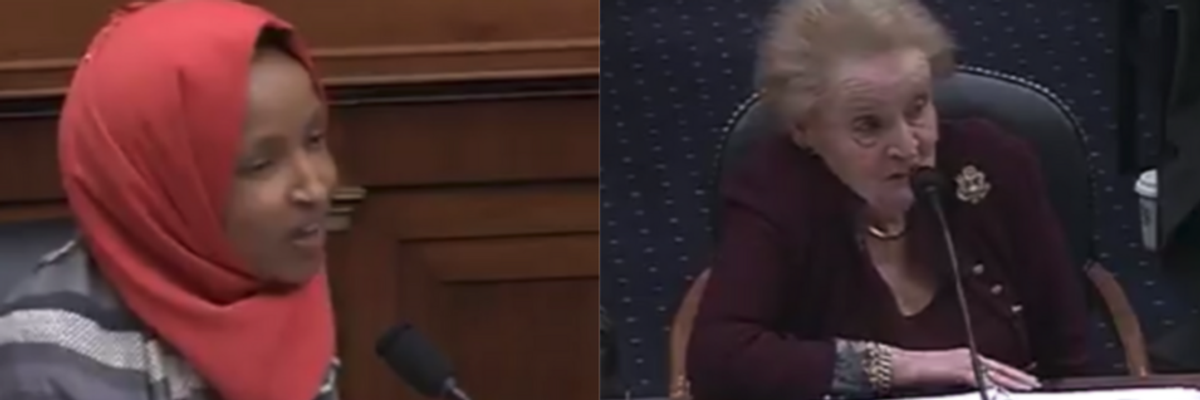
Rep. Ilhan Omar (D-Minn.) listened to testimony from former Secretary of State Madeline Albright during a hearing before the House Foreign Affairs Committee on February 27, 2019. (Photo: Screesnhot/C-SPAN)
While much of the country was watching the testimony of Michael Cohen on Wednesday, Rep. Ilhan Omar (D-Minn.) was questioning former Secretary of State Madeline Albright in a separate, largely vacant hearing room about sanctions and the pitfalls of past U.S. military interventions.
"Some scholars and practitioners of foreign policy have questioned whether sanctions are effective in changing the behavior of certain governments," Omar said, pointing out that economic sanctions can have dire effects on the innocent populations of targeted countries.
Albright, who once infamously told 60 Minutes reporter Lesley Stahl that the deaths of half-a-million Iraqi children due to sanctions were "worth it" to get rid of then-Iraqi President Saddam Hussein, said sanctions still have a role to play in American foreign policy.
Sanctions should be understood as a foreign policy tactic between diplomacy and force, explained Albright.
"We have learned a lot about sanctions," said Albright. "We learned that comprehensive sanctions, which we did in Iraq, hurt the people, and we began to look at targeted or smart sanctions."
Omar and Albright's exchange came during a hearing (pdf) in the House Foreign Affairs Committee Wednesday entitled "The Trump Administration's Foreign Policy: A Mid-Term Assessment." Albright was on hand to discuss the administration's priorities and didn't hold back in her assessment of the first two years of the Trump doctrine.
"The administration's record is marked by confusion, inconsistency, a lack of diplomacy, and, in some cases, a complete abdication of responsibility," Albright said in her testimony, adding that the State Department's funding and staffing woes were adding to a loss of U.S. standing in the world.
Newly-elected to the House, Omar joined The Intercept's Medhi Hassan this week to discuss her first two months in office. Listen to the podcast here.
Watch the full exchange between Omar and Albright below:
Dear Common Dreams reader, It’s been nearly 30 years since I co-founded Common Dreams with my late wife, Lina Newhouser. We had the radical notion that journalism should serve the public good, not corporate profits. It was clear to us from the outset what it would take to build such a project. No paid advertisements. No corporate sponsors. No millionaire publisher telling us what to think or do. Many people said we wouldn't last a year, but we proved those doubters wrong. Together with a tremendous team of journalists and dedicated staff, we built an independent media outlet free from the constraints of profits and corporate control. Our mission has always been simple: To inform. To inspire. To ignite change for the common good. Building Common Dreams was not easy. Our survival was never guaranteed. When you take on the most powerful forces—Wall Street greed, fossil fuel industry destruction, Big Tech lobbyists, and uber-rich oligarchs who have spent billions upon billions rigging the economy and democracy in their favor—the only bulwark you have is supporters who believe in your work. But here’s the urgent message from me today. It's never been this bad out there. And it's never been this hard to keep us going. At the very moment Common Dreams is most needed, the threats we face are intensifying. We need your support now more than ever. We don't accept corporate advertising and never will. We don't have a paywall because we don't think people should be blocked from critical news based on their ability to pay. Everything we do is funded by the donations of readers like you. When everyone does the little they can afford, we are strong. But if that support retreats or dries up, so do we. Will you donate now to make sure Common Dreams not only survives but thrives? —Craig Brown, Co-founder |
While much of the country was watching the testimony of Michael Cohen on Wednesday, Rep. Ilhan Omar (D-Minn.) was questioning former Secretary of State Madeline Albright in a separate, largely vacant hearing room about sanctions and the pitfalls of past U.S. military interventions.
"Some scholars and practitioners of foreign policy have questioned whether sanctions are effective in changing the behavior of certain governments," Omar said, pointing out that economic sanctions can have dire effects on the innocent populations of targeted countries.
Albright, who once infamously told 60 Minutes reporter Lesley Stahl that the deaths of half-a-million Iraqi children due to sanctions were "worth it" to get rid of then-Iraqi President Saddam Hussein, said sanctions still have a role to play in American foreign policy.
Sanctions should be understood as a foreign policy tactic between diplomacy and force, explained Albright.
"We have learned a lot about sanctions," said Albright. "We learned that comprehensive sanctions, which we did in Iraq, hurt the people, and we began to look at targeted or smart sanctions."
Omar and Albright's exchange came during a hearing (pdf) in the House Foreign Affairs Committee Wednesday entitled "The Trump Administration's Foreign Policy: A Mid-Term Assessment." Albright was on hand to discuss the administration's priorities and didn't hold back in her assessment of the first two years of the Trump doctrine.
"The administration's record is marked by confusion, inconsistency, a lack of diplomacy, and, in some cases, a complete abdication of responsibility," Albright said in her testimony, adding that the State Department's funding and staffing woes were adding to a loss of U.S. standing in the world.
Newly-elected to the House, Omar joined The Intercept's Medhi Hassan this week to discuss her first two months in office. Listen to the podcast here.
Watch the full exchange between Omar and Albright below:
While much of the country was watching the testimony of Michael Cohen on Wednesday, Rep. Ilhan Omar (D-Minn.) was questioning former Secretary of State Madeline Albright in a separate, largely vacant hearing room about sanctions and the pitfalls of past U.S. military interventions.
"Some scholars and practitioners of foreign policy have questioned whether sanctions are effective in changing the behavior of certain governments," Omar said, pointing out that economic sanctions can have dire effects on the innocent populations of targeted countries.
Albright, who once infamously told 60 Minutes reporter Lesley Stahl that the deaths of half-a-million Iraqi children due to sanctions were "worth it" to get rid of then-Iraqi President Saddam Hussein, said sanctions still have a role to play in American foreign policy.
Sanctions should be understood as a foreign policy tactic between diplomacy and force, explained Albright.
"We have learned a lot about sanctions," said Albright. "We learned that comprehensive sanctions, which we did in Iraq, hurt the people, and we began to look at targeted or smart sanctions."
Omar and Albright's exchange came during a hearing (pdf) in the House Foreign Affairs Committee Wednesday entitled "The Trump Administration's Foreign Policy: A Mid-Term Assessment." Albright was on hand to discuss the administration's priorities and didn't hold back in her assessment of the first two years of the Trump doctrine.
"The administration's record is marked by confusion, inconsistency, a lack of diplomacy, and, in some cases, a complete abdication of responsibility," Albright said in her testimony, adding that the State Department's funding and staffing woes were adding to a loss of U.S. standing in the world.
Newly-elected to the House, Omar joined The Intercept's Medhi Hassan this week to discuss her first two months in office. Listen to the podcast here.
Watch the full exchange between Omar and Albright below: