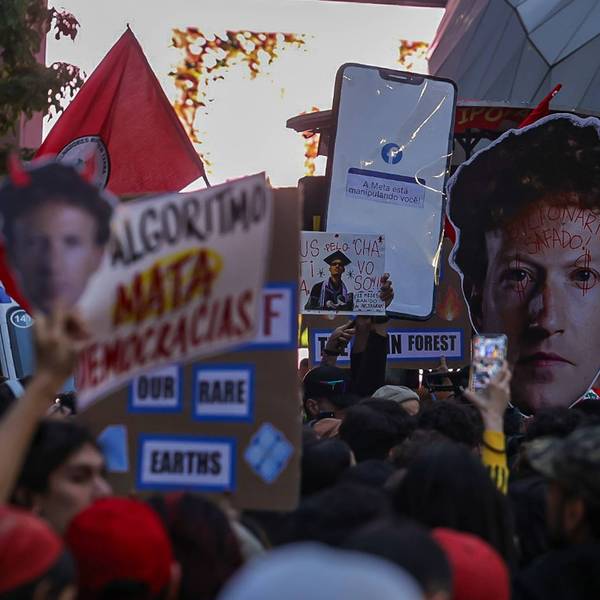
Facebook is being criticized for censoring four video pages managed by a Berlin-based media company that is partly funded by the Russian government. (Image: Wired/Tim Lahan/with overlay)
'Highly Disturbing': Facebook Blocks Viral Video Outlets Critical of US Foreign Policy and Corporate Media
Journalists and free speech advocates are calling out the social media giant for shuttering the pages after CNN inquired about Berlin-based media company Maffick's funding from the Russian government
Journalists and advocates of press freedoms are once more directing outrage and criticism at Facebook for selectively censoring pages on its platform and refusing to explain the reason behind a decision that appears to many as a clear double standard applied to outlets critical of U.S. foreign policy and corporate interests.
Facebook is under fire for shuttering four pages managed by the Berlin-based news and media company Maffick, after CNN reporters asked the social media giant about Maffick not disclosing that it is partly funded by the Russian government.
CNN held its report--titled "Russia is backing a viral video company aimed at American millennials"--until Friday, when Facebook blocked Soapbox, Waste-Ed, Backthen, and In The Now.
American-Lebanese journalist Rania Khalek, a contributor to Soapbox and In The Now who was interviewed by CNN, outlined the controversy in a lengthy, widely shared series of tweets. Monday morning, Khalek added an update to the Twitter thread:
As CNN outlined in its report, which was updated and corrected on Monday:
Company records [for Maffick] in Germany show that 51 percent of the company is owned by Ruptly [a subsidiary of RT, which is funded by the Russian government]. The remaining 49 percent is controlled by former RT presenter Anissa Naouai, who is Maffick's CEO. The records were first reported by the German outlet T-online and later by the Alliance for Securing Democracy, which brought it to CNN's attention. The Alliance for Securing Democracy is part of the German Marshall Fund, which receives funding from the U.S., German, and other governments. The Alliance for Securing Democracy says that while it is part of the German Marshall Fund, the ASD itself does not receive any funding from the GMF, and gets its money from private family funds and grants but not from government funding.
"In the Now was originally a television show on RT, hosted by Naouai. It has more than 3 million followers on Facebook," CNN noted. The other three pages "have more than 30 million video views, though they've only been operating for a few months."
What kind of content did they produce? Khalek offered a number of examples, including:
In an interview with CNN, Maffick chief operating officer J. Ray Sparks emphasized that Maffick is editorially independent from RT--which the U.S. government has forced to register as a foreign agent--and pointed out that it is "standard industry practice" not to disclose ownership of a media producer on a Facebook page.
However, as Kevin Gosztola--who cohosts a podcast with Khalek--noted in an article published Saturday on Shadowproof, "Although Khalek and Sparks detailed their editorial independence at Maffick extensively, [CNN correspondent Drew] Griffin remained incredulous at the reality that officials working at the Kremlin are not dictating what specific stories should be covered."
"Similarly to NPR, PBS, BBC, DW, CBC, AJ+, and many other media companies, Maffick is supported in part by government funding. Likewise while we haven't posted funding details on our Facebook pages etc, neither have any of our international peers," Maffick said in a statement that charges the company was singled out for "one reason and one reason only: The government that helps fund our company is Russia."
"We did not violate any of Facebook's policies whatsoever. None of our content promotes disinformation or fake news. Yet CNN pressured Facebook into unprecedented censorship in a desperate attempt to milk ratings by stoking hysteria over Russia," the statement continues, calling on Facebook to reinstate its pages and "articulate clear, consistent policies and protocols regarding obligatory funding disclosures which will be applied evenly across all pages."
Since Friday, Khalek and others who often linked to her initial thread have turned to another major social media platform--Twitter--to raise alarm about the role of the ASD and the communication CNN subsequently had with Facebook:
Although Facebook's rules don't require pages to disclose parent companies, a spokesperson told CNN in a statement that the social media company planned to reach out to Maffick page administrators "to ask that they disclose this additional information and their affiliation with their parent company to get back on the platform."
The move by Facebook comes after the company temporarily took down one of Khalek's videos for Soapbox--about "how Israel uses Palestine as a weapons testing laboratory"--in late December, and only restored it after public outcry. Facebook also was intensely criticized last year for censoring the left-leaning Latin American news network teleSUR English, funded by the Venezuelan government and others, as well as a video about Christopher Columbus' brutal legacy produced by Double Down News.
We are at a crossroads
This country and this world are at a monumental crossroads. In a few short weeks, US voters will have an opportunity to beat back the forces of fascism and confront the billionaires who are rigging the economy, our media system, and our democracy, making it increasingly impossible for ordinary people to get by. We’re not just talking about the election. We’re talking about what must be done once these fascist elements are vanquished from power. We need a bolder set of solutions than what either major party has so far been willing to offer and a working-class movement ready to fight like hell for it. Trump didn't emerge from nowhere. The conditions that fueled MAGA authoritarianism were created by decades of radical neoliberal economic policies and a corrupt political system dominated by corporate interests. They slashed taxes on the super-rich, promising that the benefits would trickle down. They said giveaways to the corporate titans would make life more affordable for the rest of us. It was all bullshit. And when a bitter, betrayed populace searches for someone to blame, right-wing demagogues have little trouble finding scapegoats. People know when they're being lied to, but you won't hear any of this from the corporate media. Only independent journalism—powered and funded by people who believe in building a better world—can deliver truly trustworthy daily news. Our Fall Campaign is underway, and we need your help. To power our newsroom through the rest of the year, we need to raise $125,000 by midnight on October 31. So if you share our vision, please contribute whatever you can to sustain our work. |
Journalists and advocates of press freedoms are once more directing outrage and criticism at Facebook for selectively censoring pages on its platform and refusing to explain the reason behind a decision that appears to many as a clear double standard applied to outlets critical of U.S. foreign policy and corporate interests.
Facebook is under fire for shuttering four pages managed by the Berlin-based news and media company Maffick, after CNN reporters asked the social media giant about Maffick not disclosing that it is partly funded by the Russian government.
CNN held its report--titled "Russia is backing a viral video company aimed at American millennials"--until Friday, when Facebook blocked Soapbox, Waste-Ed, Backthen, and In The Now.
American-Lebanese journalist Rania Khalek, a contributor to Soapbox and In The Now who was interviewed by CNN, outlined the controversy in a lengthy, widely shared series of tweets. Monday morning, Khalek added an update to the Twitter thread:
As CNN outlined in its report, which was updated and corrected on Monday:
Company records [for Maffick] in Germany show that 51 percent of the company is owned by Ruptly [a subsidiary of RT, which is funded by the Russian government]. The remaining 49 percent is controlled by former RT presenter Anissa Naouai, who is Maffick's CEO. The records were first reported by the German outlet T-online and later by the Alliance for Securing Democracy, which brought it to CNN's attention. The Alliance for Securing Democracy is part of the German Marshall Fund, which receives funding from the U.S., German, and other governments. The Alliance for Securing Democracy says that while it is part of the German Marshall Fund, the ASD itself does not receive any funding from the GMF, and gets its money from private family funds and grants but not from government funding.
"In the Now was originally a television show on RT, hosted by Naouai. It has more than 3 million followers on Facebook," CNN noted. The other three pages "have more than 30 million video views, though they've only been operating for a few months."
What kind of content did they produce? Khalek offered a number of examples, including:
In an interview with CNN, Maffick chief operating officer J. Ray Sparks emphasized that Maffick is editorially independent from RT--which the U.S. government has forced to register as a foreign agent--and pointed out that it is "standard industry practice" not to disclose ownership of a media producer on a Facebook page.
However, as Kevin Gosztola--who cohosts a podcast with Khalek--noted in an article published Saturday on Shadowproof, "Although Khalek and Sparks detailed their editorial independence at Maffick extensively, [CNN correspondent Drew] Griffin remained incredulous at the reality that officials working at the Kremlin are not dictating what specific stories should be covered."
"Similarly to NPR, PBS, BBC, DW, CBC, AJ+, and many other media companies, Maffick is supported in part by government funding. Likewise while we haven't posted funding details on our Facebook pages etc, neither have any of our international peers," Maffick said in a statement that charges the company was singled out for "one reason and one reason only: The government that helps fund our company is Russia."
"We did not violate any of Facebook's policies whatsoever. None of our content promotes disinformation or fake news. Yet CNN pressured Facebook into unprecedented censorship in a desperate attempt to milk ratings by stoking hysteria over Russia," the statement continues, calling on Facebook to reinstate its pages and "articulate clear, consistent policies and protocols regarding obligatory funding disclosures which will be applied evenly across all pages."
Since Friday, Khalek and others who often linked to her initial thread have turned to another major social media platform--Twitter--to raise alarm about the role of the ASD and the communication CNN subsequently had with Facebook:
Although Facebook's rules don't require pages to disclose parent companies, a spokesperson told CNN in a statement that the social media company planned to reach out to Maffick page administrators "to ask that they disclose this additional information and their affiliation with their parent company to get back on the platform."
The move by Facebook comes after the company temporarily took down one of Khalek's videos for Soapbox--about "how Israel uses Palestine as a weapons testing laboratory"--in late December, and only restored it after public outcry. Facebook also was intensely criticized last year for censoring the left-leaning Latin American news network teleSUR English, funded by the Venezuelan government and others, as well as a video about Christopher Columbus' brutal legacy produced by Double Down News.
Journalists and advocates of press freedoms are once more directing outrage and criticism at Facebook for selectively censoring pages on its platform and refusing to explain the reason behind a decision that appears to many as a clear double standard applied to outlets critical of U.S. foreign policy and corporate interests.
Facebook is under fire for shuttering four pages managed by the Berlin-based news and media company Maffick, after CNN reporters asked the social media giant about Maffick not disclosing that it is partly funded by the Russian government.
CNN held its report--titled "Russia is backing a viral video company aimed at American millennials"--until Friday, when Facebook blocked Soapbox, Waste-Ed, Backthen, and In The Now.
American-Lebanese journalist Rania Khalek, a contributor to Soapbox and In The Now who was interviewed by CNN, outlined the controversy in a lengthy, widely shared series of tweets. Monday morning, Khalek added an update to the Twitter thread:
As CNN outlined in its report, which was updated and corrected on Monday:
Company records [for Maffick] in Germany show that 51 percent of the company is owned by Ruptly [a subsidiary of RT, which is funded by the Russian government]. The remaining 49 percent is controlled by former RT presenter Anissa Naouai, who is Maffick's CEO. The records were first reported by the German outlet T-online and later by the Alliance for Securing Democracy, which brought it to CNN's attention. The Alliance for Securing Democracy is part of the German Marshall Fund, which receives funding from the U.S., German, and other governments. The Alliance for Securing Democracy says that while it is part of the German Marshall Fund, the ASD itself does not receive any funding from the GMF, and gets its money from private family funds and grants but not from government funding.
"In the Now was originally a television show on RT, hosted by Naouai. It has more than 3 million followers on Facebook," CNN noted. The other three pages "have more than 30 million video views, though they've only been operating for a few months."
What kind of content did they produce? Khalek offered a number of examples, including:
In an interview with CNN, Maffick chief operating officer J. Ray Sparks emphasized that Maffick is editorially independent from RT--which the U.S. government has forced to register as a foreign agent--and pointed out that it is "standard industry practice" not to disclose ownership of a media producer on a Facebook page.
However, as Kevin Gosztola--who cohosts a podcast with Khalek--noted in an article published Saturday on Shadowproof, "Although Khalek and Sparks detailed their editorial independence at Maffick extensively, [CNN correspondent Drew] Griffin remained incredulous at the reality that officials working at the Kremlin are not dictating what specific stories should be covered."
"Similarly to NPR, PBS, BBC, DW, CBC, AJ+, and many other media companies, Maffick is supported in part by government funding. Likewise while we haven't posted funding details on our Facebook pages etc, neither have any of our international peers," Maffick said in a statement that charges the company was singled out for "one reason and one reason only: The government that helps fund our company is Russia."
"We did not violate any of Facebook's policies whatsoever. None of our content promotes disinformation or fake news. Yet CNN pressured Facebook into unprecedented censorship in a desperate attempt to milk ratings by stoking hysteria over Russia," the statement continues, calling on Facebook to reinstate its pages and "articulate clear, consistent policies and protocols regarding obligatory funding disclosures which will be applied evenly across all pages."
Since Friday, Khalek and others who often linked to her initial thread have turned to another major social media platform--Twitter--to raise alarm about the role of the ASD and the communication CNN subsequently had with Facebook:
Although Facebook's rules don't require pages to disclose parent companies, a spokesperson told CNN in a statement that the social media company planned to reach out to Maffick page administrators "to ask that they disclose this additional information and their affiliation with their parent company to get back on the platform."
The move by Facebook comes after the company temporarily took down one of Khalek's videos for Soapbox--about "how Israel uses Palestine as a weapons testing laboratory"--in late December, and only restored it after public outcry. Facebook also was intensely criticized last year for censoring the left-leaning Latin American news network teleSUR English, funded by the Venezuelan government and others, as well as a video about Christopher Columbus' brutal legacy produced by Double Down News.