SUBSCRIBE TO OUR FREE NEWSLETTER
Daily news & progressive opinion—funded by the people, not the corporations—delivered straight to your inbox.
5
#000000
#FFFFFF
To donate by check, phone, or other method, see our More Ways to Give page.
Daily news & progressive opinion—funded by the people, not the corporations—delivered straight to your inbox.
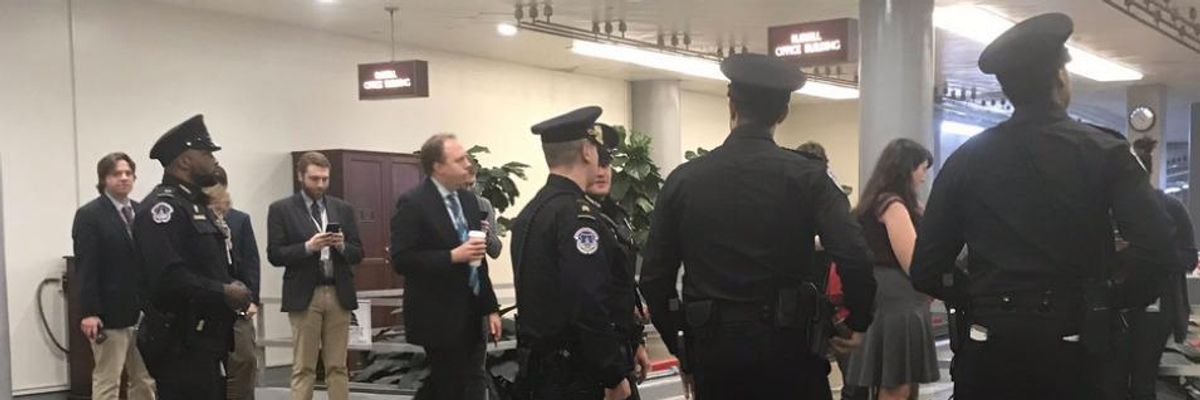
Capitol Police became physically aggressive toward journalists who were trying to speak with senators at the Russell Senate Office Building on Thursday afternoon, according to a Roll Call report. (Photo: @pkcapitol/Twitter)
Press freedom advocates and journalists described a Friday report of Capitol Police manhandling and shoving reporters in the Russell Senate Office Building as "bizarre" and "disturbing," with some calling the altercation an incident far more likely to take place in a totalitarian regime than in a democracy.
As Roll Call reported Friday, Capitol Police pushed and "slammed into" reporters on Thursday afternoon around the time that senators were voting on the spending bill. The police attempted to prevent reporters from speaking to lawmakers--a practice that is common in the Senate basement, where the incident took place.
Suzanne Nossel, CEO of PEN America, called Roll Call's report a "disturbing account," while the National Press Club said in a statement that Capitol Police's actions "contravened the chamber's long-standing bipartisan practice of supporting journalists' access to lawmakers."
According to Roll Call, some reporters believed the Sergeant-at-Arms had made more Capitol Police available in the Senate building because of the suspected presence of an independent reporter without credentials who had approached senators in the past. But journalists denounced the Capitol Police for handling the situation by assaulting reporters.
"Capitol Police dramatically over-reacted on Thursday and did more harm than good when they prevented accredited reporters from doing their job and further obstructed senators from communicating with the press. There was no call for the police to shove or place their hands on the reporters," said Alison Fitzgerald Kodjak, president of the National Press Club.
According to an audio recording provided to Roll Call, an officer pushed a pregnant reporter and "slammed into" NBC journalist Leigh Anne Caldwell as she was trying to interview Sen. Shelley Moore Capito (R-W.V.). The Capitol Police also repeatedly told reporters that attempting to speak with senators as they walked down the hallway--a common practice on the Hill--was a "violation" and something people "get locked up" for doing. Washington Post congressional reporter Paul Kane disputed the claim on social media.
"It was insane, people were getting shoved into walls," Paul McLeod, a BuzzFeed reporter, told Roll Call. "It was unsustainable. It was violent."
Kane shared an image of the Capitol Police attempting to block the press from reaching senators.
Capitol Hill reporter Matt Laslo told Roll Call that senators including Sen. Dianne Feinstein (D-Calif.) appeared taken aback by the officers' behavior, as well.
"Feinstein was doing an interview with one reporter, and she just stopped and her jaw just dropped," he told the outlet. "She was confused. She was just unable to keep doing an interview that she wanted to do because the officers were creating such a mess."
Other journalists wrote that the altercation was the latest evidence that Capitol Police have grown "increasingly aggressive" toward the press recently.
Press freedom advocates have accused President Donald Trump of creating an increasingly hostile environment for the press due to his disdain for journalists who report on his administration and deeply unpopular policies. The altercation took place days after a BBC journalist was physically attacked at Trump's rally in El Paso, Texas, by a man yelling, "Fuck the media!" The National Press Club also stated that journalists' access to reporting on Capitol Hill must be protected.
"At a time when we have seen the press' physical access around Washington reduced--including through fewer White House, State Department and Pentagon news briefings--Capitol Hill remains one of the few bright spots for reporters," said Barbara Cochran, president of the National Press Club Journalism Institute. "We call upon the Sergeant-at-Arms to continue the office's long-standing practice of working with the standing committees in devising access protocols for those times when heightened-security is warranted."
Dear Common Dreams reader, It’s been nearly 30 years since I co-founded Common Dreams with my late wife, Lina Newhouser. We had the radical notion that journalism should serve the public good, not corporate profits. It was clear to us from the outset what it would take to build such a project. No paid advertisements. No corporate sponsors. No millionaire publisher telling us what to think or do. Many people said we wouldn't last a year, but we proved those doubters wrong. Together with a tremendous team of journalists and dedicated staff, we built an independent media outlet free from the constraints of profits and corporate control. Our mission has always been simple: To inform. To inspire. To ignite change for the common good. Building Common Dreams was not easy. Our survival was never guaranteed. When you take on the most powerful forces—Wall Street greed, fossil fuel industry destruction, Big Tech lobbyists, and uber-rich oligarchs who have spent billions upon billions rigging the economy and democracy in their favor—the only bulwark you have is supporters who believe in your work. But here’s the urgent message from me today. It's never been this bad out there. And it's never been this hard to keep us going. At the very moment Common Dreams is most needed, the threats we face are intensifying. We need your support now more than ever. We don't accept corporate advertising and never will. We don't have a paywall because we don't think people should be blocked from critical news based on their ability to pay. Everything we do is funded by the donations of readers like you. When everyone does the little they can afford, we are strong. But if that support retreats or dries up, so do we. Will you donate now to make sure Common Dreams not only survives but thrives? —Craig Brown, Co-founder |
Press freedom advocates and journalists described a Friday report of Capitol Police manhandling and shoving reporters in the Russell Senate Office Building as "bizarre" and "disturbing," with some calling the altercation an incident far more likely to take place in a totalitarian regime than in a democracy.
As Roll Call reported Friday, Capitol Police pushed and "slammed into" reporters on Thursday afternoon around the time that senators were voting on the spending bill. The police attempted to prevent reporters from speaking to lawmakers--a practice that is common in the Senate basement, where the incident took place.
Suzanne Nossel, CEO of PEN America, called Roll Call's report a "disturbing account," while the National Press Club said in a statement that Capitol Police's actions "contravened the chamber's long-standing bipartisan practice of supporting journalists' access to lawmakers."
According to Roll Call, some reporters believed the Sergeant-at-Arms had made more Capitol Police available in the Senate building because of the suspected presence of an independent reporter without credentials who had approached senators in the past. But journalists denounced the Capitol Police for handling the situation by assaulting reporters.
"Capitol Police dramatically over-reacted on Thursday and did more harm than good when they prevented accredited reporters from doing their job and further obstructed senators from communicating with the press. There was no call for the police to shove or place their hands on the reporters," said Alison Fitzgerald Kodjak, president of the National Press Club.
According to an audio recording provided to Roll Call, an officer pushed a pregnant reporter and "slammed into" NBC journalist Leigh Anne Caldwell as she was trying to interview Sen. Shelley Moore Capito (R-W.V.). The Capitol Police also repeatedly told reporters that attempting to speak with senators as they walked down the hallway--a common practice on the Hill--was a "violation" and something people "get locked up" for doing. Washington Post congressional reporter Paul Kane disputed the claim on social media.
"It was insane, people were getting shoved into walls," Paul McLeod, a BuzzFeed reporter, told Roll Call. "It was unsustainable. It was violent."
Kane shared an image of the Capitol Police attempting to block the press from reaching senators.
Capitol Hill reporter Matt Laslo told Roll Call that senators including Sen. Dianne Feinstein (D-Calif.) appeared taken aback by the officers' behavior, as well.
"Feinstein was doing an interview with one reporter, and she just stopped and her jaw just dropped," he told the outlet. "She was confused. She was just unable to keep doing an interview that she wanted to do because the officers were creating such a mess."
Other journalists wrote that the altercation was the latest evidence that Capitol Police have grown "increasingly aggressive" toward the press recently.
Press freedom advocates have accused President Donald Trump of creating an increasingly hostile environment for the press due to his disdain for journalists who report on his administration and deeply unpopular policies. The altercation took place days after a BBC journalist was physically attacked at Trump's rally in El Paso, Texas, by a man yelling, "Fuck the media!" The National Press Club also stated that journalists' access to reporting on Capitol Hill must be protected.
"At a time when we have seen the press' physical access around Washington reduced--including through fewer White House, State Department and Pentagon news briefings--Capitol Hill remains one of the few bright spots for reporters," said Barbara Cochran, president of the National Press Club Journalism Institute. "We call upon the Sergeant-at-Arms to continue the office's long-standing practice of working with the standing committees in devising access protocols for those times when heightened-security is warranted."
Press freedom advocates and journalists described a Friday report of Capitol Police manhandling and shoving reporters in the Russell Senate Office Building as "bizarre" and "disturbing," with some calling the altercation an incident far more likely to take place in a totalitarian regime than in a democracy.
As Roll Call reported Friday, Capitol Police pushed and "slammed into" reporters on Thursday afternoon around the time that senators were voting on the spending bill. The police attempted to prevent reporters from speaking to lawmakers--a practice that is common in the Senate basement, where the incident took place.
Suzanne Nossel, CEO of PEN America, called Roll Call's report a "disturbing account," while the National Press Club said in a statement that Capitol Police's actions "contravened the chamber's long-standing bipartisan practice of supporting journalists' access to lawmakers."
According to Roll Call, some reporters believed the Sergeant-at-Arms had made more Capitol Police available in the Senate building because of the suspected presence of an independent reporter without credentials who had approached senators in the past. But journalists denounced the Capitol Police for handling the situation by assaulting reporters.
"Capitol Police dramatically over-reacted on Thursday and did more harm than good when they prevented accredited reporters from doing their job and further obstructed senators from communicating with the press. There was no call for the police to shove or place their hands on the reporters," said Alison Fitzgerald Kodjak, president of the National Press Club.
According to an audio recording provided to Roll Call, an officer pushed a pregnant reporter and "slammed into" NBC journalist Leigh Anne Caldwell as she was trying to interview Sen. Shelley Moore Capito (R-W.V.). The Capitol Police also repeatedly told reporters that attempting to speak with senators as they walked down the hallway--a common practice on the Hill--was a "violation" and something people "get locked up" for doing. Washington Post congressional reporter Paul Kane disputed the claim on social media.
"It was insane, people were getting shoved into walls," Paul McLeod, a BuzzFeed reporter, told Roll Call. "It was unsustainable. It was violent."
Kane shared an image of the Capitol Police attempting to block the press from reaching senators.
Capitol Hill reporter Matt Laslo told Roll Call that senators including Sen. Dianne Feinstein (D-Calif.) appeared taken aback by the officers' behavior, as well.
"Feinstein was doing an interview with one reporter, and she just stopped and her jaw just dropped," he told the outlet. "She was confused. She was just unable to keep doing an interview that she wanted to do because the officers were creating such a mess."
Other journalists wrote that the altercation was the latest evidence that Capitol Police have grown "increasingly aggressive" toward the press recently.
Press freedom advocates have accused President Donald Trump of creating an increasingly hostile environment for the press due to his disdain for journalists who report on his administration and deeply unpopular policies. The altercation took place days after a BBC journalist was physically attacked at Trump's rally in El Paso, Texas, by a man yelling, "Fuck the media!" The National Press Club also stated that journalists' access to reporting on Capitol Hill must be protected.
"At a time when we have seen the press' physical access around Washington reduced--including through fewer White House, State Department and Pentagon news briefings--Capitol Hill remains one of the few bright spots for reporters," said Barbara Cochran, president of the National Press Club Journalism Institute. "We call upon the Sergeant-at-Arms to continue the office's long-standing practice of working with the standing committees in devising access protocols for those times when heightened-security is warranted."