SUBSCRIBE TO OUR FREE NEWSLETTER
Daily news & progressive opinion—funded by the people, not the corporations—delivered straight to your inbox.
5
#000000
#FFFFFF
To donate by check, phone, or other method, see our More Ways to Give page.
Daily news & progressive opinion—funded by the people, not the corporations—delivered straight to your inbox.
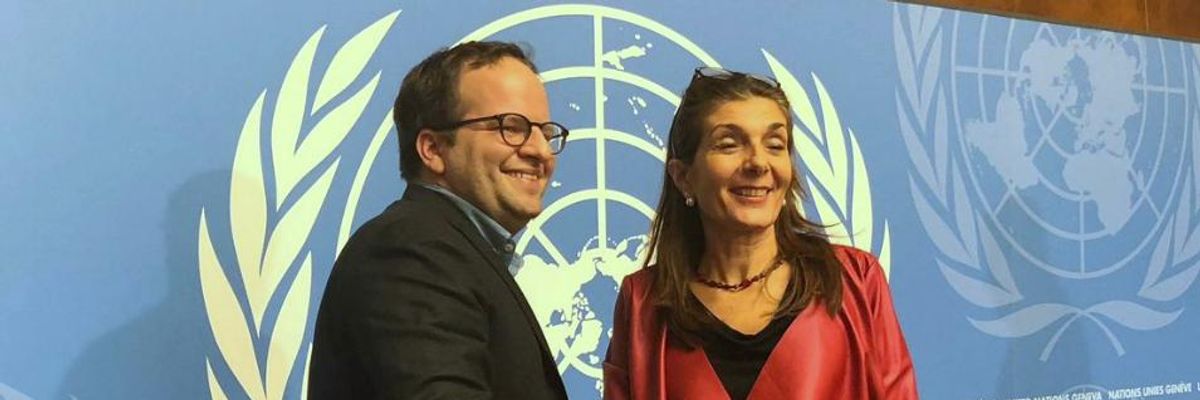
World Food Program (WFP) chief information officer Enrica Porcari and Palantir executive vice president Josh Harris announced the partnership on Tuesday. (Photo: WFP)
The CIA-funded California software firm Palantir Technologies and the World Food Program (WFP) have announced a five-year $45 million partnership that data privacy and human rights advocates are describing as "breathtaking and terrifying" as well as "horribly irresponsible and potentially incredibly harmful."
"The recipients of WFP aid are already in extremely vulnerable situations; they should not be put at additional risk of harm or exploitation."
--Privacy International
The partnership, according to a joint statement released Tuesday, builds on a pilot project that allowed the United Nations agency to analyze aid decisions using a Palantir application that pulls together data on nutritional values, sourcing locations, delivery times, and food costs.
While WFP executive director David Beasley claimed that "our work with Palantir will save time and money so we can more effectively and efficiently feed 90 million people on any given day across the globe," critics raised alarm about the company's record and warned the deal threatens the rights of people already living in precarious conditions.
Nooooo..... https://t.co/At2bubw1Vm
-- Naomi Klein (@NaomiAKlein) February 6, 2019
"This data is highly sensitive, and it is essential that proper protections are put in place, to limit the data gathered, transferred, and processed," noted Privacy International. "The recipients of WFP aid are already in extremely vulnerable situations; they should not be put at additional risk of harm or exploitation."
WFP's chief information officer Enrica Porcari insisted at a press conference that personal information won't be at risk because "there is no data-sharing" with Palantir under the deal--but Privacy International warned that with its research, "we've seen examples of systems that are produced in agreements such as the one between WFP and Palantir increasing risks to the people the systems are aiming to benefit."
A humanitarian data analyst, who requested anonymity due to work relationships, told the news outlet IRIN: "WFP is jumping headlong into something they don't understand, without thinking through the consequences, and the U.N. has put no frameworks in place to regulate it."
Palantir was co-founded by billionaire and Republican donor Peter Thiel--a supporter of President Donald Trump--with seed money from the CIA's venture capital arm. It has, among other things, provided software to U.S. Immigration and Customs Enforcement (ICE) to help the agency deport migrants.
"It is the height of irony that the very company that faced direct criticism in its role facilitating U.S. immigration authorities' human rights abuses is now promoting itself as trustworthy of working in humanitarian aid," a Privacy International spokesperson told IRIN.
Tom Fisher, a Privacy International researcher, added on Twitter: "The scale of this WFP/Palantir partnership... It's breathtaking, and terrifying."
Daniel Scarnecchia, a researcher at the Harvard Humanitarian Initiative's Signal Program on Human Security and Technology, pointed out in a series of tweets that the news "raises a fundamental question of why we collect data as a sector. What are our values, and to what ends are we seeking to make people legible, and to whom?"
Scarnecchia was also critical of WFP's decision to work with Palantir, and suggested the agreement could lay the groundwork for the data-mining firm to expand its footprint in the humanitarian aid sector.
Dear Common Dreams reader, It’s been nearly 30 years since I co-founded Common Dreams with my late wife, Lina Newhouser. We had the radical notion that journalism should serve the public good, not corporate profits. It was clear to us from the outset what it would take to build such a project. No paid advertisements. No corporate sponsors. No millionaire publisher telling us what to think or do. Many people said we wouldn't last a year, but we proved those doubters wrong. Together with a tremendous team of journalists and dedicated staff, we built an independent media outlet free from the constraints of profits and corporate control. Our mission has always been simple: To inform. To inspire. To ignite change for the common good. Building Common Dreams was not easy. Our survival was never guaranteed. When you take on the most powerful forces—Wall Street greed, fossil fuel industry destruction, Big Tech lobbyists, and uber-rich oligarchs who have spent billions upon billions rigging the economy and democracy in their favor—the only bulwark you have is supporters who believe in your work. But here’s the urgent message from me today. It's never been this bad out there. And it's never been this hard to keep us going. At the very moment Common Dreams is most needed, the threats we face are intensifying. We need your support now more than ever. We don't accept corporate advertising and never will. We don't have a paywall because we don't think people should be blocked from critical news based on their ability to pay. Everything we do is funded by the donations of readers like you. When everyone does the little they can afford, we are strong. But if that support retreats or dries up, so do we. Will you donate now to make sure Common Dreams not only survives but thrives? —Craig Brown, Co-founder |
The CIA-funded California software firm Palantir Technologies and the World Food Program (WFP) have announced a five-year $45 million partnership that data privacy and human rights advocates are describing as "breathtaking and terrifying" as well as "horribly irresponsible and potentially incredibly harmful."
"The recipients of WFP aid are already in extremely vulnerable situations; they should not be put at additional risk of harm or exploitation."
--Privacy International
The partnership, according to a joint statement released Tuesday, builds on a pilot project that allowed the United Nations agency to analyze aid decisions using a Palantir application that pulls together data on nutritional values, sourcing locations, delivery times, and food costs.
While WFP executive director David Beasley claimed that "our work with Palantir will save time and money so we can more effectively and efficiently feed 90 million people on any given day across the globe," critics raised alarm about the company's record and warned the deal threatens the rights of people already living in precarious conditions.
Nooooo..... https://t.co/At2bubw1Vm
-- Naomi Klein (@NaomiAKlein) February 6, 2019
"This data is highly sensitive, and it is essential that proper protections are put in place, to limit the data gathered, transferred, and processed," noted Privacy International. "The recipients of WFP aid are already in extremely vulnerable situations; they should not be put at additional risk of harm or exploitation."
WFP's chief information officer Enrica Porcari insisted at a press conference that personal information won't be at risk because "there is no data-sharing" with Palantir under the deal--but Privacy International warned that with its research, "we've seen examples of systems that are produced in agreements such as the one between WFP and Palantir increasing risks to the people the systems are aiming to benefit."
A humanitarian data analyst, who requested anonymity due to work relationships, told the news outlet IRIN: "WFP is jumping headlong into something they don't understand, without thinking through the consequences, and the U.N. has put no frameworks in place to regulate it."
Palantir was co-founded by billionaire and Republican donor Peter Thiel--a supporter of President Donald Trump--with seed money from the CIA's venture capital arm. It has, among other things, provided software to U.S. Immigration and Customs Enforcement (ICE) to help the agency deport migrants.
"It is the height of irony that the very company that faced direct criticism in its role facilitating U.S. immigration authorities' human rights abuses is now promoting itself as trustworthy of working in humanitarian aid," a Privacy International spokesperson told IRIN.
Tom Fisher, a Privacy International researcher, added on Twitter: "The scale of this WFP/Palantir partnership... It's breathtaking, and terrifying."
Daniel Scarnecchia, a researcher at the Harvard Humanitarian Initiative's Signal Program on Human Security and Technology, pointed out in a series of tweets that the news "raises a fundamental question of why we collect data as a sector. What are our values, and to what ends are we seeking to make people legible, and to whom?"
Scarnecchia was also critical of WFP's decision to work with Palantir, and suggested the agreement could lay the groundwork for the data-mining firm to expand its footprint in the humanitarian aid sector.
The CIA-funded California software firm Palantir Technologies and the World Food Program (WFP) have announced a five-year $45 million partnership that data privacy and human rights advocates are describing as "breathtaking and terrifying" as well as "horribly irresponsible and potentially incredibly harmful."
"The recipients of WFP aid are already in extremely vulnerable situations; they should not be put at additional risk of harm or exploitation."
--Privacy International
The partnership, according to a joint statement released Tuesday, builds on a pilot project that allowed the United Nations agency to analyze aid decisions using a Palantir application that pulls together data on nutritional values, sourcing locations, delivery times, and food costs.
While WFP executive director David Beasley claimed that "our work with Palantir will save time and money so we can more effectively and efficiently feed 90 million people on any given day across the globe," critics raised alarm about the company's record and warned the deal threatens the rights of people already living in precarious conditions.
Nooooo..... https://t.co/At2bubw1Vm
-- Naomi Klein (@NaomiAKlein) February 6, 2019
"This data is highly sensitive, and it is essential that proper protections are put in place, to limit the data gathered, transferred, and processed," noted Privacy International. "The recipients of WFP aid are already in extremely vulnerable situations; they should not be put at additional risk of harm or exploitation."
WFP's chief information officer Enrica Porcari insisted at a press conference that personal information won't be at risk because "there is no data-sharing" with Palantir under the deal--but Privacy International warned that with its research, "we've seen examples of systems that are produced in agreements such as the one between WFP and Palantir increasing risks to the people the systems are aiming to benefit."
A humanitarian data analyst, who requested anonymity due to work relationships, told the news outlet IRIN: "WFP is jumping headlong into something they don't understand, without thinking through the consequences, and the U.N. has put no frameworks in place to regulate it."
Palantir was co-founded by billionaire and Republican donor Peter Thiel--a supporter of President Donald Trump--with seed money from the CIA's venture capital arm. It has, among other things, provided software to U.S. Immigration and Customs Enforcement (ICE) to help the agency deport migrants.
"It is the height of irony that the very company that faced direct criticism in its role facilitating U.S. immigration authorities' human rights abuses is now promoting itself as trustworthy of working in humanitarian aid," a Privacy International spokesperson told IRIN.
Tom Fisher, a Privacy International researcher, added on Twitter: "The scale of this WFP/Palantir partnership... It's breathtaking, and terrifying."
Daniel Scarnecchia, a researcher at the Harvard Humanitarian Initiative's Signal Program on Human Security and Technology, pointed out in a series of tweets that the news "raises a fundamental question of why we collect data as a sector. What are our values, and to what ends are we seeking to make people legible, and to whom?"
Scarnecchia was also critical of WFP's decision to work with Palantir, and suggested the agreement could lay the groundwork for the data-mining firm to expand its footprint in the humanitarian aid sector.