SUBSCRIBE TO OUR FREE NEWSLETTER
Daily news & progressive opinion—funded by the people, not the corporations—delivered straight to your inbox.
5
#000000
#FFFFFF
To donate by check, phone, or other method, see our More Ways to Give page.
Daily news & progressive opinion—funded by the people, not the corporations—delivered straight to your inbox.
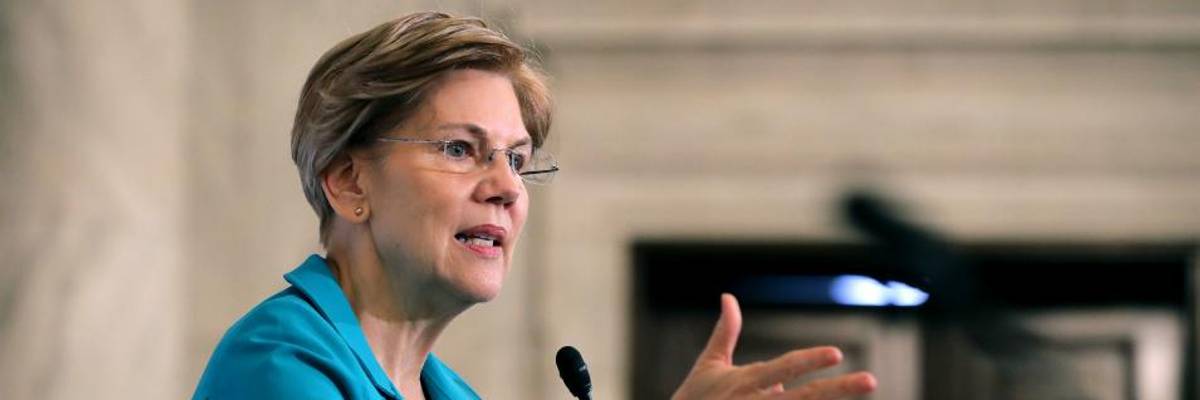
Sen. Elizabeth Warren (D-Mass.) addresses the Rev. Al Sharpton's National Action Network during a post-midterm election meeting in the Kennedy Caucus Room at the Russell Senate Office Building on Capitol Hill November 13, 2018 in Washington, D.C. (Photo: Chip Somodevilla/Getty Images)
While many declared and likely Democratic presidential candidates have expressed enthusiastic support for Medicare for All, a Green New Deal, a $15 minimum wage, and other ambitious progressive policies, 2020 hopefuls have not yet committed to eliminating the archaic filibuster rule in the Senate that--if left intact--would make these priorities virtually impossible to pass.
"As long as the filibuster exists, single-payer, voting rights, and pretty much any meaningful gun control [bills] are off the table."
--Jordan Weissmann, Slate
In an interview with Politico on Thursday, Sen. Elizabeth Warren (D-Mass.) became the first 2020 contender to suggest that she is open to scrapping the legislative filibuster, the Senate's longstanding requirement that all legislation must receive 60 votes before it can proceed through the chamber.
"Everything stays on the table. You keep it all on the table. Don't take anything off the table," Warren said when asked if she would support killing the filibuster, which can be eliminated with a simple majority vote--a move known as the "nuclear option."
But Sen. Cory Booker (D-N.J.), who announced he is running for president on Friday, told Politico that he holds the opposite view. Democrats, he said, should not consider touching the filibuster, even though it could give a future GOP Senate minority the power to stonewall progressive legislation.
"We should not be doing anything to mess with the strength of the filibuster," Booker said. "It's one of the distinguishing factors of this body. And I think it is good to have the power of the filibuster."
With the first 2020 presidential primaries just over a year away, progressive commentators and advocacy groups have increasingly stressed how important eliminating the filibuster is to achieving the kinds of bold policy transformations that Democratic candidates say they support--and that the science says are necessary to avert planetary catastrophe.
"Many are talking about big progressive plans. All are empty promises while the filibuster lives," noted Indivisible co-founder Ezra Levin.
"As long as the filibuster exists, single-payer, voting rights, and pretty much any meaningful gun control [bills] are off the table," added Slate's Jordan Weissmann. "It's just not even a close question to me. Do you think we need new voting rights legislation in this country? Then you think we need to eliminate the filibuster. Do you think we should pass gun control? Then you think we need to eliminate the filibuster. There's no choice."
Sen. Bernie Sanders (I-Vt.)--who is reportedly gearing up to announce his presidential bid "imminently"--and 2020 candidate Kirsten Gillibrand acknowledged in interviews with Politico that the debate over the filibuster is extremely consequential, but both declined to say whether they would support eliminating the rule, which many Senate Democrats continue to firmly support despite what one critic described as its "monstrously anti-democratic" nature.
While Gillibrand told Politico that her team is weighing all "the pros and cons" of the filibuster, Sanders said Democrats should worry about winning a majority in the Senate before considering whether to eliminate the supermajority requirement.
"Very good discussion. But not for today, ok? First of all we've got to take back [power]," the Vermont senator said. "You're too far ahead."
"There is no sign that a critical mass of Republican senators will be willing to back the kinds of 'big government' interventions necessary for mitigating climate change before it's too late."
--Eric Levitz, New York Magazine
In order to eliminate the filibuster, Democrats would have to both retake the Senate in 2020 and win over at least 51 senators to the prevailing progressive view that scrapping the rule is the only way to move ahead with the progressive agenda--and rescue the planet from the climate crisis.
As New York Magazine's Eric Levitz argued on Friday, Senate Democrats' "irrational love of the filibuster could doom their agenda" and the environment.
"A deepening ecological crisis will (almost certainly) be humanity's central challenge for the rest of our lives. We have a short window of time to take actions that will keep that crisis in the category of 'not quite catastrophic,'" Levitz notes. "And there is no sign that a critical mass of Republican senators will be willing to back the kinds of 'big government' interventions necessary for mitigating climate change before it's too late."
"Right now, Democrats have 47 Senate seats, and a reasonable chance of regaining a narrow majority in 2020 or 2022," Levitz concluded. "But the party's chances of gaining 60 votes in the medium-term future are nil. Which means that, absent the legislative filibuster's (de facto or de jure) destruction, the party's prospects for passing Medicare for All, a Green New Deal--or voting-rights legislation strong enough to combat the GOP's voter-suppression efforts at the state level--are bleak."
Dear Common Dreams reader, It’s been nearly 30 years since I co-founded Common Dreams with my late wife, Lina Newhouser. We had the radical notion that journalism should serve the public good, not corporate profits. It was clear to us from the outset what it would take to build such a project. No paid advertisements. No corporate sponsors. No millionaire publisher telling us what to think or do. Many people said we wouldn't last a year, but we proved those doubters wrong. Together with a tremendous team of journalists and dedicated staff, we built an independent media outlet free from the constraints of profits and corporate control. Our mission has always been simple: To inform. To inspire. To ignite change for the common good. Building Common Dreams was not easy. Our survival was never guaranteed. When you take on the most powerful forces—Wall Street greed, fossil fuel industry destruction, Big Tech lobbyists, and uber-rich oligarchs who have spent billions upon billions rigging the economy and democracy in their favor—the only bulwark you have is supporters who believe in your work. But here’s the urgent message from me today. It's never been this bad out there. And it's never been this hard to keep us going. At the very moment Common Dreams is most needed, the threats we face are intensifying. We need your support now more than ever. We don't accept corporate advertising and never will. We don't have a paywall because we don't think people should be blocked from critical news based on their ability to pay. Everything we do is funded by the donations of readers like you. When everyone does the little they can afford, we are strong. But if that support retreats or dries up, so do we. Will you donate now to make sure Common Dreams not only survives but thrives? —Craig Brown, Co-founder |
While many declared and likely Democratic presidential candidates have expressed enthusiastic support for Medicare for All, a Green New Deal, a $15 minimum wage, and other ambitious progressive policies, 2020 hopefuls have not yet committed to eliminating the archaic filibuster rule in the Senate that--if left intact--would make these priorities virtually impossible to pass.
"As long as the filibuster exists, single-payer, voting rights, and pretty much any meaningful gun control [bills] are off the table."
--Jordan Weissmann, Slate
In an interview with Politico on Thursday, Sen. Elizabeth Warren (D-Mass.) became the first 2020 contender to suggest that she is open to scrapping the legislative filibuster, the Senate's longstanding requirement that all legislation must receive 60 votes before it can proceed through the chamber.
"Everything stays on the table. You keep it all on the table. Don't take anything off the table," Warren said when asked if she would support killing the filibuster, which can be eliminated with a simple majority vote--a move known as the "nuclear option."
But Sen. Cory Booker (D-N.J.), who announced he is running for president on Friday, told Politico that he holds the opposite view. Democrats, he said, should not consider touching the filibuster, even though it could give a future GOP Senate minority the power to stonewall progressive legislation.
"We should not be doing anything to mess with the strength of the filibuster," Booker said. "It's one of the distinguishing factors of this body. And I think it is good to have the power of the filibuster."
With the first 2020 presidential primaries just over a year away, progressive commentators and advocacy groups have increasingly stressed how important eliminating the filibuster is to achieving the kinds of bold policy transformations that Democratic candidates say they support--and that the science says are necessary to avert planetary catastrophe.
"Many are talking about big progressive plans. All are empty promises while the filibuster lives," noted Indivisible co-founder Ezra Levin.
"As long as the filibuster exists, single-payer, voting rights, and pretty much any meaningful gun control [bills] are off the table," added Slate's Jordan Weissmann. "It's just not even a close question to me. Do you think we need new voting rights legislation in this country? Then you think we need to eliminate the filibuster. Do you think we should pass gun control? Then you think we need to eliminate the filibuster. There's no choice."
Sen. Bernie Sanders (I-Vt.)--who is reportedly gearing up to announce his presidential bid "imminently"--and 2020 candidate Kirsten Gillibrand acknowledged in interviews with Politico that the debate over the filibuster is extremely consequential, but both declined to say whether they would support eliminating the rule, which many Senate Democrats continue to firmly support despite what one critic described as its "monstrously anti-democratic" nature.
While Gillibrand told Politico that her team is weighing all "the pros and cons" of the filibuster, Sanders said Democrats should worry about winning a majority in the Senate before considering whether to eliminate the supermajority requirement.
"Very good discussion. But not for today, ok? First of all we've got to take back [power]," the Vermont senator said. "You're too far ahead."
"There is no sign that a critical mass of Republican senators will be willing to back the kinds of 'big government' interventions necessary for mitigating climate change before it's too late."
--Eric Levitz, New York Magazine
In order to eliminate the filibuster, Democrats would have to both retake the Senate in 2020 and win over at least 51 senators to the prevailing progressive view that scrapping the rule is the only way to move ahead with the progressive agenda--and rescue the planet from the climate crisis.
As New York Magazine's Eric Levitz argued on Friday, Senate Democrats' "irrational love of the filibuster could doom their agenda" and the environment.
"A deepening ecological crisis will (almost certainly) be humanity's central challenge for the rest of our lives. We have a short window of time to take actions that will keep that crisis in the category of 'not quite catastrophic,'" Levitz notes. "And there is no sign that a critical mass of Republican senators will be willing to back the kinds of 'big government' interventions necessary for mitigating climate change before it's too late."
"Right now, Democrats have 47 Senate seats, and a reasonable chance of regaining a narrow majority in 2020 or 2022," Levitz concluded. "But the party's chances of gaining 60 votes in the medium-term future are nil. Which means that, absent the legislative filibuster's (de facto or de jure) destruction, the party's prospects for passing Medicare for All, a Green New Deal--or voting-rights legislation strong enough to combat the GOP's voter-suppression efforts at the state level--are bleak."
While many declared and likely Democratic presidential candidates have expressed enthusiastic support for Medicare for All, a Green New Deal, a $15 minimum wage, and other ambitious progressive policies, 2020 hopefuls have not yet committed to eliminating the archaic filibuster rule in the Senate that--if left intact--would make these priorities virtually impossible to pass.
"As long as the filibuster exists, single-payer, voting rights, and pretty much any meaningful gun control [bills] are off the table."
--Jordan Weissmann, Slate
In an interview with Politico on Thursday, Sen. Elizabeth Warren (D-Mass.) became the first 2020 contender to suggest that she is open to scrapping the legislative filibuster, the Senate's longstanding requirement that all legislation must receive 60 votes before it can proceed through the chamber.
"Everything stays on the table. You keep it all on the table. Don't take anything off the table," Warren said when asked if she would support killing the filibuster, which can be eliminated with a simple majority vote--a move known as the "nuclear option."
But Sen. Cory Booker (D-N.J.), who announced he is running for president on Friday, told Politico that he holds the opposite view. Democrats, he said, should not consider touching the filibuster, even though it could give a future GOP Senate minority the power to stonewall progressive legislation.
"We should not be doing anything to mess with the strength of the filibuster," Booker said. "It's one of the distinguishing factors of this body. And I think it is good to have the power of the filibuster."
With the first 2020 presidential primaries just over a year away, progressive commentators and advocacy groups have increasingly stressed how important eliminating the filibuster is to achieving the kinds of bold policy transformations that Democratic candidates say they support--and that the science says are necessary to avert planetary catastrophe.
"Many are talking about big progressive plans. All are empty promises while the filibuster lives," noted Indivisible co-founder Ezra Levin.
"As long as the filibuster exists, single-payer, voting rights, and pretty much any meaningful gun control [bills] are off the table," added Slate's Jordan Weissmann. "It's just not even a close question to me. Do you think we need new voting rights legislation in this country? Then you think we need to eliminate the filibuster. Do you think we should pass gun control? Then you think we need to eliminate the filibuster. There's no choice."
Sen. Bernie Sanders (I-Vt.)--who is reportedly gearing up to announce his presidential bid "imminently"--and 2020 candidate Kirsten Gillibrand acknowledged in interviews with Politico that the debate over the filibuster is extremely consequential, but both declined to say whether they would support eliminating the rule, which many Senate Democrats continue to firmly support despite what one critic described as its "monstrously anti-democratic" nature.
While Gillibrand told Politico that her team is weighing all "the pros and cons" of the filibuster, Sanders said Democrats should worry about winning a majority in the Senate before considering whether to eliminate the supermajority requirement.
"Very good discussion. But not for today, ok? First of all we've got to take back [power]," the Vermont senator said. "You're too far ahead."
"There is no sign that a critical mass of Republican senators will be willing to back the kinds of 'big government' interventions necessary for mitigating climate change before it's too late."
--Eric Levitz, New York Magazine
In order to eliminate the filibuster, Democrats would have to both retake the Senate in 2020 and win over at least 51 senators to the prevailing progressive view that scrapping the rule is the only way to move ahead with the progressive agenda--and rescue the planet from the climate crisis.
As New York Magazine's Eric Levitz argued on Friday, Senate Democrats' "irrational love of the filibuster could doom their agenda" and the environment.
"A deepening ecological crisis will (almost certainly) be humanity's central challenge for the rest of our lives. We have a short window of time to take actions that will keep that crisis in the category of 'not quite catastrophic,'" Levitz notes. "And there is no sign that a critical mass of Republican senators will be willing to back the kinds of 'big government' interventions necessary for mitigating climate change before it's too late."
"Right now, Democrats have 47 Senate seats, and a reasonable chance of regaining a narrow majority in 2020 or 2022," Levitz concluded. "But the party's chances of gaining 60 votes in the medium-term future are nil. Which means that, absent the legislative filibuster's (de facto or de jure) destruction, the party's prospects for passing Medicare for All, a Green New Deal--or voting-rights legislation strong enough to combat the GOP's voter-suppression efforts at the state level--are bleak."