SUBSCRIBE TO OUR FREE NEWSLETTER
Daily news & progressive opinion—funded by the people, not the corporations—delivered straight to your inbox.
5
#000000
#FFFFFF
To donate by check, phone, or other method, see our More Ways to Give page.
Daily news & progressive opinion—funded by the people, not the corporations—delivered straight to your inbox.
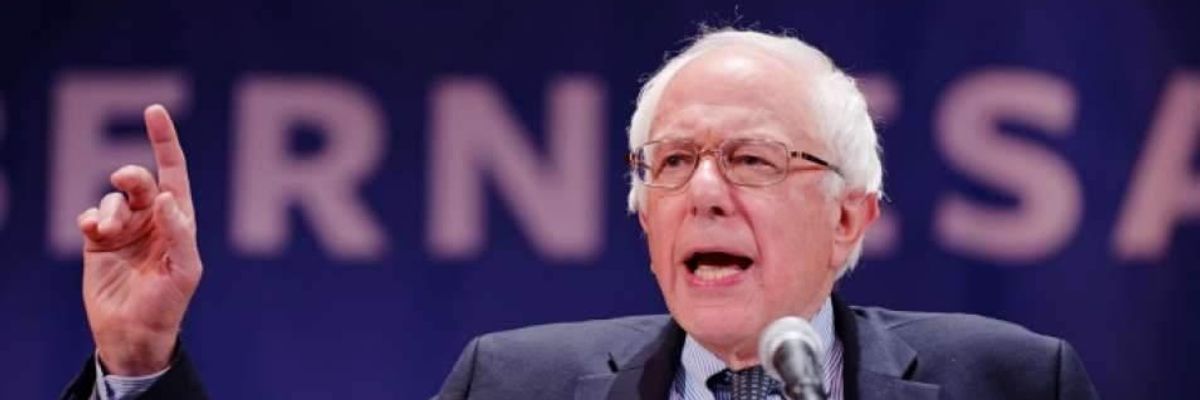
Sen. Bernie Sanders (I-Vt.) has introduced a new bill to combat national wealth inequality. (Photo: Michael Vadon/Flickr/cc)
To combat astronomical wealth inequality across the United States, Sen. Bernie Sanders (I-Vt.) on Thursday introduced the For the 99.8% Act (pdf), which would impose a progressive estate tax on the ultra wealthy and significantly raise rates on the nation's billionaires.
"The fairest way to reduce wealth inequality, invest in the disappearing middle class, and preserve our democracy is to enact a progressive estate tax on the inherited wealth of multi-millionaires and billionaires."
--Sen. Bernie Sanders
"Our bill does what the American people want by substantially increasing the estate tax on the wealthiest families in this country and dramatically reducing wealth inequality," Sanders said in a statement that specifically pointed to the Koch, Walton, and Bezos families.
The Independent senator's proposal comes just days after Senate Republicans showed that "greed has no limit for the GOP" by putting forward a bill to permanently repeal the estate tax, a move that critics blasted as yet another "blatant giveaway to their wealthy donors."
"At a time of massive wealth and income inequality, when the three richest Americans own more wealth than 160 million Americans, it is literally beyond belief that the Republican leadership wants to provide hundreds of billions of dollars in tax breaks to the top 0.2 percent," Sanders declared Thursday.
Like the bill currently being pushed by the Senate's Republican leaders, Sanders' measure would also target the wealthiest 0.2 percent of Americans--but unlike the GOP legislation, it aims to make the rich pay more in taxes, and close loopholes that have enabled them to easily pass on massive wealth to younger relatives.
Specifically, Sanders' plan would establish:
While the timetable would be uncertain, as estate taxes only take effect when someone dies, Sanders' team estimates the changes would raise $2.2 trillion from the country's 588 billionaires. Policy aides told the Washington Post that over the next decade, the tax would raise about $315 billion.
Citing estimates by Sanders' staff based on Forbes data, the Post outlined:
The law would dramatically affect how much taxes the wealthiest Americans pay when they die. Under current law, Jeffrey P. Bezos' heirs would pay $52 billion in estate tax upon his death, while Bill Gates' heirs would pay $38 billion... The GOP proposal would take both of their payments down to $0, while Sanders' would raise them to $101 billion and $74 billion, respectively.
Sanders' bold bill also comes on the heels of a proposed wealth tax from Sen. Elizabeth Warren (D-Mass.), who is considering running for president in 2020. After billionaire and former Starbucks CEO Howard Schultz--who's also weighing a presidential run--dismissed her plan as "ridiculous," Warren charged, "What's 'ridiculous' is billionaires who think they can buy the presidency to keep the system rigged for themselves while opportunity slips away for everyone else."
Sanders' policy director Warren Gunnels mused on Twitter that Schultz--who's worth more than $3 billion, according to Forbes--"is probably not going to like our bill, but that's ok. It's called For the 99.8 percent Act for a reason."
Welcoming the measure, Chuck Collins of the Institute for Policy Studies wrote for Common Dreams on Thursday, "Sanders' estate tax proposal is a plutocracy prevention act, squarely aimed at preventing the children of today's billionaires from dominating our future democracy, economy, culture, and philanthropy."
Massive fortunes that exceed $100 million, explained Collins, are "a form of power" that the nation's ultra wealthy use "to rig the rules of our economy and shape the culture through ownership of media." Sanders' proposal, he said, "is one of the ways we protect our society" from what President Theodore Roosevelt called the "tyranny of plutocracy."
"Today's U.S. is becoming even more unequal than Pre-World War I Europe... The way out is stronger investment in skills, higher paying jobs, and a more progressive tax system."
-- Thomas Piketty, economist
Endorsing Sanders' plan, Paris School of Economics professor Thomas Piketty noted that "one century ago, the U.S. invented steeply progressive estate and income taxes in order to maintain the egalitarian and democratic legacy of the country. Today's U.S. is becoming even more unequal than Pre-World War I Europe."
"The way out is stronger investment in skills, higher paying jobs, and a more progressive tax system," Piketty argued, calling Sanders' estate tax legislation "an important step in this direction."
In a series of tweets about his new proposal, Sanders asserted that "the fairest way to reduce wealth inequality, invest in the disappearing middle class, and preserve our democracy is to enact a progressive estate tax on the inherited wealth of multi-millionaires and billionaires."
"From a moral, economic, and political perspective," he concluded, "our nation will not thrive when so few have so much and so many have so little."
Sanders took to the Senate floor on Thursday to decry rampant wealth inequality and discuss his proposal to address it:
Dear Common Dreams reader, It’s been nearly 30 years since I co-founded Common Dreams with my late wife, Lina Newhouser. We had the radical notion that journalism should serve the public good, not corporate profits. It was clear to us from the outset what it would take to build such a project. No paid advertisements. No corporate sponsors. No millionaire publisher telling us what to think or do. Many people said we wouldn't last a year, but we proved those doubters wrong. Together with a tremendous team of journalists and dedicated staff, we built an independent media outlet free from the constraints of profits and corporate control. Our mission has always been simple: To inform. To inspire. To ignite change for the common good. Building Common Dreams was not easy. Our survival was never guaranteed. When you take on the most powerful forces—Wall Street greed, fossil fuel industry destruction, Big Tech lobbyists, and uber-rich oligarchs who have spent billions upon billions rigging the economy and democracy in their favor—the only bulwark you have is supporters who believe in your work. But here’s the urgent message from me today. It's never been this bad out there. And it's never been this hard to keep us going. At the very moment Common Dreams is most needed, the threats we face are intensifying. We need your support now more than ever. We don't accept corporate advertising and never will. We don't have a paywall because we don't think people should be blocked from critical news based on their ability to pay. Everything we do is funded by the donations of readers like you. When everyone does the little they can afford, we are strong. But if that support retreats or dries up, so do we. Will you donate now to make sure Common Dreams not only survives but thrives? —Craig Brown, Co-founder |
To combat astronomical wealth inequality across the United States, Sen. Bernie Sanders (I-Vt.) on Thursday introduced the For the 99.8% Act (pdf), which would impose a progressive estate tax on the ultra wealthy and significantly raise rates on the nation's billionaires.
"The fairest way to reduce wealth inequality, invest in the disappearing middle class, and preserve our democracy is to enact a progressive estate tax on the inherited wealth of multi-millionaires and billionaires."
--Sen. Bernie Sanders
"Our bill does what the American people want by substantially increasing the estate tax on the wealthiest families in this country and dramatically reducing wealth inequality," Sanders said in a statement that specifically pointed to the Koch, Walton, and Bezos families.
The Independent senator's proposal comes just days after Senate Republicans showed that "greed has no limit for the GOP" by putting forward a bill to permanently repeal the estate tax, a move that critics blasted as yet another "blatant giveaway to their wealthy donors."
"At a time of massive wealth and income inequality, when the three richest Americans own more wealth than 160 million Americans, it is literally beyond belief that the Republican leadership wants to provide hundreds of billions of dollars in tax breaks to the top 0.2 percent," Sanders declared Thursday.
Like the bill currently being pushed by the Senate's Republican leaders, Sanders' measure would also target the wealthiest 0.2 percent of Americans--but unlike the GOP legislation, it aims to make the rich pay more in taxes, and close loopholes that have enabled them to easily pass on massive wealth to younger relatives.
Specifically, Sanders' plan would establish:
While the timetable would be uncertain, as estate taxes only take effect when someone dies, Sanders' team estimates the changes would raise $2.2 trillion from the country's 588 billionaires. Policy aides told the Washington Post that over the next decade, the tax would raise about $315 billion.
Citing estimates by Sanders' staff based on Forbes data, the Post outlined:
The law would dramatically affect how much taxes the wealthiest Americans pay when they die. Under current law, Jeffrey P. Bezos' heirs would pay $52 billion in estate tax upon his death, while Bill Gates' heirs would pay $38 billion... The GOP proposal would take both of their payments down to $0, while Sanders' would raise them to $101 billion and $74 billion, respectively.
Sanders' bold bill also comes on the heels of a proposed wealth tax from Sen. Elizabeth Warren (D-Mass.), who is considering running for president in 2020. After billionaire and former Starbucks CEO Howard Schultz--who's also weighing a presidential run--dismissed her plan as "ridiculous," Warren charged, "What's 'ridiculous' is billionaires who think they can buy the presidency to keep the system rigged for themselves while opportunity slips away for everyone else."
Sanders' policy director Warren Gunnels mused on Twitter that Schultz--who's worth more than $3 billion, according to Forbes--"is probably not going to like our bill, but that's ok. It's called For the 99.8 percent Act for a reason."
Welcoming the measure, Chuck Collins of the Institute for Policy Studies wrote for Common Dreams on Thursday, "Sanders' estate tax proposal is a plutocracy prevention act, squarely aimed at preventing the children of today's billionaires from dominating our future democracy, economy, culture, and philanthropy."
Massive fortunes that exceed $100 million, explained Collins, are "a form of power" that the nation's ultra wealthy use "to rig the rules of our economy and shape the culture through ownership of media." Sanders' proposal, he said, "is one of the ways we protect our society" from what President Theodore Roosevelt called the "tyranny of plutocracy."
"Today's U.S. is becoming even more unequal than Pre-World War I Europe... The way out is stronger investment in skills, higher paying jobs, and a more progressive tax system."
-- Thomas Piketty, economist
Endorsing Sanders' plan, Paris School of Economics professor Thomas Piketty noted that "one century ago, the U.S. invented steeply progressive estate and income taxes in order to maintain the egalitarian and democratic legacy of the country. Today's U.S. is becoming even more unequal than Pre-World War I Europe."
"The way out is stronger investment in skills, higher paying jobs, and a more progressive tax system," Piketty argued, calling Sanders' estate tax legislation "an important step in this direction."
In a series of tweets about his new proposal, Sanders asserted that "the fairest way to reduce wealth inequality, invest in the disappearing middle class, and preserve our democracy is to enact a progressive estate tax on the inherited wealth of multi-millionaires and billionaires."
"From a moral, economic, and political perspective," he concluded, "our nation will not thrive when so few have so much and so many have so little."
Sanders took to the Senate floor on Thursday to decry rampant wealth inequality and discuss his proposal to address it:
To combat astronomical wealth inequality across the United States, Sen. Bernie Sanders (I-Vt.) on Thursday introduced the For the 99.8% Act (pdf), which would impose a progressive estate tax on the ultra wealthy and significantly raise rates on the nation's billionaires.
"The fairest way to reduce wealth inequality, invest in the disappearing middle class, and preserve our democracy is to enact a progressive estate tax on the inherited wealth of multi-millionaires and billionaires."
--Sen. Bernie Sanders
"Our bill does what the American people want by substantially increasing the estate tax on the wealthiest families in this country and dramatically reducing wealth inequality," Sanders said in a statement that specifically pointed to the Koch, Walton, and Bezos families.
The Independent senator's proposal comes just days after Senate Republicans showed that "greed has no limit for the GOP" by putting forward a bill to permanently repeal the estate tax, a move that critics blasted as yet another "blatant giveaway to their wealthy donors."
"At a time of massive wealth and income inequality, when the three richest Americans own more wealth than 160 million Americans, it is literally beyond belief that the Republican leadership wants to provide hundreds of billions of dollars in tax breaks to the top 0.2 percent," Sanders declared Thursday.
Like the bill currently being pushed by the Senate's Republican leaders, Sanders' measure would also target the wealthiest 0.2 percent of Americans--but unlike the GOP legislation, it aims to make the rich pay more in taxes, and close loopholes that have enabled them to easily pass on massive wealth to younger relatives.
Specifically, Sanders' plan would establish:
While the timetable would be uncertain, as estate taxes only take effect when someone dies, Sanders' team estimates the changes would raise $2.2 trillion from the country's 588 billionaires. Policy aides told the Washington Post that over the next decade, the tax would raise about $315 billion.
Citing estimates by Sanders' staff based on Forbes data, the Post outlined:
The law would dramatically affect how much taxes the wealthiest Americans pay when they die. Under current law, Jeffrey P. Bezos' heirs would pay $52 billion in estate tax upon his death, while Bill Gates' heirs would pay $38 billion... The GOP proposal would take both of their payments down to $0, while Sanders' would raise them to $101 billion and $74 billion, respectively.
Sanders' bold bill also comes on the heels of a proposed wealth tax from Sen. Elizabeth Warren (D-Mass.), who is considering running for president in 2020. After billionaire and former Starbucks CEO Howard Schultz--who's also weighing a presidential run--dismissed her plan as "ridiculous," Warren charged, "What's 'ridiculous' is billionaires who think they can buy the presidency to keep the system rigged for themselves while opportunity slips away for everyone else."
Sanders' policy director Warren Gunnels mused on Twitter that Schultz--who's worth more than $3 billion, according to Forbes--"is probably not going to like our bill, but that's ok. It's called For the 99.8 percent Act for a reason."
Welcoming the measure, Chuck Collins of the Institute for Policy Studies wrote for Common Dreams on Thursday, "Sanders' estate tax proposal is a plutocracy prevention act, squarely aimed at preventing the children of today's billionaires from dominating our future democracy, economy, culture, and philanthropy."
Massive fortunes that exceed $100 million, explained Collins, are "a form of power" that the nation's ultra wealthy use "to rig the rules of our economy and shape the culture through ownership of media." Sanders' proposal, he said, "is one of the ways we protect our society" from what President Theodore Roosevelt called the "tyranny of plutocracy."
"Today's U.S. is becoming even more unequal than Pre-World War I Europe... The way out is stronger investment in skills, higher paying jobs, and a more progressive tax system."
-- Thomas Piketty, economist
Endorsing Sanders' plan, Paris School of Economics professor Thomas Piketty noted that "one century ago, the U.S. invented steeply progressive estate and income taxes in order to maintain the egalitarian and democratic legacy of the country. Today's U.S. is becoming even more unequal than Pre-World War I Europe."
"The way out is stronger investment in skills, higher paying jobs, and a more progressive tax system," Piketty argued, calling Sanders' estate tax legislation "an important step in this direction."
In a series of tweets about his new proposal, Sanders asserted that "the fairest way to reduce wealth inequality, invest in the disappearing middle class, and preserve our democracy is to enact a progressive estate tax on the inherited wealth of multi-millionaires and billionaires."
"From a moral, economic, and political perspective," he concluded, "our nation will not thrive when so few have so much and so many have so little."
Sanders took to the Senate floor on Thursday to decry rampant wealth inequality and discuss his proposal to address it: