

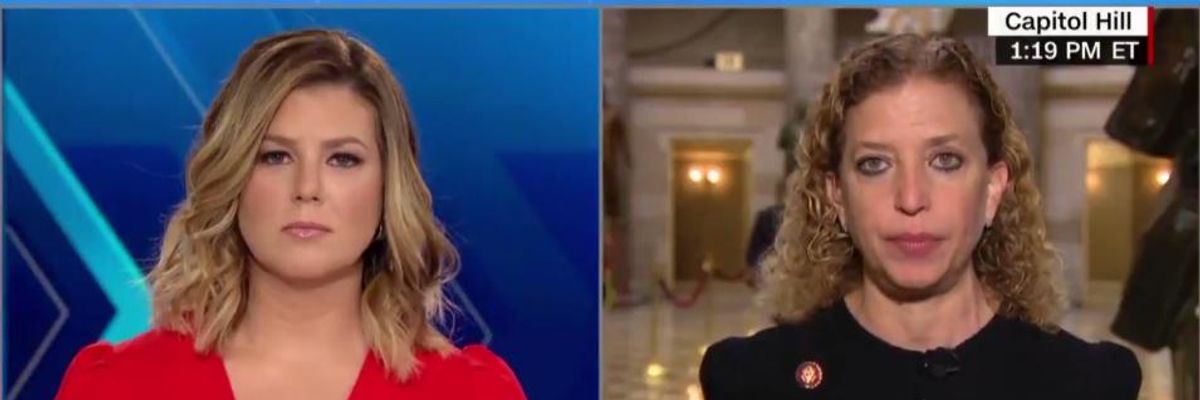
"I think we have to look past the surface-level name for it," Rep. Debbie Wasserman Schultz (D-Fla.) said during a CNN appearance on Wednesday. (Photo: CNN/Screengrab)
As Wasserman Schultz Exemplifies Muddled Stance, This Reminder: Medicare for All "Ain't a Slogan. It's a 94-Page Bill"
"There's only one bill in the Senate that guarantees healthcare as a right, saves families and businesses thousands a year, and reduces total national healthcare expenditures by at least $2 trillion over 10 years."
As some Senate Democrats offer up half-measures that fall far short of Medicare for All and rush to distance themselves from Sen. Kamala Harris' (D-Calif.) expressed support for eliminating private insurance, Rep. Debbie Wasserman Schultz (D-Fla.) on Wednesday made heavy use of buzzwords and verbal gymnastics--with phrases such as "the moniker of what you call the concept"--in an attempt to paper over these substantive and crucial healthcare policy differences within the Democratic Party.
"If a Democratic presidential contender offers you Medicare for All, read the fine print."
--Addy Baird, ThinkProgress
"I think we have to look past the surface-level name for it," Wasserman Schultz said during a CNN appearance when asked about Harris' remarks and what Medicare for All really means.
"The moniker of what you call the concept, which we are all fully embracing, is that healthcare is a right and should not be treated as a privilege that is only available to those who can afford it," the Florida congresswoman continued. "That is what Democrats are for, that's what you'll see every Democratic presidential candidate be for. And, as you would expect, they will take different approaches to getting there."
Wasserman Schultz went on to dismiss "the black and white choice of are you or are you not for Medicare for All" as meaningless, arguing that the more important "litmus test" for Democrats is "making sure that everyone in America can get access to quality affordable healthcare."
Watch:
Single-payer advocates have long warned of efforts by politicians to co-opt Medicare for All as a useful and popular campaign slogan while stripping the program of its substance. As Common Dreams reported last week, Medicare for All advocates have also denounced Democrats like Sens. Tim Kaine (D-Va.), Dick Durbin (D-Ill.), and others for advocating various incremental public option plans that would not adequately confront America's for-profit healthcare crisis.
Concisely summarizing the wariness among longtime single-payer activists, Addy Baird of ThinkProgress wrote on Wednesday, "If a Democratic presidential contender offers you Medicare for All, read the fine print."
Harris' remarks in support of eliminating the private insurance industry--which her team has since walked back--during a CNN town hall earlier this week intensified an ongoing national conversation about what Medicare for All would actually look like and how the transformative policy might be implemented.
Warren Gunnels, policy director for Sen. Bernie Sanders (I-Vt.), pointed to the Vermont senator's Medicare for All Act and emphasized in a tweet on Tuesday that Medicare for All "ain't a slogan. It's a 94-page bill."
Democratic Socialists for Medicare for All--a single-payer campaign organized by the Democratic Socialists of America (DSA)--declared that the recent "obfuscation" by Democrats on the definition of Medicare for All is why they go out of their way to "define Medicare for All according to five guiding principles":
We are at a crossroads
This country and this world are at a monumental crossroads. In a few short weeks, US voters will have an opportunity to beat back the forces of fascism and confront the billionaires who are rigging the economy, our media system, and our democracy, making it increasingly impossible for ordinary people to get by. We’re not just talking about the election. We’re talking about what must be done once these fascist elements are vanquished from power. We need a bolder set of solutions than what either major party has so far been willing to offer and a working-class movement ready to fight like hell for it. Trump didn't emerge from nowhere. The conditions that fueled MAGA authoritarianism were created by decades of radical neoliberal economic policies and a corrupt political system dominated by corporate interests. They slashed taxes on the super-rich, promising that the benefits would trickle down. They said giveaways to the corporate titans would make life more affordable for the rest of us. It was all bullshit. And when a bitter, betrayed populace searches for someone to blame, right-wing demagogues have little trouble finding scapegoats. People know when they're being lied to, but you won't hear any of this from the corporate media. Only independent journalism—powered and funded by people who believe in building a better world—can deliver truly trustworthy daily news. Our Fall Campaign is underway, and we need your help. To power our newsroom through the rest of the year, we need to raise $125,000 by midnight on October 31. So if you share our vision, please contribute whatever you can to sustain our work. |
As some Senate Democrats offer up half-measures that fall far short of Medicare for All and rush to distance themselves from Sen. Kamala Harris' (D-Calif.) expressed support for eliminating private insurance, Rep. Debbie Wasserman Schultz (D-Fla.) on Wednesday made heavy use of buzzwords and verbal gymnastics--with phrases such as "the moniker of what you call the concept"--in an attempt to paper over these substantive and crucial healthcare policy differences within the Democratic Party.
"If a Democratic presidential contender offers you Medicare for All, read the fine print."
--Addy Baird, ThinkProgress
"I think we have to look past the surface-level name for it," Wasserman Schultz said during a CNN appearance when asked about Harris' remarks and what Medicare for All really means.
"The moniker of what you call the concept, which we are all fully embracing, is that healthcare is a right and should not be treated as a privilege that is only available to those who can afford it," the Florida congresswoman continued. "That is what Democrats are for, that's what you'll see every Democratic presidential candidate be for. And, as you would expect, they will take different approaches to getting there."
Wasserman Schultz went on to dismiss "the black and white choice of are you or are you not for Medicare for All" as meaningless, arguing that the more important "litmus test" for Democrats is "making sure that everyone in America can get access to quality affordable healthcare."
Watch:
Single-payer advocates have long warned of efforts by politicians to co-opt Medicare for All as a useful and popular campaign slogan while stripping the program of its substance. As Common Dreams reported last week, Medicare for All advocates have also denounced Democrats like Sens. Tim Kaine (D-Va.), Dick Durbin (D-Ill.), and others for advocating various incremental public option plans that would not adequately confront America's for-profit healthcare crisis.
Concisely summarizing the wariness among longtime single-payer activists, Addy Baird of ThinkProgress wrote on Wednesday, "If a Democratic presidential contender offers you Medicare for All, read the fine print."
Harris' remarks in support of eliminating the private insurance industry--which her team has since walked back--during a CNN town hall earlier this week intensified an ongoing national conversation about what Medicare for All would actually look like and how the transformative policy might be implemented.
Warren Gunnels, policy director for Sen. Bernie Sanders (I-Vt.), pointed to the Vermont senator's Medicare for All Act and emphasized in a tweet on Tuesday that Medicare for All "ain't a slogan. It's a 94-page bill."
Democratic Socialists for Medicare for All--a single-payer campaign organized by the Democratic Socialists of America (DSA)--declared that the recent "obfuscation" by Democrats on the definition of Medicare for All is why they go out of their way to "define Medicare for All according to five guiding principles":
As some Senate Democrats offer up half-measures that fall far short of Medicare for All and rush to distance themselves from Sen. Kamala Harris' (D-Calif.) expressed support for eliminating private insurance, Rep. Debbie Wasserman Schultz (D-Fla.) on Wednesday made heavy use of buzzwords and verbal gymnastics--with phrases such as "the moniker of what you call the concept"--in an attempt to paper over these substantive and crucial healthcare policy differences within the Democratic Party.
"If a Democratic presidential contender offers you Medicare for All, read the fine print."
--Addy Baird, ThinkProgress
"I think we have to look past the surface-level name for it," Wasserman Schultz said during a CNN appearance when asked about Harris' remarks and what Medicare for All really means.
"The moniker of what you call the concept, which we are all fully embracing, is that healthcare is a right and should not be treated as a privilege that is only available to those who can afford it," the Florida congresswoman continued. "That is what Democrats are for, that's what you'll see every Democratic presidential candidate be for. And, as you would expect, they will take different approaches to getting there."
Wasserman Schultz went on to dismiss "the black and white choice of are you or are you not for Medicare for All" as meaningless, arguing that the more important "litmus test" for Democrats is "making sure that everyone in America can get access to quality affordable healthcare."
Watch:
Single-payer advocates have long warned of efforts by politicians to co-opt Medicare for All as a useful and popular campaign slogan while stripping the program of its substance. As Common Dreams reported last week, Medicare for All advocates have also denounced Democrats like Sens. Tim Kaine (D-Va.), Dick Durbin (D-Ill.), and others for advocating various incremental public option plans that would not adequately confront America's for-profit healthcare crisis.
Concisely summarizing the wariness among longtime single-payer activists, Addy Baird of ThinkProgress wrote on Wednesday, "If a Democratic presidential contender offers you Medicare for All, read the fine print."
Harris' remarks in support of eliminating the private insurance industry--which her team has since walked back--during a CNN town hall earlier this week intensified an ongoing national conversation about what Medicare for All would actually look like and how the transformative policy might be implemented.
Warren Gunnels, policy director for Sen. Bernie Sanders (I-Vt.), pointed to the Vermont senator's Medicare for All Act and emphasized in a tweet on Tuesday that Medicare for All "ain't a slogan. It's a 94-page bill."
Democratic Socialists for Medicare for All--a single-payer campaign organized by the Democratic Socialists of America (DSA)--declared that the recent "obfuscation" by Democrats on the definition of Medicare for All is why they go out of their way to "define Medicare for All according to five guiding principles":