

SUBSCRIBE TO OUR FREE NEWSLETTER
Daily news & progressive opinion—funded by the people, not the corporations—delivered straight to your inbox.
5
#000000
#FFFFFF
To donate by check, phone, or other method, see our More Ways to Give page.
Daily news & progressive opinion—funded by the people, not the corporations—delivered straight to your inbox.
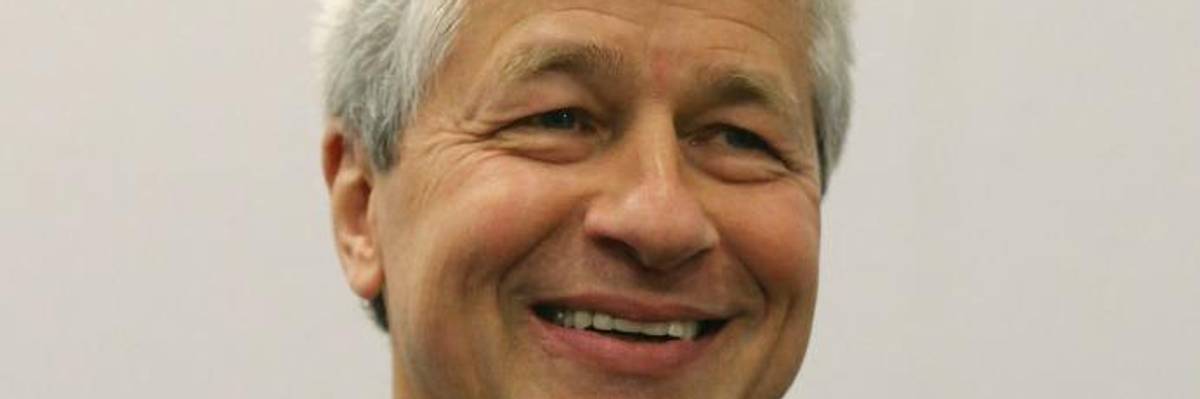
Jamie Dimon, chairman and CEO of JPMorgan Chase & Co., participates in a discussion on Detroit's economic recovery on April 5, 2016 in Washington, D.C. (Photo: Mark Wilson/Getty Images)
The global elite are getting ready to gather in the Swiss Alps for the World Economic Forum (WEF), and while the backdrop may be one of "deepening gloom over the global economic and political outlook," a new analysis reveals that for at least some of the attendees, the outlook is sunnier than ever.
Released by Bloomberg just ahead of the gathering in Davos, it shows how the net worth of some of the "gold-collar executives" that will be attending have surged in the ten years since the financial crisis.
JPMorgan Chase chairman and CEO Jamie Dimon, for example, now holds $1.5 billion--a threefold increase over the decade. Stephen Schwarzman, co-founder and CEO of private equity giant Blackstone, meanwhile, saw his wealth urge sixfold, as his net worth is now $12.3 billion. Rupert Murdoch's wealth similarly went up nearly sixfold, with his fortune now at $18.3 billion. Salesforce CEO Marc Benioff, for his part, is now worth $6.5 billion--a more than ninefold increase.
But, the reporting notes, while the economic elite are enjoying a bigger slice of the pie, for regular Americans, "Wages have stagnated and while equity markets have risen, fewer U.S. adults are invested in the stock market than in 2009."
"The data illustrate the ever-widening gap between the true haves--those in the 0.1 percent--and the have-nots of a global economy," it adds.
To further illustrate the divide, the reporting also points to a study released last year by the Economic Policy Institute (EPI), which found that in 2017, the CEO-to-worker compensation ratio was 312-to-1.
"With wages for working people barely budging, it's remarkable to see top CEO pay surging again," report co-author Lawrence Mishel said at the time. "It is difficult to believe that Congress passed a tax cut weighted so heavily towards the wealthy when the nation's top CEOs are clearly doing fine."
As for the Davos gathering, the Associated Press reports:
The Davos confab has always been vulnerable to snark: hedge fund billionaires flying into Davos in fuel-guzzling private jets to discuss the threat of climate change; millionaire CEOs discussing inequality while downing cocktails; endless conversations between people who describe themselves as "thought leaders."
Last week, the WEF published a report that stated, "Of all risks, it is in relation to the environment that the world is most clearly sleepwalking into catastrophe."
And while "this year's WEF conference will hear from influential voices which have repeatedly warned that time for world leaders to address climate change is running out," as DeSmogUK reported, the fossil fuel industry will still get the red carpet roll-out.
Responding to WEF's report, Greenpeace International executive director Jennifer Morgan lamented: "The Davos 'elite' are still pretending we have time to fix the climate crisis. We don't. We have already entered into a new phase of climate change, one in which the impacts are coming faster, with greater intensity, and where we must act immediately."
"No global gathering should take place without those in attendance committing to do everything in their power to meet this opportunity to hold climate warming to below 1.5 degrees," she added. "Davos is only the first such gathering in 2019 but it is an opportunity too important to squander."
The forum, whose theme this year is Globalization 4.0., kicks off Tuesday.
Dear Common Dreams reader, It’s been nearly 30 years since I co-founded Common Dreams with my late wife, Lina Newhouser. We had the radical notion that journalism should serve the public good, not corporate profits. It was clear to us from the outset what it would take to build such a project. No paid advertisements. No corporate sponsors. No millionaire publisher telling us what to think or do. Many people said we wouldn't last a year, but we proved those doubters wrong. Together with a tremendous team of journalists and dedicated staff, we built an independent media outlet free from the constraints of profits and corporate control. Our mission has always been simple: To inform. To inspire. To ignite change for the common good. Building Common Dreams was not easy. Our survival was never guaranteed. When you take on the most powerful forces—Wall Street greed, fossil fuel industry destruction, Big Tech lobbyists, and uber-rich oligarchs who have spent billions upon billions rigging the economy and democracy in their favor—the only bulwark you have is supporters who believe in your work. But here’s the urgent message from me today. It's never been this bad out there. And it's never been this hard to keep us going. At the very moment Common Dreams is most needed, the threats we face are intensifying. We need your support now more than ever. We don't accept corporate advertising and never will. We don't have a paywall because we don't think people should be blocked from critical news based on their ability to pay. Everything we do is funded by the donations of readers like you. When everyone does the little they can afford, we are strong. But if that support retreats or dries up, so do we. Will you donate now to make sure Common Dreams not only survives but thrives? —Craig Brown, Co-founder |
The global elite are getting ready to gather in the Swiss Alps for the World Economic Forum (WEF), and while the backdrop may be one of "deepening gloom over the global economic and political outlook," a new analysis reveals that for at least some of the attendees, the outlook is sunnier than ever.
Released by Bloomberg just ahead of the gathering in Davos, it shows how the net worth of some of the "gold-collar executives" that will be attending have surged in the ten years since the financial crisis.
JPMorgan Chase chairman and CEO Jamie Dimon, for example, now holds $1.5 billion--a threefold increase over the decade. Stephen Schwarzman, co-founder and CEO of private equity giant Blackstone, meanwhile, saw his wealth urge sixfold, as his net worth is now $12.3 billion. Rupert Murdoch's wealth similarly went up nearly sixfold, with his fortune now at $18.3 billion. Salesforce CEO Marc Benioff, for his part, is now worth $6.5 billion--a more than ninefold increase.
But, the reporting notes, while the economic elite are enjoying a bigger slice of the pie, for regular Americans, "Wages have stagnated and while equity markets have risen, fewer U.S. adults are invested in the stock market than in 2009."
"The data illustrate the ever-widening gap between the true haves--those in the 0.1 percent--and the have-nots of a global economy," it adds.
To further illustrate the divide, the reporting also points to a study released last year by the Economic Policy Institute (EPI), which found that in 2017, the CEO-to-worker compensation ratio was 312-to-1.
"With wages for working people barely budging, it's remarkable to see top CEO pay surging again," report co-author Lawrence Mishel said at the time. "It is difficult to believe that Congress passed a tax cut weighted so heavily towards the wealthy when the nation's top CEOs are clearly doing fine."
As for the Davos gathering, the Associated Press reports:
The Davos confab has always been vulnerable to snark: hedge fund billionaires flying into Davos in fuel-guzzling private jets to discuss the threat of climate change; millionaire CEOs discussing inequality while downing cocktails; endless conversations between people who describe themselves as "thought leaders."
Last week, the WEF published a report that stated, "Of all risks, it is in relation to the environment that the world is most clearly sleepwalking into catastrophe."
And while "this year's WEF conference will hear from influential voices which have repeatedly warned that time for world leaders to address climate change is running out," as DeSmogUK reported, the fossil fuel industry will still get the red carpet roll-out.
Responding to WEF's report, Greenpeace International executive director Jennifer Morgan lamented: "The Davos 'elite' are still pretending we have time to fix the climate crisis. We don't. We have already entered into a new phase of climate change, one in which the impacts are coming faster, with greater intensity, and where we must act immediately."
"No global gathering should take place without those in attendance committing to do everything in their power to meet this opportunity to hold climate warming to below 1.5 degrees," she added. "Davos is only the first such gathering in 2019 but it is an opportunity too important to squander."
The forum, whose theme this year is Globalization 4.0., kicks off Tuesday.
The global elite are getting ready to gather in the Swiss Alps for the World Economic Forum (WEF), and while the backdrop may be one of "deepening gloom over the global economic and political outlook," a new analysis reveals that for at least some of the attendees, the outlook is sunnier than ever.
Released by Bloomberg just ahead of the gathering in Davos, it shows how the net worth of some of the "gold-collar executives" that will be attending have surged in the ten years since the financial crisis.
JPMorgan Chase chairman and CEO Jamie Dimon, for example, now holds $1.5 billion--a threefold increase over the decade. Stephen Schwarzman, co-founder and CEO of private equity giant Blackstone, meanwhile, saw his wealth urge sixfold, as his net worth is now $12.3 billion. Rupert Murdoch's wealth similarly went up nearly sixfold, with his fortune now at $18.3 billion. Salesforce CEO Marc Benioff, for his part, is now worth $6.5 billion--a more than ninefold increase.
But, the reporting notes, while the economic elite are enjoying a bigger slice of the pie, for regular Americans, "Wages have stagnated and while equity markets have risen, fewer U.S. adults are invested in the stock market than in 2009."
"The data illustrate the ever-widening gap between the true haves--those in the 0.1 percent--and the have-nots of a global economy," it adds.
To further illustrate the divide, the reporting also points to a study released last year by the Economic Policy Institute (EPI), which found that in 2017, the CEO-to-worker compensation ratio was 312-to-1.
"With wages for working people barely budging, it's remarkable to see top CEO pay surging again," report co-author Lawrence Mishel said at the time. "It is difficult to believe that Congress passed a tax cut weighted so heavily towards the wealthy when the nation's top CEOs are clearly doing fine."
As for the Davos gathering, the Associated Press reports:
The Davos confab has always been vulnerable to snark: hedge fund billionaires flying into Davos in fuel-guzzling private jets to discuss the threat of climate change; millionaire CEOs discussing inequality while downing cocktails; endless conversations between people who describe themselves as "thought leaders."
Last week, the WEF published a report that stated, "Of all risks, it is in relation to the environment that the world is most clearly sleepwalking into catastrophe."
And while "this year's WEF conference will hear from influential voices which have repeatedly warned that time for world leaders to address climate change is running out," as DeSmogUK reported, the fossil fuel industry will still get the red carpet roll-out.
Responding to WEF's report, Greenpeace International executive director Jennifer Morgan lamented: "The Davos 'elite' are still pretending we have time to fix the climate crisis. We don't. We have already entered into a new phase of climate change, one in which the impacts are coming faster, with greater intensity, and where we must act immediately."
"No global gathering should take place without those in attendance committing to do everything in their power to meet this opportunity to hold climate warming to below 1.5 degrees," she added. "Davos is only the first such gathering in 2019 but it is an opportunity too important to squander."
The forum, whose theme this year is Globalization 4.0., kicks off Tuesday.

