SUBSCRIBE TO OUR FREE NEWSLETTER
Daily news & progressive opinion—funded by the people, not the corporations—delivered straight to your inbox.
5
#000000
#FFFFFF
To donate by check, phone, or other method, see our More Ways to Give page.
Daily news & progressive opinion—funded by the people, not the corporations—delivered straight to your inbox.
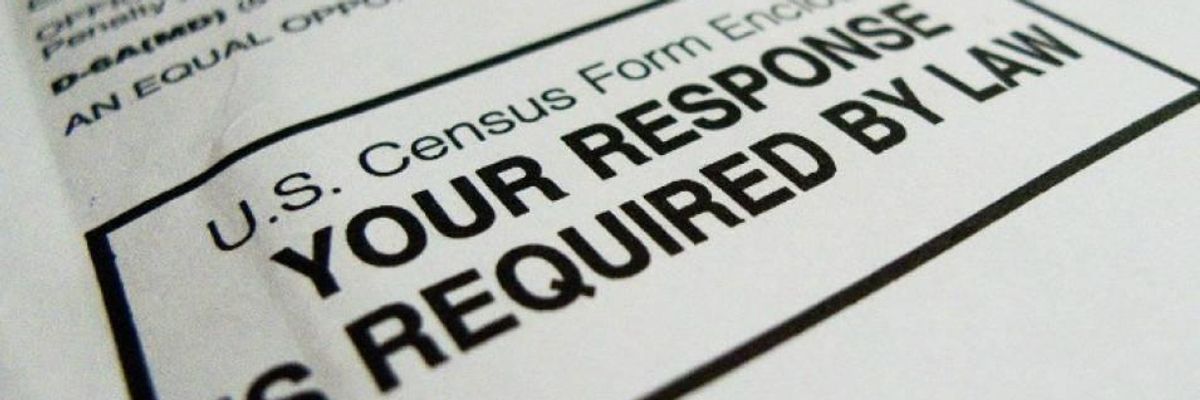
Common Cause called the Trump administration's goal of including a citizenship status question on the 2020 U.S. census "an attempt to racially rig the census" last year. (Photo: Paul J. Richards/AFP/Getty Images)
Civil liberties and immigration rights advocates are applauding a ruling decision by a federal judge New York on Tuesday after the court struck down the Trump administration's attempt to insert a citizenship question in to the 2020 Census.
Ruling on a lawsuit filed by the New York Immigration Coalition (NYIC), the ACLU, and other groups, U.S. District Judge Jess Furman said that Commerce Secretary Wilbur Ross, who oversees the Census, acted illegally when he requested that the question be added.
Ross had previously claimed that the Justice Department (DOJ) had originally requested the question, which was to read, "Is this person a citizen of the United States?" But the lawsuit filed by the groups revealed that Ross had actually consulted with former White House strategist--and open white supremacist--Steve Bannon. Ross's addition of the question violated the Administrative Procedures Act, the judge ruled.
"Today's decision is a victory for all New Yorkers and immigrants across the country, as Judge Furman rebuked the Trump administration's naked attempt to circumvent the law for its own gain," said NYIC executive director Steven Choi. "The Administrative Act cannot be used to rig the Census as part of a white supremacist agenda led by Kris Kobach and Steve Bannon."
Ross has claimed that the addition of the citizenship question--which has not been included on the U.S. Census since 1950--was necessary to make sure the government could better enforce the Voting Rights Act to ensure that minorities are not discriminated against.
In his ruling, however, Furman determined the claim simply didn't stand up.
"The evidence establishes that Secretary Ross's stated rationale, to promote VRA enforcement, was pretextual--in other words, that he announced his decision in a manner that concealed its true basis rather than explaining it," wrote Furman.
Critics argue that far from ensuring enforcement of the Voting Rights Act, a citizenship question would cause many in immigrant communities to go into hiding and refuse to answer the Census next year, resulting in an undercount. An inaccurate Census can keep billions of dollars in federal funds from reaching communities, and threaten political representation as new determinations are made about how many representatives states should have in Congress and state legislatures.
"If included, a citizenship question will stoke unnecessary fear in immigrant communities and could result in a significant undercount, particularly already under-counted racial and ethnic minority groups," said the NYIC. "With immigrants constituting nearly one out of four New Yorkers, an undercount in the 2020 Census will have catastrophic consequences--costing all New Yorkers political power and billions of dollars in federal funding for key services."
Common Cause president Karen Hobert Flynn expressed relief at Furman's ruling, as well as dismay at the Trump administration's blatant attempt to rig the 2020 Census.
"Most shocking and disappointing is that all indications are that the question was added specifically to drive down participation by noncitizens for purely partisan political purposes," said Hobert Flynn. "The court recognized and called out this effort to rig the census for political advantage as an affront to the Constitution."
Furman's ruling is expected to be appealed and eventually end up before the U.S. Supreme Court. The nation's highest court is also scheduled to hear oral arguments next month regarding whether Ross can be questioned under oath about his decision to include the citizenship question.
Despite the likely appeal, Thomas Wolf of the Brennan Center for Justice expressed optimism regarding the ruling--with several other lawsuits over the citizenship pending in states across the country.
"Today's ruling is a strong signal to the Trump administration that any attempts to politicize and corrupt the 2020 census will fail," said Wolf. "Hard data and commonsense show that the citizenship question would intimidate vulnerable communities and massively suppress participation in the 2020 Census, with damaging effects that would undermine our democracy for a decade or more."
This country and this world are at a monumental crossroads. US voters have an opportunity to beat back the forces of fascism and confront the billionaires who are rigging the economy, our media system, and our democracy, making it increasingly impossible for ordinary people to get by. We’re not just talking about the election. We’re talking about what must be done once these fascist elements are vanquished from power. We need a bolder set of solutions than what either major party has so far been willing to offer and a working-class movement ready to fight like hell for it. Trump didn't emerge from nowhere. The conditions that fueled MAGA authoritarianism were created by decades of radical neoliberal economic policies and a corrupt political system dominated by corporate interests. They slashed taxes on the super-rich, promising that the benefits would trickle down. They said giveaways to the corporate titans would make life more affordable for the rest of us. It was all bullshit. And when a bitter, betrayed populace searches for someone to blame, right-wing demagogues have little trouble finding scapegoats. People know when they're being lied to, but you won't hear any of this from the corporate media. Only independent journalism—powered and funded by people who believe in building a better world—can deliver truly trustworthy daily news. If you share our vision, please contribute whatever you can to sustain our work. |
Civil liberties and immigration rights advocates are applauding a ruling decision by a federal judge New York on Tuesday after the court struck down the Trump administration's attempt to insert a citizenship question in to the 2020 Census.
Ruling on a lawsuit filed by the New York Immigration Coalition (NYIC), the ACLU, and other groups, U.S. District Judge Jess Furman said that Commerce Secretary Wilbur Ross, who oversees the Census, acted illegally when he requested that the question be added.
Ross had previously claimed that the Justice Department (DOJ) had originally requested the question, which was to read, "Is this person a citizen of the United States?" But the lawsuit filed by the groups revealed that Ross had actually consulted with former White House strategist--and open white supremacist--Steve Bannon. Ross's addition of the question violated the Administrative Procedures Act, the judge ruled.
"Today's decision is a victory for all New Yorkers and immigrants across the country, as Judge Furman rebuked the Trump administration's naked attempt to circumvent the law for its own gain," said NYIC executive director Steven Choi. "The Administrative Act cannot be used to rig the Census as part of a white supremacist agenda led by Kris Kobach and Steve Bannon."
Ross has claimed that the addition of the citizenship question--which has not been included on the U.S. Census since 1950--was necessary to make sure the government could better enforce the Voting Rights Act to ensure that minorities are not discriminated against.
In his ruling, however, Furman determined the claim simply didn't stand up.
"The evidence establishes that Secretary Ross's stated rationale, to promote VRA enforcement, was pretextual--in other words, that he announced his decision in a manner that concealed its true basis rather than explaining it," wrote Furman.
Critics argue that far from ensuring enforcement of the Voting Rights Act, a citizenship question would cause many in immigrant communities to go into hiding and refuse to answer the Census next year, resulting in an undercount. An inaccurate Census can keep billions of dollars in federal funds from reaching communities, and threaten political representation as new determinations are made about how many representatives states should have in Congress and state legislatures.
"If included, a citizenship question will stoke unnecessary fear in immigrant communities and could result in a significant undercount, particularly already under-counted racial and ethnic minority groups," said the NYIC. "With immigrants constituting nearly one out of four New Yorkers, an undercount in the 2020 Census will have catastrophic consequences--costing all New Yorkers political power and billions of dollars in federal funding for key services."
Common Cause president Karen Hobert Flynn expressed relief at Furman's ruling, as well as dismay at the Trump administration's blatant attempt to rig the 2020 Census.
"Most shocking and disappointing is that all indications are that the question was added specifically to drive down participation by noncitizens for purely partisan political purposes," said Hobert Flynn. "The court recognized and called out this effort to rig the census for political advantage as an affront to the Constitution."
Furman's ruling is expected to be appealed and eventually end up before the U.S. Supreme Court. The nation's highest court is also scheduled to hear oral arguments next month regarding whether Ross can be questioned under oath about his decision to include the citizenship question.
Despite the likely appeal, Thomas Wolf of the Brennan Center for Justice expressed optimism regarding the ruling--with several other lawsuits over the citizenship pending in states across the country.
"Today's ruling is a strong signal to the Trump administration that any attempts to politicize and corrupt the 2020 census will fail," said Wolf. "Hard data and commonsense show that the citizenship question would intimidate vulnerable communities and massively suppress participation in the 2020 Census, with damaging effects that would undermine our democracy for a decade or more."