

SUBSCRIBE TO OUR FREE NEWSLETTER
Daily news & progressive opinion—funded by the people, not the corporations—delivered straight to your inbox.
5
#000000
#FFFFFF
To donate by check, phone, or other method, see our More Ways to Give page.
Daily news & progressive opinion—funded by the people, not the corporations—delivered straight to your inbox.
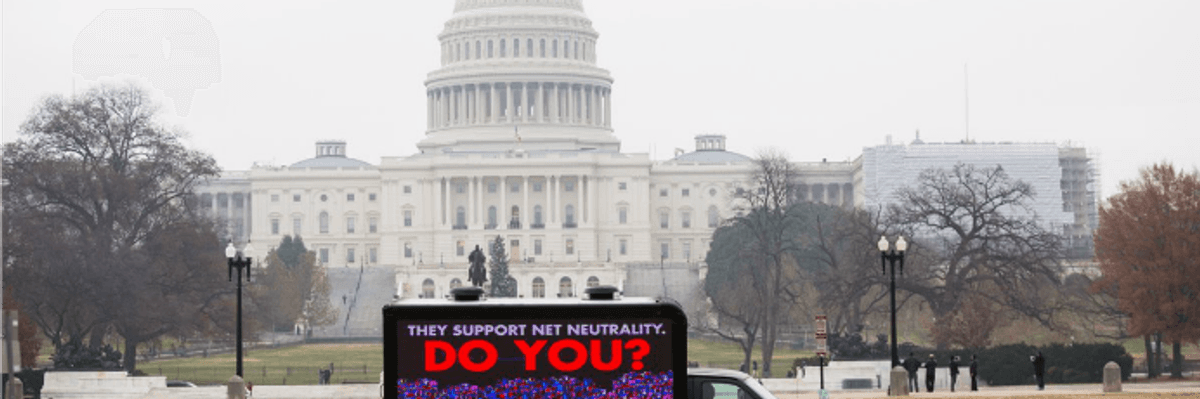
"Lawmakers have no excuse. Signing on to the CRA discharge petition is the clearest way to show support for real net neutrality protections. It's a simple up or down vote on the future of the free and open web," Evan Greer, deputy director of Fight for the Future, said in a statement. (Photo: Fight for the Future)
The U.S. House still has an opportunity to side with the vast majority of the American public and overturn the Republican-controlled FCC's net neutrality repeal, but time is quickly running out.
With Friday, Dec. 21, marking the official deadline to restore net neutrality in this session of Congress, the House still needs 38 signatures to pass the Congressional Review Act (CRA) resolution that would reverse the FCC's deeply unpopular repeal, which was crafted by agency chairman and former Verizon lawyer Ajit Pai.
"Lawmakers have no excuse. Signing on to the CRA discharge petition is the clearest way to show support for real net neutrality protections. It's a simple up or down vote on the future of the free and open web."
--Evan Greer, Fight for the Future
According to Fight for the Future, 16 Democrats--all of whom are major recipients of telecom cash--still haven't signed on to the CRA. To pass, the CRA needs every Democrat and at least 22 Republicans to sign on before the Friday deadline.
The 16 House Democrats who still haven't signed on to the Congressional Review Act (CRA) measure to restore net neutrality protections are: Reps. Brandon Boyle (Pa.), Robert Brady (Pa.), G.K. Butterfield (N.C.), Matt Cartwright (Pa.), Jim Costa (Calif.), Henry Cueller (Texas), Dwight Evans (Pa.), Vicente Gonzalez (Texas), Josh Gottheimer (N.J.), Gene Green (Texas), Tom O'Halleran (Ariz.), Brad Schneider (Ill.), David Scott (Ga.), Kyrsten Sinema (Ariz.), Filemon Vela (Texas), and Pete Visclosky (Ind.).
View the full list of House members who have yet to back the CRA here.
"Lawmakers have no excuse. Signing on to the CRA discharge petition is the clearest way to show support for real net neutrality protections. It's a simple up or down vote on the future of the free and open web," Evan Greer, deputy director of Fight for the Future, said in a statement. "Any rep who doesn't sign is making it clear that they don't really support net neutrality, and would rather take money from big telecom companies than side with the overwhelming majority of voters from across the political spectrum."
On the one-year anniversary of the FCC's net neutrality repeal last Friday, Fight for the Future drove a digital billboard around the U.S. Capitol building for more than eight hours to shame and pressure holdout lawmakers to sign the CRA before it's too late.
The crowdfunded billboard displayed the names of every House member who has yet to back the effort to restore net neutrality, along with how much campaign money they've received from the telecom industry.
Fight for the Future's billboard action came after the group launched a website targeting Democrats who haven't supported the CRA.
"The internet still works. But unless something changes soon, either in the courts or in Congress, it might not work the same way for very much longer."
--April Glaser, Slate
The pressure campaign appears to be having an effect. As Gizmodo reported last Thursday, Rep. Mary Gay Scanlon (D-Penn.) announced that she will support the resolution to restore net neutrality after receiving a flood of calls from her constituents.
"A year after the FCC repeal, people are still pissed off and paying attention," Greer declared in response to Scanlon's announcement.
While right-wing opponents of net neutrality have predictably used the fact that the internet hasn't totally collapsed as evidence that the protections were never needed in the first place, Fight for the Future dismissed this argument as the "tech policy equivalent to 'Look, it's snowing outside. Climate change is a hoax.'"
"Don't fall for it," the group declared, urging net neutrality supporters to continue flooding the phone lines and email inboxes of their representatives.
"The internet still works. But unless something changes soon, either in the courts or in Congress, it might not work the same way for very much longer," noted Slate's April Glaser. "Internet service providers stand to make a killing without net neutrality rules, since they can essentially operate a two-way toll, charging both subscribers for access to the internet and websites to reach subscribers at faster speeds."
Though the House CRA faces long odds amid opposition from telecom-funded Republicans and Democrats, Timothy Karr, senior director of strategy for Free Press, expressed confidence in a blog post that "this year without net neutrality is an aberration--and that the days of Chairman Pai's assault on the open internet are numbered."
Highlighting the crop of net neutrality backers set to take their seats in the next Congress, ongoing state efforts to develop robust open internet protections, and the legal battle against the FCC's repeal, Karr argued that "open internet supporters will win in the end. And that victory will come sooner rather than later."
"That's because people understand what's at stake," Karr concluded. "Without net neutrality, large phone and cable companies will take control of the stories we tell, deciding who gets a voice and who doesn't."
Dear Common Dreams reader, It’s been nearly 30 years since I co-founded Common Dreams with my late wife, Lina Newhouser. We had the radical notion that journalism should serve the public good, not corporate profits. It was clear to us from the outset what it would take to build such a project. No paid advertisements. No corporate sponsors. No millionaire publisher telling us what to think or do. Many people said we wouldn't last a year, but we proved those doubters wrong. Together with a tremendous team of journalists and dedicated staff, we built an independent media outlet free from the constraints of profits and corporate control. Our mission has always been simple: To inform. To inspire. To ignite change for the common good. Building Common Dreams was not easy. Our survival was never guaranteed. When you take on the most powerful forces—Wall Street greed, fossil fuel industry destruction, Big Tech lobbyists, and uber-rich oligarchs who have spent billions upon billions rigging the economy and democracy in their favor—the only bulwark you have is supporters who believe in your work. But here’s the urgent message from me today. It's never been this bad out there. And it's never been this hard to keep us going. At the very moment Common Dreams is most needed, the threats we face are intensifying. We need your support now more than ever. We don't accept corporate advertising and never will. We don't have a paywall because we don't think people should be blocked from critical news based on their ability to pay. Everything we do is funded by the donations of readers like you. When everyone does the little they can afford, we are strong. But if that support retreats or dries up, so do we. Will you donate now to make sure Common Dreams not only survives but thrives? —Craig Brown, Co-founder |
The U.S. House still has an opportunity to side with the vast majority of the American public and overturn the Republican-controlled FCC's net neutrality repeal, but time is quickly running out.
With Friday, Dec. 21, marking the official deadline to restore net neutrality in this session of Congress, the House still needs 38 signatures to pass the Congressional Review Act (CRA) resolution that would reverse the FCC's deeply unpopular repeal, which was crafted by agency chairman and former Verizon lawyer Ajit Pai.
"Lawmakers have no excuse. Signing on to the CRA discharge petition is the clearest way to show support for real net neutrality protections. It's a simple up or down vote on the future of the free and open web."
--Evan Greer, Fight for the Future
According to Fight for the Future, 16 Democrats--all of whom are major recipients of telecom cash--still haven't signed on to the CRA. To pass, the CRA needs every Democrat and at least 22 Republicans to sign on before the Friday deadline.
The 16 House Democrats who still haven't signed on to the Congressional Review Act (CRA) measure to restore net neutrality protections are: Reps. Brandon Boyle (Pa.), Robert Brady (Pa.), G.K. Butterfield (N.C.), Matt Cartwright (Pa.), Jim Costa (Calif.), Henry Cueller (Texas), Dwight Evans (Pa.), Vicente Gonzalez (Texas), Josh Gottheimer (N.J.), Gene Green (Texas), Tom O'Halleran (Ariz.), Brad Schneider (Ill.), David Scott (Ga.), Kyrsten Sinema (Ariz.), Filemon Vela (Texas), and Pete Visclosky (Ind.).
View the full list of House members who have yet to back the CRA here.
"Lawmakers have no excuse. Signing on to the CRA discharge petition is the clearest way to show support for real net neutrality protections. It's a simple up or down vote on the future of the free and open web," Evan Greer, deputy director of Fight for the Future, said in a statement. "Any rep who doesn't sign is making it clear that they don't really support net neutrality, and would rather take money from big telecom companies than side with the overwhelming majority of voters from across the political spectrum."
On the one-year anniversary of the FCC's net neutrality repeal last Friday, Fight for the Future drove a digital billboard around the U.S. Capitol building for more than eight hours to shame and pressure holdout lawmakers to sign the CRA before it's too late.
The crowdfunded billboard displayed the names of every House member who has yet to back the effort to restore net neutrality, along with how much campaign money they've received from the telecom industry.
Fight for the Future's billboard action came after the group launched a website targeting Democrats who haven't supported the CRA.
"The internet still works. But unless something changes soon, either in the courts or in Congress, it might not work the same way for very much longer."
--April Glaser, Slate
The pressure campaign appears to be having an effect. As Gizmodo reported last Thursday, Rep. Mary Gay Scanlon (D-Penn.) announced that she will support the resolution to restore net neutrality after receiving a flood of calls from her constituents.
"A year after the FCC repeal, people are still pissed off and paying attention," Greer declared in response to Scanlon's announcement.
While right-wing opponents of net neutrality have predictably used the fact that the internet hasn't totally collapsed as evidence that the protections were never needed in the first place, Fight for the Future dismissed this argument as the "tech policy equivalent to 'Look, it's snowing outside. Climate change is a hoax.'"
"Don't fall for it," the group declared, urging net neutrality supporters to continue flooding the phone lines and email inboxes of their representatives.
"The internet still works. But unless something changes soon, either in the courts or in Congress, it might not work the same way for very much longer," noted Slate's April Glaser. "Internet service providers stand to make a killing without net neutrality rules, since they can essentially operate a two-way toll, charging both subscribers for access to the internet and websites to reach subscribers at faster speeds."
Though the House CRA faces long odds amid opposition from telecom-funded Republicans and Democrats, Timothy Karr, senior director of strategy for Free Press, expressed confidence in a blog post that "this year without net neutrality is an aberration--and that the days of Chairman Pai's assault on the open internet are numbered."
Highlighting the crop of net neutrality backers set to take their seats in the next Congress, ongoing state efforts to develop robust open internet protections, and the legal battle against the FCC's repeal, Karr argued that "open internet supporters will win in the end. And that victory will come sooner rather than later."
"That's because people understand what's at stake," Karr concluded. "Without net neutrality, large phone and cable companies will take control of the stories we tell, deciding who gets a voice and who doesn't."
The U.S. House still has an opportunity to side with the vast majority of the American public and overturn the Republican-controlled FCC's net neutrality repeal, but time is quickly running out.
With Friday, Dec. 21, marking the official deadline to restore net neutrality in this session of Congress, the House still needs 38 signatures to pass the Congressional Review Act (CRA) resolution that would reverse the FCC's deeply unpopular repeal, which was crafted by agency chairman and former Verizon lawyer Ajit Pai.
"Lawmakers have no excuse. Signing on to the CRA discharge petition is the clearest way to show support for real net neutrality protections. It's a simple up or down vote on the future of the free and open web."
--Evan Greer, Fight for the Future
According to Fight for the Future, 16 Democrats--all of whom are major recipients of telecom cash--still haven't signed on to the CRA. To pass, the CRA needs every Democrat and at least 22 Republicans to sign on before the Friday deadline.
The 16 House Democrats who still haven't signed on to the Congressional Review Act (CRA) measure to restore net neutrality protections are: Reps. Brandon Boyle (Pa.), Robert Brady (Pa.), G.K. Butterfield (N.C.), Matt Cartwright (Pa.), Jim Costa (Calif.), Henry Cueller (Texas), Dwight Evans (Pa.), Vicente Gonzalez (Texas), Josh Gottheimer (N.J.), Gene Green (Texas), Tom O'Halleran (Ariz.), Brad Schneider (Ill.), David Scott (Ga.), Kyrsten Sinema (Ariz.), Filemon Vela (Texas), and Pete Visclosky (Ind.).
View the full list of House members who have yet to back the CRA here.
"Lawmakers have no excuse. Signing on to the CRA discharge petition is the clearest way to show support for real net neutrality protections. It's a simple up or down vote on the future of the free and open web," Evan Greer, deputy director of Fight for the Future, said in a statement. "Any rep who doesn't sign is making it clear that they don't really support net neutrality, and would rather take money from big telecom companies than side with the overwhelming majority of voters from across the political spectrum."
On the one-year anniversary of the FCC's net neutrality repeal last Friday, Fight for the Future drove a digital billboard around the U.S. Capitol building for more than eight hours to shame and pressure holdout lawmakers to sign the CRA before it's too late.
The crowdfunded billboard displayed the names of every House member who has yet to back the effort to restore net neutrality, along with how much campaign money they've received from the telecom industry.
Fight for the Future's billboard action came after the group launched a website targeting Democrats who haven't supported the CRA.
"The internet still works. But unless something changes soon, either in the courts or in Congress, it might not work the same way for very much longer."
--April Glaser, Slate
The pressure campaign appears to be having an effect. As Gizmodo reported last Thursday, Rep. Mary Gay Scanlon (D-Penn.) announced that she will support the resolution to restore net neutrality after receiving a flood of calls from her constituents.
"A year after the FCC repeal, people are still pissed off and paying attention," Greer declared in response to Scanlon's announcement.
While right-wing opponents of net neutrality have predictably used the fact that the internet hasn't totally collapsed as evidence that the protections were never needed in the first place, Fight for the Future dismissed this argument as the "tech policy equivalent to 'Look, it's snowing outside. Climate change is a hoax.'"
"Don't fall for it," the group declared, urging net neutrality supporters to continue flooding the phone lines and email inboxes of their representatives.
"The internet still works. But unless something changes soon, either in the courts or in Congress, it might not work the same way for very much longer," noted Slate's April Glaser. "Internet service providers stand to make a killing without net neutrality rules, since they can essentially operate a two-way toll, charging both subscribers for access to the internet and websites to reach subscribers at faster speeds."
Though the House CRA faces long odds amid opposition from telecom-funded Republicans and Democrats, Timothy Karr, senior director of strategy for Free Press, expressed confidence in a blog post that "this year without net neutrality is an aberration--and that the days of Chairman Pai's assault on the open internet are numbered."
Highlighting the crop of net neutrality backers set to take their seats in the next Congress, ongoing state efforts to develop robust open internet protections, and the legal battle against the FCC's repeal, Karr argued that "open internet supporters will win in the end. And that victory will come sooner rather than later."
"That's because people understand what's at stake," Karr concluded. "Without net neutrality, large phone and cable companies will take control of the stories we tell, deciding who gets a voice and who doesn't."

