

SUBSCRIBE TO OUR FREE NEWSLETTER
Daily news & progressive opinion—funded by the people, not the corporations—delivered straight to your inbox.
5
#000000
#FFFFFF
To donate by check, phone, or other method, see our More Ways to Give page.
Daily news & progressive opinion—funded by the people, not the corporations—delivered straight to your inbox.
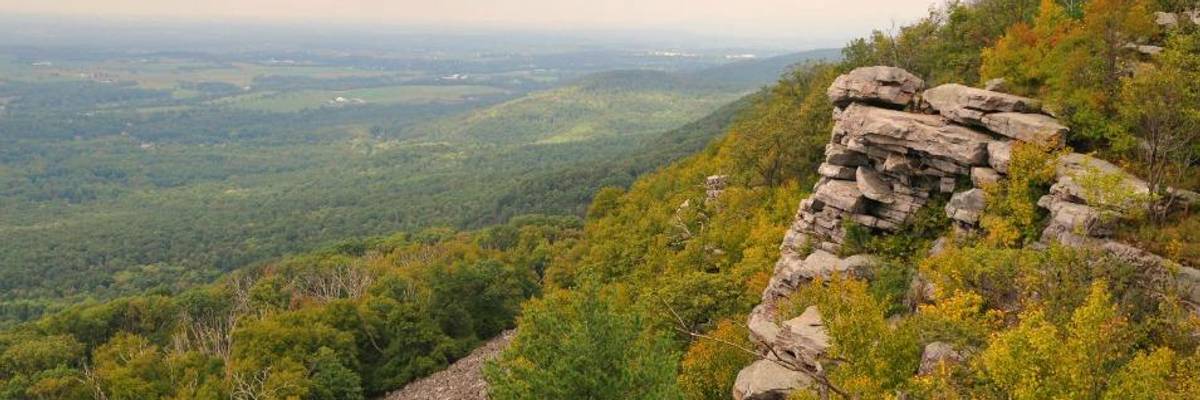
A federal appeals court threw out permits for a pipeline project that would have cut across the Appalachian Trail and two national forests. (Photo: Jerry Edmundson/Flickr/cc)
A federal appeals court rebuked the U.S. Forest Service (USFS) for allowing an energy corporation to move ahead with its plan to build a pipeline that would cut across two national forests and the Appalachian Trail--arguing that the agency put two energy companies' profits ahead of its own stated mission of protecting the nation's forests.
The three judges on the 4th Circuit Court of Appeals threw out the company's permit to build its 600-mile Atlantic Coast Pipeline in its planned area, starting in West Virginia and crossing through Virginia before terminating in North Carolina. As proposed, the $7 billion pipeline would have cut across the George Washington and Monongahela national forests as well as the historic trail, damaging the habitats of at least four endangered species.
Quoting Dr. Seuss's popular 1971 children's book "The Lorax," the judges said the USFS had "abdicated its responsibility" by issuing the permit.
"We trust the United States Forest Service to 'speak for the trees, for the trees have no tongues,'" the court wrote in its opinion.
"The George Washington National Forest, Monongahela National Forest, and the Appalachian Trail are national treasures," said Patrick Hunter of the Southern Environmental Law Center (SELC), which brought the case to the appeals court, in a statement. "This pipeline is unnecessary and asking natural gas customers to pay developers to blast this boondoggle through our public lands only [adds] insult to injury."
The appeals court accused Dominion Energy and Duke Energy of rushing through the environmental review process required for permitting such projects--and the USFS of allowing the company to do so.
As the Washington Post reported, the companies provided the agency in December 2016 with two potential routes for the pipeline so the environmental impacts of each could be investigated. The two proposals cut across USFS property, but not land controlled by the National Park Service (NPS), and so did not require congressional approval.
Dominion and Duke also made the USFS aware of its strict deadline for gaining approval for the construction, and the USFS issued the permits in time for the company to stay on schedule.
"Dominion has used influence, money, and politics to bend the rules for the Atlantic Coast Pipeline, and that plan has backfired," Greg Buppert, a lawyer with the SELC, told the Post.
The court said that based on the chain of events, the decision to grant the permits appeared to be "pre-ordained" rather than subject to a serious environmental review.
The USFS's environmental concerns were "suddenly, and mysteriously, assuaged in time to meet a private pipeline company's deadlines," wrote the judges.
"The administration was far too eager to trade them away for a pipeline conceived to deliver profit to its developers, not gas to consumers," said Hunter.
Dear Common Dreams reader, It’s been nearly 30 years since I co-founded Common Dreams with my late wife, Lina Newhouser. We had the radical notion that journalism should serve the public good, not corporate profits. It was clear to us from the outset what it would take to build such a project. No paid advertisements. No corporate sponsors. No millionaire publisher telling us what to think or do. Many people said we wouldn't last a year, but we proved those doubters wrong. Together with a tremendous team of journalists and dedicated staff, we built an independent media outlet free from the constraints of profits and corporate control. Our mission has always been simple: To inform. To inspire. To ignite change for the common good. Building Common Dreams was not easy. Our survival was never guaranteed. When you take on the most powerful forces—Wall Street greed, fossil fuel industry destruction, Big Tech lobbyists, and uber-rich oligarchs who have spent billions upon billions rigging the economy and democracy in their favor—the only bulwark you have is supporters who believe in your work. But here’s the urgent message from me today. It's never been this bad out there. And it's never been this hard to keep us going. At the very moment Common Dreams is most needed, the threats we face are intensifying. We need your support now more than ever. We don't accept corporate advertising and never will. We don't have a paywall because we don't think people should be blocked from critical news based on their ability to pay. Everything we do is funded by the donations of readers like you. When everyone does the little they can afford, we are strong. But if that support retreats or dries up, so do we. Will you donate now to make sure Common Dreams not only survives but thrives? —Craig Brown, Co-founder |
A federal appeals court rebuked the U.S. Forest Service (USFS) for allowing an energy corporation to move ahead with its plan to build a pipeline that would cut across two national forests and the Appalachian Trail--arguing that the agency put two energy companies' profits ahead of its own stated mission of protecting the nation's forests.
The three judges on the 4th Circuit Court of Appeals threw out the company's permit to build its 600-mile Atlantic Coast Pipeline in its planned area, starting in West Virginia and crossing through Virginia before terminating in North Carolina. As proposed, the $7 billion pipeline would have cut across the George Washington and Monongahela national forests as well as the historic trail, damaging the habitats of at least four endangered species.
Quoting Dr. Seuss's popular 1971 children's book "The Lorax," the judges said the USFS had "abdicated its responsibility" by issuing the permit.
"We trust the United States Forest Service to 'speak for the trees, for the trees have no tongues,'" the court wrote in its opinion.
"The George Washington National Forest, Monongahela National Forest, and the Appalachian Trail are national treasures," said Patrick Hunter of the Southern Environmental Law Center (SELC), which brought the case to the appeals court, in a statement. "This pipeline is unnecessary and asking natural gas customers to pay developers to blast this boondoggle through our public lands only [adds] insult to injury."
The appeals court accused Dominion Energy and Duke Energy of rushing through the environmental review process required for permitting such projects--and the USFS of allowing the company to do so.
As the Washington Post reported, the companies provided the agency in December 2016 with two potential routes for the pipeline so the environmental impacts of each could be investigated. The two proposals cut across USFS property, but not land controlled by the National Park Service (NPS), and so did not require congressional approval.
Dominion and Duke also made the USFS aware of its strict deadline for gaining approval for the construction, and the USFS issued the permits in time for the company to stay on schedule.
"Dominion has used influence, money, and politics to bend the rules for the Atlantic Coast Pipeline, and that plan has backfired," Greg Buppert, a lawyer with the SELC, told the Post.
The court said that based on the chain of events, the decision to grant the permits appeared to be "pre-ordained" rather than subject to a serious environmental review.
The USFS's environmental concerns were "suddenly, and mysteriously, assuaged in time to meet a private pipeline company's deadlines," wrote the judges.
"The administration was far too eager to trade them away for a pipeline conceived to deliver profit to its developers, not gas to consumers," said Hunter.
A federal appeals court rebuked the U.S. Forest Service (USFS) for allowing an energy corporation to move ahead with its plan to build a pipeline that would cut across two national forests and the Appalachian Trail--arguing that the agency put two energy companies' profits ahead of its own stated mission of protecting the nation's forests.
The three judges on the 4th Circuit Court of Appeals threw out the company's permit to build its 600-mile Atlantic Coast Pipeline in its planned area, starting in West Virginia and crossing through Virginia before terminating in North Carolina. As proposed, the $7 billion pipeline would have cut across the George Washington and Monongahela national forests as well as the historic trail, damaging the habitats of at least four endangered species.
Quoting Dr. Seuss's popular 1971 children's book "The Lorax," the judges said the USFS had "abdicated its responsibility" by issuing the permit.
"We trust the United States Forest Service to 'speak for the trees, for the trees have no tongues,'" the court wrote in its opinion.
"The George Washington National Forest, Monongahela National Forest, and the Appalachian Trail are national treasures," said Patrick Hunter of the Southern Environmental Law Center (SELC), which brought the case to the appeals court, in a statement. "This pipeline is unnecessary and asking natural gas customers to pay developers to blast this boondoggle through our public lands only [adds] insult to injury."
The appeals court accused Dominion Energy and Duke Energy of rushing through the environmental review process required for permitting such projects--and the USFS of allowing the company to do so.
As the Washington Post reported, the companies provided the agency in December 2016 with two potential routes for the pipeline so the environmental impacts of each could be investigated. The two proposals cut across USFS property, but not land controlled by the National Park Service (NPS), and so did not require congressional approval.
Dominion and Duke also made the USFS aware of its strict deadline for gaining approval for the construction, and the USFS issued the permits in time for the company to stay on schedule.
"Dominion has used influence, money, and politics to bend the rules for the Atlantic Coast Pipeline, and that plan has backfired," Greg Buppert, a lawyer with the SELC, told the Post.
The court said that based on the chain of events, the decision to grant the permits appeared to be "pre-ordained" rather than subject to a serious environmental review.
The USFS's environmental concerns were "suddenly, and mysteriously, assuaged in time to meet a private pipeline company's deadlines," wrote the judges.
"The administration was far too eager to trade them away for a pipeline conceived to deliver profit to its developers, not gas to consumers," said Hunter.

