SUBSCRIBE TO OUR FREE NEWSLETTER
Daily news & progressive opinion—funded by the people, not the corporations—delivered straight to your inbox.
5
#000000
#FFFFFF
To donate by check, phone, or other method, see our More Ways to Give page.
Daily news & progressive opinion—funded by the people, not the corporations—delivered straight to your inbox.
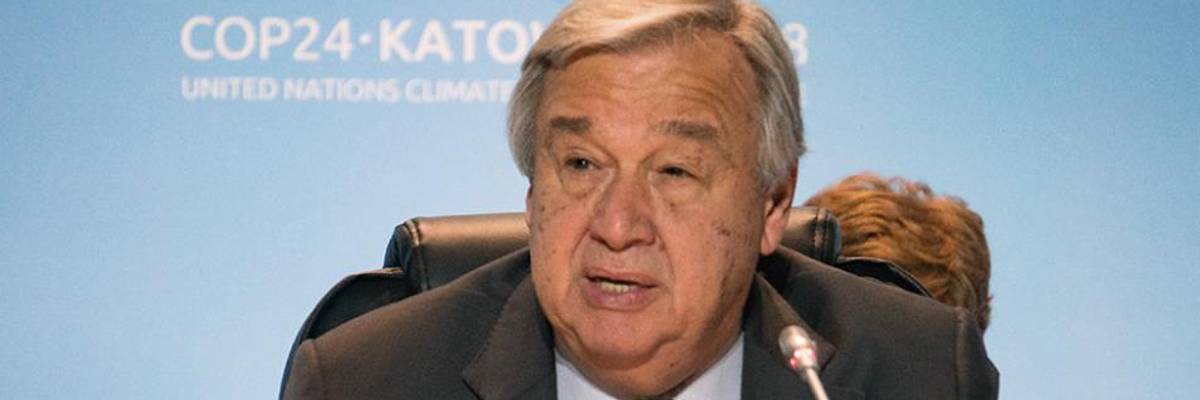
"This is the time for political compromises to be reached. This means sacrifices, but it will benefit us all collectively," U.N. Secretary-General Antonio Guterres said Wednesday. (Photo: James Dowson/UNFCCC Secretariat)
As people across the globe are rising up to demand bold climate action amid record-breaking levels of planet-warming emissions, "off the charts" rates of melting ice, and mounting concerns about extreme weather and declining biodiversity, U.N. Secretary-General Antonio Guterres on Wednesday warned world leaders of the consequences if the COP24 talks in Poland conclude without an ambitious plan for the future.
"To waste this opportunity in Katowice would compromise our last best chance to stop runaway climate change. It would not only be immoral, it would be suicidal."
--U.N. Secretary-General Antonio Guterres
"To waste this opportunity in Katowice would compromise our last best chance to stop runaway climate change," he declared. "It would not only be immoral, it would be suicidal."
"In my opening statement to this conference one week ago," Guterres said, "I warned that climate change is running faster than we are and that Katowice must--in no uncertain terms--be a success, as a necessary platform to reverse this trend."
Since then, parties to the Paris agreement--supported by every nation on Earth except the United States, after President Donald Trump announced last year that he plans to withdraw from it--have engaged in negotiations on how to reach the accord's goals to curb global warming. But with the summit slated to end Friday, as Guterres noted, "key political issues remain unresolved."
Sticking points include how to set rules for industrialized versus developing nations; which scientific findings to rely on; how to track emissions levels in a way that ensures accountability; and how to reach the financial goal of the Paris agreement, to mobilize $100 billion to address the climate crisis each year beginning in 2020.
Following reports on Tuesday that negotiators were working behind closed doors in hopes of resolving persistent disagreements over what the Paris accord's official rulebook should look like, Poland on Wednesday began circulating "a condensed draft text...running to about 100 pages, down from about 300 at the start of the talks," according to the Associated Press.
In an interview with the AP, Greenpeace International executive director Jennifer Morgan, who is in Katowice for the summit, raised concerns that some of the current draft's provisions don't go nearly far enough in terms of holding the world's worst polluters accountable for their greenhouse gas emissions.
"One proposal is that every country can pick to count it however they want to," she said. "There's no scientific integrity in that."
Adding to the tension, some nations that export fossil fuels have stymied progress at the event. Although the Trump administration's pro-coal side panel earlier this week was met with laughter by climate campaigners and experts, the United States also has joined with Russia, Saudi Arabia, and Kuwait in an effort to water down worldwide support for a key U.N. climate study published in October.
"This is the time for political compromises to be reached. This means sacrifices, but it will benefit us all collectively."
--Guterres
In light of these barriers, Guterres called on participants to resolve their differences and find "the political will to move forward" with the draft before COP24 ends.
"Over the last 10 days... many of you have worked long, hard hours and I want to acknowledge your efforts. But we need to accelerate those efforts to reach consensus if we want to follow-up on the commitments made in Paris," he told participants. "This is the time for political compromises to be reached. This means sacrifices, but it will benefit us all collectively."
"I do not want my granddaughters or anybody else's to suffer the consequences of our failures," he concluded. "They would not forgive us if uncontrolled and spiraling climate change would be our legacy to them."
Dear Common Dreams reader, It’s been nearly 30 years since I co-founded Common Dreams with my late wife, Lina Newhouser. We had the radical notion that journalism should serve the public good, not corporate profits. It was clear to us from the outset what it would take to build such a project. No paid advertisements. No corporate sponsors. No millionaire publisher telling us what to think or do. Many people said we wouldn't last a year, but we proved those doubters wrong. Together with a tremendous team of journalists and dedicated staff, we built an independent media outlet free from the constraints of profits and corporate control. Our mission has always been simple: To inform. To inspire. To ignite change for the common good. Building Common Dreams was not easy. Our survival was never guaranteed. When you take on the most powerful forces—Wall Street greed, fossil fuel industry destruction, Big Tech lobbyists, and uber-rich oligarchs who have spent billions upon billions rigging the economy and democracy in their favor—the only bulwark you have is supporters who believe in your work. But here’s the urgent message from me today. It's never been this bad out there. And it's never been this hard to keep us going. At the very moment Common Dreams is most needed, the threats we face are intensifying. We need your support now more than ever. We don't accept corporate advertising and never will. We don't have a paywall because we don't think people should be blocked from critical news based on their ability to pay. Everything we do is funded by the donations of readers like you. When everyone does the little they can afford, we are strong. But if that support retreats or dries up, so do we. Will you donate now to make sure Common Dreams not only survives but thrives? —Craig Brown, Co-founder |
As people across the globe are rising up to demand bold climate action amid record-breaking levels of planet-warming emissions, "off the charts" rates of melting ice, and mounting concerns about extreme weather and declining biodiversity, U.N. Secretary-General Antonio Guterres on Wednesday warned world leaders of the consequences if the COP24 talks in Poland conclude without an ambitious plan for the future.
"To waste this opportunity in Katowice would compromise our last best chance to stop runaway climate change. It would not only be immoral, it would be suicidal."
--U.N. Secretary-General Antonio Guterres
"To waste this opportunity in Katowice would compromise our last best chance to stop runaway climate change," he declared. "It would not only be immoral, it would be suicidal."
"In my opening statement to this conference one week ago," Guterres said, "I warned that climate change is running faster than we are and that Katowice must--in no uncertain terms--be a success, as a necessary platform to reverse this trend."
Since then, parties to the Paris agreement--supported by every nation on Earth except the United States, after President Donald Trump announced last year that he plans to withdraw from it--have engaged in negotiations on how to reach the accord's goals to curb global warming. But with the summit slated to end Friday, as Guterres noted, "key political issues remain unresolved."
Sticking points include how to set rules for industrialized versus developing nations; which scientific findings to rely on; how to track emissions levels in a way that ensures accountability; and how to reach the financial goal of the Paris agreement, to mobilize $100 billion to address the climate crisis each year beginning in 2020.
Following reports on Tuesday that negotiators were working behind closed doors in hopes of resolving persistent disagreements over what the Paris accord's official rulebook should look like, Poland on Wednesday began circulating "a condensed draft text...running to about 100 pages, down from about 300 at the start of the talks," according to the Associated Press.
In an interview with the AP, Greenpeace International executive director Jennifer Morgan, who is in Katowice for the summit, raised concerns that some of the current draft's provisions don't go nearly far enough in terms of holding the world's worst polluters accountable for their greenhouse gas emissions.
"One proposal is that every country can pick to count it however they want to," she said. "There's no scientific integrity in that."
Adding to the tension, some nations that export fossil fuels have stymied progress at the event. Although the Trump administration's pro-coal side panel earlier this week was met with laughter by climate campaigners and experts, the United States also has joined with Russia, Saudi Arabia, and Kuwait in an effort to water down worldwide support for a key U.N. climate study published in October.
"This is the time for political compromises to be reached. This means sacrifices, but it will benefit us all collectively."
--Guterres
In light of these barriers, Guterres called on participants to resolve their differences and find "the political will to move forward" with the draft before COP24 ends.
"Over the last 10 days... many of you have worked long, hard hours and I want to acknowledge your efforts. But we need to accelerate those efforts to reach consensus if we want to follow-up on the commitments made in Paris," he told participants. "This is the time for political compromises to be reached. This means sacrifices, but it will benefit us all collectively."
"I do not want my granddaughters or anybody else's to suffer the consequences of our failures," he concluded. "They would not forgive us if uncontrolled and spiraling climate change would be our legacy to them."
As people across the globe are rising up to demand bold climate action amid record-breaking levels of planet-warming emissions, "off the charts" rates of melting ice, and mounting concerns about extreme weather and declining biodiversity, U.N. Secretary-General Antonio Guterres on Wednesday warned world leaders of the consequences if the COP24 talks in Poland conclude without an ambitious plan for the future.
"To waste this opportunity in Katowice would compromise our last best chance to stop runaway climate change. It would not only be immoral, it would be suicidal."
--U.N. Secretary-General Antonio Guterres
"To waste this opportunity in Katowice would compromise our last best chance to stop runaway climate change," he declared. "It would not only be immoral, it would be suicidal."
"In my opening statement to this conference one week ago," Guterres said, "I warned that climate change is running faster than we are and that Katowice must--in no uncertain terms--be a success, as a necessary platform to reverse this trend."
Since then, parties to the Paris agreement--supported by every nation on Earth except the United States, after President Donald Trump announced last year that he plans to withdraw from it--have engaged in negotiations on how to reach the accord's goals to curb global warming. But with the summit slated to end Friday, as Guterres noted, "key political issues remain unresolved."
Sticking points include how to set rules for industrialized versus developing nations; which scientific findings to rely on; how to track emissions levels in a way that ensures accountability; and how to reach the financial goal of the Paris agreement, to mobilize $100 billion to address the climate crisis each year beginning in 2020.
Following reports on Tuesday that negotiators were working behind closed doors in hopes of resolving persistent disagreements over what the Paris accord's official rulebook should look like, Poland on Wednesday began circulating "a condensed draft text...running to about 100 pages, down from about 300 at the start of the talks," according to the Associated Press.
In an interview with the AP, Greenpeace International executive director Jennifer Morgan, who is in Katowice for the summit, raised concerns that some of the current draft's provisions don't go nearly far enough in terms of holding the world's worst polluters accountable for their greenhouse gas emissions.
"One proposal is that every country can pick to count it however they want to," she said. "There's no scientific integrity in that."
Adding to the tension, some nations that export fossil fuels have stymied progress at the event. Although the Trump administration's pro-coal side panel earlier this week was met with laughter by climate campaigners and experts, the United States also has joined with Russia, Saudi Arabia, and Kuwait in an effort to water down worldwide support for a key U.N. climate study published in October.
"This is the time for political compromises to be reached. This means sacrifices, but it will benefit us all collectively."
--Guterres
In light of these barriers, Guterres called on participants to resolve their differences and find "the political will to move forward" with the draft before COP24 ends.
"Over the last 10 days... many of you have worked long, hard hours and I want to acknowledge your efforts. But we need to accelerate those efforts to reach consensus if we want to follow-up on the commitments made in Paris," he told participants. "This is the time for political compromises to be reached. This means sacrifices, but it will benefit us all collectively."
"I do not want my granddaughters or anybody else's to suffer the consequences of our failures," he concluded. "They would not forgive us if uncontrolled and spiraling climate change would be our legacy to them."