SUBSCRIBE TO OUR FREE NEWSLETTER
Daily news & progressive opinion—funded by the people, not the corporations—delivered straight to your inbox.
5
#000000
#FFFFFF
To donate by check, phone, or other method, see our More Ways to Give page.
Daily news & progressive opinion—funded by the people, not the corporations—delivered straight to your inbox.
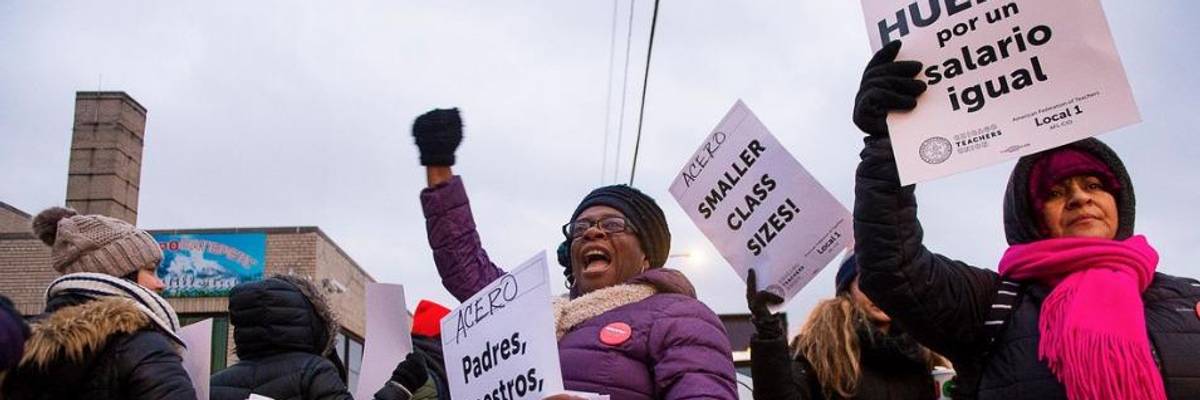
Teachers at 15 charter schools run by the Acero network in Chicago went on strike Tuesday after contract negotiations stalled. (Photo: @TylerLaRiviere/Twitter)
Days after learning that their charter school network's refusal to give cost-of-living raises comes amid a cash windfall for the organization, about 550 teachers and staff members from Chicago's Acero Charter Schools went on strike Tuesday, forming picket lines and demanding fair wages and resources in the country's first charter school walkout.
Classes were canceled for the network's 15 schools after contract negotiations, led by the Chicago Teachers Union (CTU), stalled just after midnight. Acero's teachers are demanding cost-of-living wages for paraprofessionals, reduced class sizes, and more special education teachers to support the network's 7,500 students.
Teachers and supporters held signs reading "I'd rather be teaching but this is important" and "On strike for a fair contract" in both English and Spanish, in picket lines outside their schools.
On Friday, Acero released an audit of its finances showing that in the midst of its stingy treatment of its teachers, it currently has $24 million in unrestricted cash on hand--$10 million more than it had at the end of 2017--and brought in $89 million in revenue this past year.
"Yet they remain unwilling to provide a penny more in compensation to paraprofessionals, their lowest wage workers," said Chris Geovanis, CTU's communications director, in a statement. "Management has also refused to move on a host of other critical issues that would improve the quality of education for students and reduce staff turnover rates, which are currently averaging over 30 percent in a two-year cycle."
The network spent $1 million less on staff and teacher salaries this year than it did in 2017, giving a small raise to educators which were found to be "paltry" and "laughable" according to the union, and giving no wage increases to paraprofessionals including teachers' aides, IT workers, and other staff.
"Our paraprofessionals are the backbone of our school communities," said 5th grade teacher Martha Baumgarten in a statement. "What they are 'offering' isn't an offer, it's a slap in the face."
American Federation of Teachers (AFT) president Randi Weingarten joined the strikers to offer support, reminding them of the teachers' strikes in several states earlier this year in which educators were able to secure salary increases, health insurance, and increased education funding.
"When the boss refuses to do what's right sometimes we have to do what's right ourselves," Weingarten said. "That's what you're doing...We would not do this right now unless we thought there was a pathway to winning. We are all here together just like in West Virginia, just like in Arizona, just like in Oklahoma, having everybody's back."
Teachers at Acero--where more than 90 percent of students and families are Latinx--are also calling for a contract that officially makes the schools sanctuary schools, extending teachers' lunch "hour" to 40 minutes, and cutting class sizes from 32 students per class, which educators say is both "outrageous and unsafe," especially for younger students.
"That's just way too many students to really give the best educational opportunity possible," Baumgarten told the Guardian. "That's 32 different personalities, different academic levels, different needs, and my school serves a high population of low income and immigrant families, so there are a lot of needs, everything from hunger to winter coats to unstable family and living situations."
CTU president Jesse Starkey pledged to continue the strike until Acero Schools agrees to use its vast resources to provide its employees with fair wages and the support they are demanding.
"We will be on the picket line until they come back with an offer that respects our students and the people who educate them," Starkey said.
Dear Common Dreams reader, It’s been nearly 30 years since I co-founded Common Dreams with my late wife, Lina Newhouser. We had the radical notion that journalism should serve the public good, not corporate profits. It was clear to us from the outset what it would take to build such a project. No paid advertisements. No corporate sponsors. No millionaire publisher telling us what to think or do. Many people said we wouldn't last a year, but we proved those doubters wrong. Together with a tremendous team of journalists and dedicated staff, we built an independent media outlet free from the constraints of profits and corporate control. Our mission has always been simple: To inform. To inspire. To ignite change for the common good. Building Common Dreams was not easy. Our survival was never guaranteed. When you take on the most powerful forces—Wall Street greed, fossil fuel industry destruction, Big Tech lobbyists, and uber-rich oligarchs who have spent billions upon billions rigging the economy and democracy in their favor—the only bulwark you have is supporters who believe in your work. But here’s the urgent message from me today. It's never been this bad out there. And it's never been this hard to keep us going. At the very moment Common Dreams is most needed, the threats we face are intensifying. We need your support now more than ever. We don't accept corporate advertising and never will. We don't have a paywall because we don't think people should be blocked from critical news based on their ability to pay. Everything we do is funded by the donations of readers like you. When everyone does the little they can afford, we are strong. But if that support retreats or dries up, so do we. Will you donate now to make sure Common Dreams not only survives but thrives? —Craig Brown, Co-founder |
Days after learning that their charter school network's refusal to give cost-of-living raises comes amid a cash windfall for the organization, about 550 teachers and staff members from Chicago's Acero Charter Schools went on strike Tuesday, forming picket lines and demanding fair wages and resources in the country's first charter school walkout.
Classes were canceled for the network's 15 schools after contract negotiations, led by the Chicago Teachers Union (CTU), stalled just after midnight. Acero's teachers are demanding cost-of-living wages for paraprofessionals, reduced class sizes, and more special education teachers to support the network's 7,500 students.
Teachers and supporters held signs reading "I'd rather be teaching but this is important" and "On strike for a fair contract" in both English and Spanish, in picket lines outside their schools.
On Friday, Acero released an audit of its finances showing that in the midst of its stingy treatment of its teachers, it currently has $24 million in unrestricted cash on hand--$10 million more than it had at the end of 2017--and brought in $89 million in revenue this past year.
"Yet they remain unwilling to provide a penny more in compensation to paraprofessionals, their lowest wage workers," said Chris Geovanis, CTU's communications director, in a statement. "Management has also refused to move on a host of other critical issues that would improve the quality of education for students and reduce staff turnover rates, which are currently averaging over 30 percent in a two-year cycle."
The network spent $1 million less on staff and teacher salaries this year than it did in 2017, giving a small raise to educators which were found to be "paltry" and "laughable" according to the union, and giving no wage increases to paraprofessionals including teachers' aides, IT workers, and other staff.
"Our paraprofessionals are the backbone of our school communities," said 5th grade teacher Martha Baumgarten in a statement. "What they are 'offering' isn't an offer, it's a slap in the face."
American Federation of Teachers (AFT) president Randi Weingarten joined the strikers to offer support, reminding them of the teachers' strikes in several states earlier this year in which educators were able to secure salary increases, health insurance, and increased education funding.
"When the boss refuses to do what's right sometimes we have to do what's right ourselves," Weingarten said. "That's what you're doing...We would not do this right now unless we thought there was a pathway to winning. We are all here together just like in West Virginia, just like in Arizona, just like in Oklahoma, having everybody's back."
Teachers at Acero--where more than 90 percent of students and families are Latinx--are also calling for a contract that officially makes the schools sanctuary schools, extending teachers' lunch "hour" to 40 minutes, and cutting class sizes from 32 students per class, which educators say is both "outrageous and unsafe," especially for younger students.
"That's just way too many students to really give the best educational opportunity possible," Baumgarten told the Guardian. "That's 32 different personalities, different academic levels, different needs, and my school serves a high population of low income and immigrant families, so there are a lot of needs, everything from hunger to winter coats to unstable family and living situations."
CTU president Jesse Starkey pledged to continue the strike until Acero Schools agrees to use its vast resources to provide its employees with fair wages and the support they are demanding.
"We will be on the picket line until they come back with an offer that respects our students and the people who educate them," Starkey said.
Days after learning that their charter school network's refusal to give cost-of-living raises comes amid a cash windfall for the organization, about 550 teachers and staff members from Chicago's Acero Charter Schools went on strike Tuesday, forming picket lines and demanding fair wages and resources in the country's first charter school walkout.
Classes were canceled for the network's 15 schools after contract negotiations, led by the Chicago Teachers Union (CTU), stalled just after midnight. Acero's teachers are demanding cost-of-living wages for paraprofessionals, reduced class sizes, and more special education teachers to support the network's 7,500 students.
Teachers and supporters held signs reading "I'd rather be teaching but this is important" and "On strike for a fair contract" in both English and Spanish, in picket lines outside their schools.
On Friday, Acero released an audit of its finances showing that in the midst of its stingy treatment of its teachers, it currently has $24 million in unrestricted cash on hand--$10 million more than it had at the end of 2017--and brought in $89 million in revenue this past year.
"Yet they remain unwilling to provide a penny more in compensation to paraprofessionals, their lowest wage workers," said Chris Geovanis, CTU's communications director, in a statement. "Management has also refused to move on a host of other critical issues that would improve the quality of education for students and reduce staff turnover rates, which are currently averaging over 30 percent in a two-year cycle."
The network spent $1 million less on staff and teacher salaries this year than it did in 2017, giving a small raise to educators which were found to be "paltry" and "laughable" according to the union, and giving no wage increases to paraprofessionals including teachers' aides, IT workers, and other staff.
"Our paraprofessionals are the backbone of our school communities," said 5th grade teacher Martha Baumgarten in a statement. "What they are 'offering' isn't an offer, it's a slap in the face."
American Federation of Teachers (AFT) president Randi Weingarten joined the strikers to offer support, reminding them of the teachers' strikes in several states earlier this year in which educators were able to secure salary increases, health insurance, and increased education funding.
"When the boss refuses to do what's right sometimes we have to do what's right ourselves," Weingarten said. "That's what you're doing...We would not do this right now unless we thought there was a pathway to winning. We are all here together just like in West Virginia, just like in Arizona, just like in Oklahoma, having everybody's back."
Teachers at Acero--where more than 90 percent of students and families are Latinx--are also calling for a contract that officially makes the schools sanctuary schools, extending teachers' lunch "hour" to 40 minutes, and cutting class sizes from 32 students per class, which educators say is both "outrageous and unsafe," especially for younger students.
"That's just way too many students to really give the best educational opportunity possible," Baumgarten told the Guardian. "That's 32 different personalities, different academic levels, different needs, and my school serves a high population of low income and immigrant families, so there are a lot of needs, everything from hunger to winter coats to unstable family and living situations."
CTU president Jesse Starkey pledged to continue the strike until Acero Schools agrees to use its vast resources to provide its employees with fair wages and the support they are demanding.
"We will be on the picket line until they come back with an offer that respects our students and the people who educate them," Starkey said.