SUBSCRIBE TO OUR FREE NEWSLETTER
Daily news & progressive opinion—funded by the people, not the corporations—delivered straight to your inbox.
5
#000000
#FFFFFF
To donate by check, phone, or other method, see our More Ways to Give page.
Daily news & progressive opinion—funded by the people, not the corporations—delivered straight to your inbox.
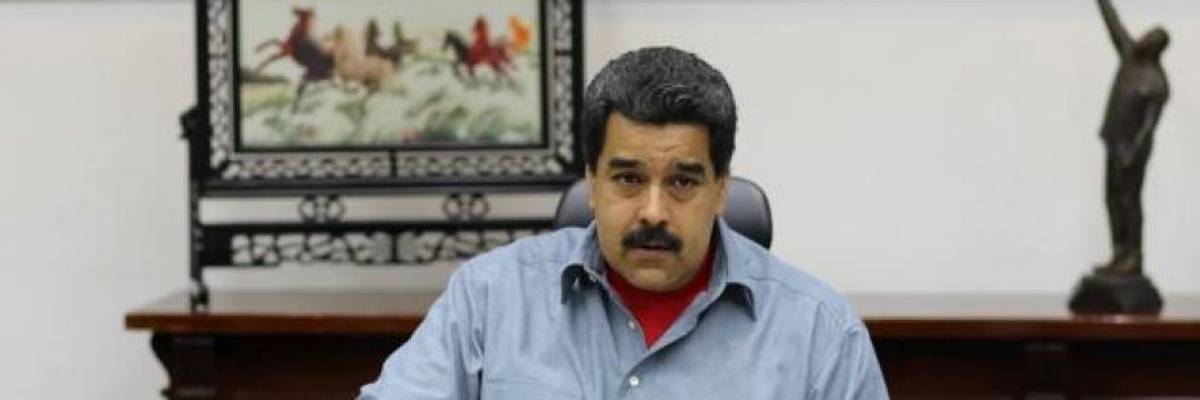
In 2016 Venezuela President Nicolas Maduro warned of plots from the U.S. and local right-wing groups to overthrow him. (Photo: Miraflores Palace/Reuters)
A day after suggesting that he could overthrow Venezuelan President Nicolas Maduro, President Donald Trump indicated that a meeting between the two leaders could be possible at the United Nations General Assembly (UNGA)--but didn't rule out military action.
"All options are on the table, every one," Trump told the press Wednesday. "The strong ones and the less than strong ones and you know what I mean by strong. Every option is on the table with respect to Venezuela."
The statement, doubling down on Trump's earlier threat that Venezuela "could be toppled very quickly by the military if the military decides to do that," was just the latest threat of violent action against a foreign country by the Trump administration, coming a day after the president's speech on Iran.
Venezuela's Foreign Minister Jorge Arreaza quickly denounced Trump's earlier threat as "grotesque."
"Of course, because it isn't his family that's going to die, it's easy for [Trump] to promote violence and the assassination of leaders in a country," Arreaza said.
Maduro arrived in New York for the potential meeting with Trump on Wednesday after initially saying he would not attend UNGA. His arrival and Trump's latest comments also came a day after the Trump administration announced it was imposing sanctions on Maduro's wife, vice president, and other close associates.
The sanctions were the result of accusations of corruption by Maduro's government. Venezuela has been the target of harsh criticism by Trump and his allies in recent months as conservatives have attempted to portray socialism as the cause of the country's hyperinflation and high level of poverty.
As a number of journalists have reported at Vox and Yahoo Finance, the cause of Venezuela's deterioriating economy was not the actions of Maduro's predecessor, Hugo Chavez, who took advantage of high oil prices to pay for strong public food subsidies and healthcare programs--but of plummeting oil production and Maduro's consolidation of power. Yahoo reported in May:
Venezuela's problems stem from corruption and egregious mismanagement, which can happen anywhere. Countries with socialist regimes such as China, Vietnam, Chile and many in Europe have managed to successfully grow their economies as Venezuela's has tumbled.
The Maduro government oversaw the nationalized oil sector and took over a number of other businesses while redirecting resources from private companies to some of the country's poorest citizens. The redistribution plan led to major reductions in poverty under former President Hugo Chavez, who remains very popular in the country.
But it buckled under Maduro when oil prices dropped and he began seizing more industries.
Trump said Wednesday that he was open to speaking with Maduro in the interest of getting Venezuela "straightened out," as of Wednesday afternoon, hours after Maduro's arrival in New York, White House reports indicated that Trump had not made good on his statement.
Dear Common Dreams reader, It’s been nearly 30 years since I co-founded Common Dreams with my late wife, Lina Newhouser. We had the radical notion that journalism should serve the public good, not corporate profits. It was clear to us from the outset what it would take to build such a project. No paid advertisements. No corporate sponsors. No millionaire publisher telling us what to think or do. Many people said we wouldn't last a year, but we proved those doubters wrong. Together with a tremendous team of journalists and dedicated staff, we built an independent media outlet free from the constraints of profits and corporate control. Our mission has always been simple: To inform. To inspire. To ignite change for the common good. Building Common Dreams was not easy. Our survival was never guaranteed. When you take on the most powerful forces—Wall Street greed, fossil fuel industry destruction, Big Tech lobbyists, and uber-rich oligarchs who have spent billions upon billions rigging the economy and democracy in their favor—the only bulwark you have is supporters who believe in your work. But here’s the urgent message from me today. It's never been this bad out there. And it's never been this hard to keep us going. At the very moment Common Dreams is most needed, the threats we face are intensifying. We need your support now more than ever. We don't accept corporate advertising and never will. We don't have a paywall because we don't think people should be blocked from critical news based on their ability to pay. Everything we do is funded by the donations of readers like you. When everyone does the little they can afford, we are strong. But if that support retreats or dries up, so do we. Will you donate now to make sure Common Dreams not only survives but thrives? —Craig Brown, Co-founder |
A day after suggesting that he could overthrow Venezuelan President Nicolas Maduro, President Donald Trump indicated that a meeting between the two leaders could be possible at the United Nations General Assembly (UNGA)--but didn't rule out military action.
"All options are on the table, every one," Trump told the press Wednesday. "The strong ones and the less than strong ones and you know what I mean by strong. Every option is on the table with respect to Venezuela."
The statement, doubling down on Trump's earlier threat that Venezuela "could be toppled very quickly by the military if the military decides to do that," was just the latest threat of violent action against a foreign country by the Trump administration, coming a day after the president's speech on Iran.
Venezuela's Foreign Minister Jorge Arreaza quickly denounced Trump's earlier threat as "grotesque."
"Of course, because it isn't his family that's going to die, it's easy for [Trump] to promote violence and the assassination of leaders in a country," Arreaza said.
Maduro arrived in New York for the potential meeting with Trump on Wednesday after initially saying he would not attend UNGA. His arrival and Trump's latest comments also came a day after the Trump administration announced it was imposing sanctions on Maduro's wife, vice president, and other close associates.
The sanctions were the result of accusations of corruption by Maduro's government. Venezuela has been the target of harsh criticism by Trump and his allies in recent months as conservatives have attempted to portray socialism as the cause of the country's hyperinflation and high level of poverty.
As a number of journalists have reported at Vox and Yahoo Finance, the cause of Venezuela's deterioriating economy was not the actions of Maduro's predecessor, Hugo Chavez, who took advantage of high oil prices to pay for strong public food subsidies and healthcare programs--but of plummeting oil production and Maduro's consolidation of power. Yahoo reported in May:
Venezuela's problems stem from corruption and egregious mismanagement, which can happen anywhere. Countries with socialist regimes such as China, Vietnam, Chile and many in Europe have managed to successfully grow their economies as Venezuela's has tumbled.
The Maduro government oversaw the nationalized oil sector and took over a number of other businesses while redirecting resources from private companies to some of the country's poorest citizens. The redistribution plan led to major reductions in poverty under former President Hugo Chavez, who remains very popular in the country.
But it buckled under Maduro when oil prices dropped and he began seizing more industries.
Trump said Wednesday that he was open to speaking with Maduro in the interest of getting Venezuela "straightened out," as of Wednesday afternoon, hours after Maduro's arrival in New York, White House reports indicated that Trump had not made good on his statement.
A day after suggesting that he could overthrow Venezuelan President Nicolas Maduro, President Donald Trump indicated that a meeting between the two leaders could be possible at the United Nations General Assembly (UNGA)--but didn't rule out military action.
"All options are on the table, every one," Trump told the press Wednesday. "The strong ones and the less than strong ones and you know what I mean by strong. Every option is on the table with respect to Venezuela."
The statement, doubling down on Trump's earlier threat that Venezuela "could be toppled very quickly by the military if the military decides to do that," was just the latest threat of violent action against a foreign country by the Trump administration, coming a day after the president's speech on Iran.
Venezuela's Foreign Minister Jorge Arreaza quickly denounced Trump's earlier threat as "grotesque."
"Of course, because it isn't his family that's going to die, it's easy for [Trump] to promote violence and the assassination of leaders in a country," Arreaza said.
Maduro arrived in New York for the potential meeting with Trump on Wednesday after initially saying he would not attend UNGA. His arrival and Trump's latest comments also came a day after the Trump administration announced it was imposing sanctions on Maduro's wife, vice president, and other close associates.
The sanctions were the result of accusations of corruption by Maduro's government. Venezuela has been the target of harsh criticism by Trump and his allies in recent months as conservatives have attempted to portray socialism as the cause of the country's hyperinflation and high level of poverty.
As a number of journalists have reported at Vox and Yahoo Finance, the cause of Venezuela's deterioriating economy was not the actions of Maduro's predecessor, Hugo Chavez, who took advantage of high oil prices to pay for strong public food subsidies and healthcare programs--but of plummeting oil production and Maduro's consolidation of power. Yahoo reported in May:
Venezuela's problems stem from corruption and egregious mismanagement, which can happen anywhere. Countries with socialist regimes such as China, Vietnam, Chile and many in Europe have managed to successfully grow their economies as Venezuela's has tumbled.
The Maduro government oversaw the nationalized oil sector and took over a number of other businesses while redirecting resources from private companies to some of the country's poorest citizens. The redistribution plan led to major reductions in poverty under former President Hugo Chavez, who remains very popular in the country.
But it buckled under Maduro when oil prices dropped and he began seizing more industries.
Trump said Wednesday that he was open to speaking with Maduro in the interest of getting Venezuela "straightened out," as of Wednesday afternoon, hours after Maduro's arrival in New York, White House reports indicated that Trump had not made good on his statement.