

SUBSCRIBE TO OUR FREE NEWSLETTER
Daily news & progressive opinion—funded by the people, not the corporations—delivered straight to your inbox.
5
#000000
#FFFFFF
To donate by check, phone, or other method, see our More Ways to Give page.
Daily news & progressive opinion—funded by the people, not the corporations—delivered straight to your inbox.
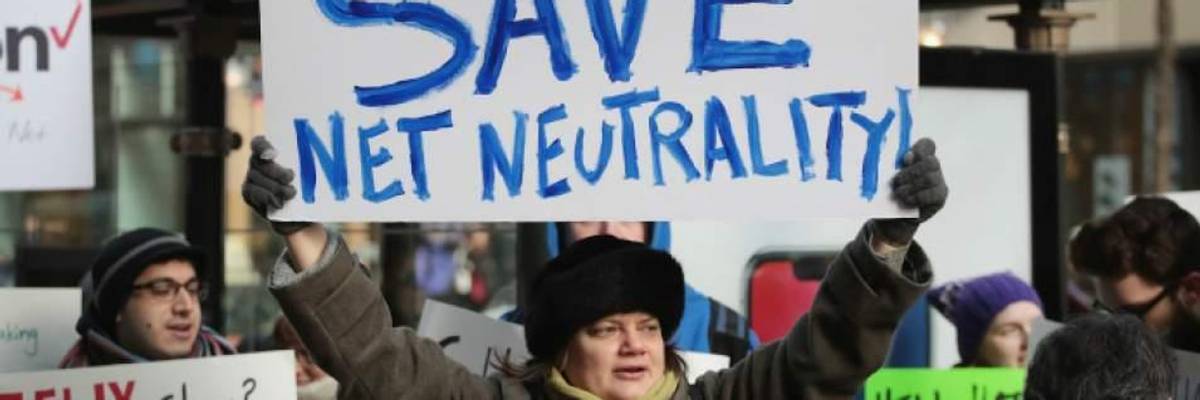
More than 100 Democratic lawmakers on Wednesday signed on to an amicus brief backing a lawsuit to restore net neutrality rules nationwide. (Photo: Scott Olson/Getty Images)
More than 100 Democrats in Congress, led by Sen. Ed Markey (Mass.) and Rep. Anna Eshoo (Calif.), are formally backing a federal lawsuit to restore net neutrality protections that the Republican-controlled Federal Communications Commission (FCC) repealed last year.
"Whether in the halls of Congress or the halls of the courts, the fight for net neutrality is the fight for our online future, and we will prevail."
--Sen. Ed Markey
A total of 27 U.S. senators and 76 members of the House of Representatives filed an amicus brief (pdf) with the D.C. Circuit Court of Appeals asserting that the repeal order amounted to "an abuse of discretion," and was "inconsistent with the plain language" of federal legislation that subjected internet service providers (ISPs) to Title II regulations.
"Both the plain language and congressional intent behind the Telecommunications Act of 1996 that Congresswoman Eshoo and I helped author make clear that today, broadband access to the internet is a telecommunications service," explained Markey, who also spearheaded a measure in Congress to restore the consumer protection rules.
Although net neutrality campaigners maintain that Markey's Congressional Review Act (CRA) resolution, which narrowly passed the Senate earlier this year, is the best way to reverse the FCC's order, so far the measure has only gained the support of one Republican in the House.
"Whether in the halls of Congress or the halls of the courts, the fight for net neutrality is the fight for our online future, and we will prevail," Markey optimistically declared Wednesday. He charged that FCC Chairman Ajit Pai and the Republican commissioners "are on the wrong side of history," and ignored the intent of the 1996 law when they "reclassified broadband back to an information service and eviscerated net neutrality rules."
The Telecommunications Act "was written to be technologically neutral and forward-looking," added Eshoo. "It was established that there would always be a cop on the beat to protect the public in communications, regardless of advances in technology."
Describing the internet as "one of the greatest inventions in human history," she emphasized that "it's our responsibility to protect it as a force to drive innovation, expand our economy, and promote free speech and our democracy."
Former FCC Commissioner Michael Copps, who now serves as a special adviser to Common Cause, praised the lawmakers' move on Twitter, concluding that their brief presents "powerful and irrefutable evidence" that repealing federal net neutrality rules was "abysmally wrong."
Common Cause joined with several other groups in filing a separate amicus brief on Tuesday. In a statement, Copps said that the now-rolled back rules had "established a framework that ensured the internet remained open for free speech, civic engagement, economic opportunity, and innovation."
Copps accused Pai's FCC of illegally "creating a wild west where ISPs are free to block, throttle, or create fast lanes and slow lanes," and warned that this "direct attack on our democracy...will lead to the 'cable-ization' of the internet--where internet service providers can control what we do, what we see, and where we go online."
Net neutrality activists and federal lawmakers aren't alone in their fight to restore consumer protections. In a tweet announcing the lawmakers' brief, Markey acknowledged states' efforts to pass net neutrality laws in the absence of federal rules. The California Assembly is expected to vote on what advocates have called the "gold standard" of state-level legislation as early as Wednesday afternoon.
Dear Common Dreams reader, It’s been nearly 30 years since I co-founded Common Dreams with my late wife, Lina Newhouser. We had the radical notion that journalism should serve the public good, not corporate profits. It was clear to us from the outset what it would take to build such a project. No paid advertisements. No corporate sponsors. No millionaire publisher telling us what to think or do. Many people said we wouldn't last a year, but we proved those doubters wrong. Together with a tremendous team of journalists and dedicated staff, we built an independent media outlet free from the constraints of profits and corporate control. Our mission has always been simple: To inform. To inspire. To ignite change for the common good. Building Common Dreams was not easy. Our survival was never guaranteed. When you take on the most powerful forces—Wall Street greed, fossil fuel industry destruction, Big Tech lobbyists, and uber-rich oligarchs who have spent billions upon billions rigging the economy and democracy in their favor—the only bulwark you have is supporters who believe in your work. But here’s the urgent message from me today. It's never been this bad out there. And it's never been this hard to keep us going. At the very moment Common Dreams is most needed, the threats we face are intensifying. We need your support now more than ever. We don't accept corporate advertising and never will. We don't have a paywall because we don't think people should be blocked from critical news based on their ability to pay. Everything we do is funded by the donations of readers like you. When everyone does the little they can afford, we are strong. But if that support retreats or dries up, so do we. Will you donate now to make sure Common Dreams not only survives but thrives? —Craig Brown, Co-founder |
More than 100 Democrats in Congress, led by Sen. Ed Markey (Mass.) and Rep. Anna Eshoo (Calif.), are formally backing a federal lawsuit to restore net neutrality protections that the Republican-controlled Federal Communications Commission (FCC) repealed last year.
"Whether in the halls of Congress or the halls of the courts, the fight for net neutrality is the fight for our online future, and we will prevail."
--Sen. Ed Markey
A total of 27 U.S. senators and 76 members of the House of Representatives filed an amicus brief (pdf) with the D.C. Circuit Court of Appeals asserting that the repeal order amounted to "an abuse of discretion," and was "inconsistent with the plain language" of federal legislation that subjected internet service providers (ISPs) to Title II regulations.
"Both the plain language and congressional intent behind the Telecommunications Act of 1996 that Congresswoman Eshoo and I helped author make clear that today, broadband access to the internet is a telecommunications service," explained Markey, who also spearheaded a measure in Congress to restore the consumer protection rules.
Although net neutrality campaigners maintain that Markey's Congressional Review Act (CRA) resolution, which narrowly passed the Senate earlier this year, is the best way to reverse the FCC's order, so far the measure has only gained the support of one Republican in the House.
"Whether in the halls of Congress or the halls of the courts, the fight for net neutrality is the fight for our online future, and we will prevail," Markey optimistically declared Wednesday. He charged that FCC Chairman Ajit Pai and the Republican commissioners "are on the wrong side of history," and ignored the intent of the 1996 law when they "reclassified broadband back to an information service and eviscerated net neutrality rules."
The Telecommunications Act "was written to be technologically neutral and forward-looking," added Eshoo. "It was established that there would always be a cop on the beat to protect the public in communications, regardless of advances in technology."
Describing the internet as "one of the greatest inventions in human history," she emphasized that "it's our responsibility to protect it as a force to drive innovation, expand our economy, and promote free speech and our democracy."
Former FCC Commissioner Michael Copps, who now serves as a special adviser to Common Cause, praised the lawmakers' move on Twitter, concluding that their brief presents "powerful and irrefutable evidence" that repealing federal net neutrality rules was "abysmally wrong."
Common Cause joined with several other groups in filing a separate amicus brief on Tuesday. In a statement, Copps said that the now-rolled back rules had "established a framework that ensured the internet remained open for free speech, civic engagement, economic opportunity, and innovation."
Copps accused Pai's FCC of illegally "creating a wild west where ISPs are free to block, throttle, or create fast lanes and slow lanes," and warned that this "direct attack on our democracy...will lead to the 'cable-ization' of the internet--where internet service providers can control what we do, what we see, and where we go online."
Net neutrality activists and federal lawmakers aren't alone in their fight to restore consumer protections. In a tweet announcing the lawmakers' brief, Markey acknowledged states' efforts to pass net neutrality laws in the absence of federal rules. The California Assembly is expected to vote on what advocates have called the "gold standard" of state-level legislation as early as Wednesday afternoon.
More than 100 Democrats in Congress, led by Sen. Ed Markey (Mass.) and Rep. Anna Eshoo (Calif.), are formally backing a federal lawsuit to restore net neutrality protections that the Republican-controlled Federal Communications Commission (FCC) repealed last year.
"Whether in the halls of Congress or the halls of the courts, the fight for net neutrality is the fight for our online future, and we will prevail."
--Sen. Ed Markey
A total of 27 U.S. senators and 76 members of the House of Representatives filed an amicus brief (pdf) with the D.C. Circuit Court of Appeals asserting that the repeal order amounted to "an abuse of discretion," and was "inconsistent with the plain language" of federal legislation that subjected internet service providers (ISPs) to Title II regulations.
"Both the plain language and congressional intent behind the Telecommunications Act of 1996 that Congresswoman Eshoo and I helped author make clear that today, broadband access to the internet is a telecommunications service," explained Markey, who also spearheaded a measure in Congress to restore the consumer protection rules.
Although net neutrality campaigners maintain that Markey's Congressional Review Act (CRA) resolution, which narrowly passed the Senate earlier this year, is the best way to reverse the FCC's order, so far the measure has only gained the support of one Republican in the House.
"Whether in the halls of Congress or the halls of the courts, the fight for net neutrality is the fight for our online future, and we will prevail," Markey optimistically declared Wednesday. He charged that FCC Chairman Ajit Pai and the Republican commissioners "are on the wrong side of history," and ignored the intent of the 1996 law when they "reclassified broadband back to an information service and eviscerated net neutrality rules."
The Telecommunications Act "was written to be technologically neutral and forward-looking," added Eshoo. "It was established that there would always be a cop on the beat to protect the public in communications, regardless of advances in technology."
Describing the internet as "one of the greatest inventions in human history," she emphasized that "it's our responsibility to protect it as a force to drive innovation, expand our economy, and promote free speech and our democracy."
Former FCC Commissioner Michael Copps, who now serves as a special adviser to Common Cause, praised the lawmakers' move on Twitter, concluding that their brief presents "powerful and irrefutable evidence" that repealing federal net neutrality rules was "abysmally wrong."
Common Cause joined with several other groups in filing a separate amicus brief on Tuesday. In a statement, Copps said that the now-rolled back rules had "established a framework that ensured the internet remained open for free speech, civic engagement, economic opportunity, and innovation."
Copps accused Pai's FCC of illegally "creating a wild west where ISPs are free to block, throttle, or create fast lanes and slow lanes," and warned that this "direct attack on our democracy...will lead to the 'cable-ization' of the internet--where internet service providers can control what we do, what we see, and where we go online."
Net neutrality activists and federal lawmakers aren't alone in their fight to restore consumer protections. In a tweet announcing the lawmakers' brief, Markey acknowledged states' efforts to pass net neutrality laws in the absence of federal rules. The California Assembly is expected to vote on what advocates have called the "gold standard" of state-level legislation as early as Wednesday afternoon.

