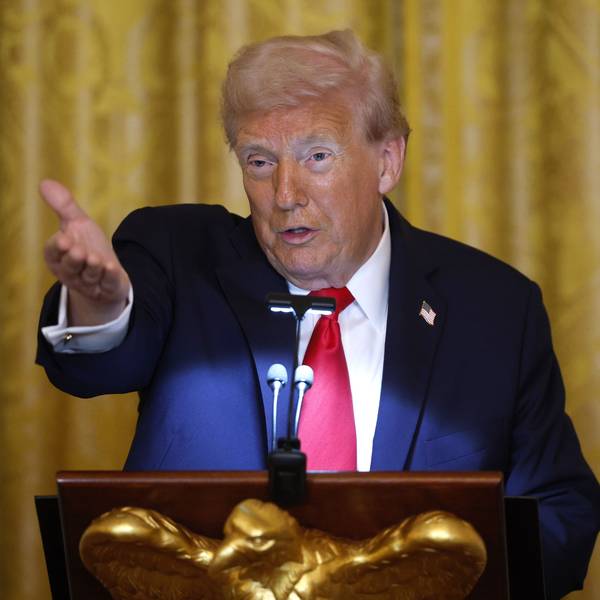

JP Morgan Chase CEO Jamie Dimon is among the corporate executives who have met with President Donald Trump since last year's violence in Charlottesville, Virginia--even after he spoke out against Trump's comments on the incident. (Photo: Chip Somodevilla/Getty Images)
Despite Frequent Lip Service to Anti-Trump Resistance, Corporate Executives Continue Cozy Relationship with President
"Corporate executives have demonstrated that they distanced themselves from the president just for show."
Business leaders have attempted to appease the public numerous times since President Donald Trump took office in 2017--distancing themselves from Trump's statements, speaking out in favor of immigrants' rights, and even leaving his business advisory councils.
But a new report by the consumer advocacy group Public Citizen shows the limits of corporate executives' attempts to save face by publicly pushing back against Trump's racist and unpopular policies and remarks--especially when privately, they continue to associate with the president.
"The corporate class's continued coziness with the president, despite their condemnations, betrays their cowardice." --Rick Claypool, Public Citizen
"Corporate executives strongly condemned the president's bigoted comments on the violence in Charlottesville, Virginia last year, but since then, more than 100 corporate leaders from 91 businesses have flocked to the president's side," the group said.
The president claimed he'd decided to disband his Strategy and Policy Forum and Manufacturing Council last summer, after his insistence that a deadly confrontation between white supremacists and anti-racist counter-protesters had "very bad people" on "both sides" caused nationwide outrage and resulted in numerous business leaders leaving the panels.
But Trump has had more than 100 meetings with corproate executives just in the year since the Charlottesville protests--compared with 100 corporate meetings President Barack Obama had in his first seven years in the White House--even as his relations with the business community have had strained moments.
Jamie Dimon, CEO of JP Morgan Chase; Alex Gorsky, CEO of Johnson & Johnson; and Tim Cook, CEO of Apple, all spoke out against Trump's comments, but have met with him since Charlottesville.
Boeing and General Motors also released statements after Trump disbanded the councils--but Boeing CEO Kevin McAllister met with the president just two months later, while General Motors chief Mary Barra met with him this past spring.
"The corporate class's continued coziness with the president, despite their condemnations, betrays their cowardice," said Rick Claypool, a Public Citizen research director, in a statement. "Corporate executives have demonstrated that they distanced themselves from the president just for show."
Including meetings Trump took with corporate executives before the incident in Charlottesville last year, the president has had a total of 502 corporate meetings since taking office--which have occurred alongside his promotion of the $1.5 trillion Republican tax law, which cut the corporate tax rate from 35 to 21 percent, and the rollback of environmental regulatory reforms for the fossil fuel industry.
We are at a crossroads
This country and this world are at a monumental crossroads. US voters have an opportunity to beat back the forces of fascism and confront the billionaires who are rigging the economy, our media system, and our democracy, making it increasingly impossible for ordinary people to get by. We’re not just talking about the election. We’re talking about what must be done once these fascist elements are vanquished from power. We need a bolder set of solutions than what either major party has so far been willing to offer and a working-class movement ready to fight like hell for it. Trump didn't emerge from nowhere. The conditions that fueled MAGA authoritarianism were created by decades of radical neoliberal economic policies and a corrupt political system dominated by corporate interests. They slashed taxes on the super-rich, promising that the benefits would trickle down. They said giveaways to the corporate titans would make life more affordable for the rest of us. It was all bullshit. And when a bitter, betrayed populace searches for someone to blame, right-wing demagogues have little trouble finding scapegoats. People know when they're being lied to, but you won't hear any of this from the corporate media. Only independent journalism—powered and funded by people who believe in building a better world—can deliver truly trustworthy daily news. Our Fall Campaign is underway, and we need your help. To power our newsroom through the rest of the year, we need to raise $125,000 by midnight on October 31. So if you share our vision, please contribute whatever you can to sustain our work. |
Business leaders have attempted to appease the public numerous times since President Donald Trump took office in 2017--distancing themselves from Trump's statements, speaking out in favor of immigrants' rights, and even leaving his business advisory councils.
But a new report by the consumer advocacy group Public Citizen shows the limits of corporate executives' attempts to save face by publicly pushing back against Trump's racist and unpopular policies and remarks--especially when privately, they continue to associate with the president.
"The corporate class's continued coziness with the president, despite their condemnations, betrays their cowardice." --Rick Claypool, Public Citizen
"Corporate executives strongly condemned the president's bigoted comments on the violence in Charlottesville, Virginia last year, but since then, more than 100 corporate leaders from 91 businesses have flocked to the president's side," the group said.
The president claimed he'd decided to disband his Strategy and Policy Forum and Manufacturing Council last summer, after his insistence that a deadly confrontation between white supremacists and anti-racist counter-protesters had "very bad people" on "both sides" caused nationwide outrage and resulted in numerous business leaders leaving the panels.
But Trump has had more than 100 meetings with corproate executives just in the year since the Charlottesville protests--compared with 100 corporate meetings President Barack Obama had in his first seven years in the White House--even as his relations with the business community have had strained moments.
Jamie Dimon, CEO of JP Morgan Chase; Alex Gorsky, CEO of Johnson & Johnson; and Tim Cook, CEO of Apple, all spoke out against Trump's comments, but have met with him since Charlottesville.
Boeing and General Motors also released statements after Trump disbanded the councils--but Boeing CEO Kevin McAllister met with the president just two months later, while General Motors chief Mary Barra met with him this past spring.
"The corporate class's continued coziness with the president, despite their condemnations, betrays their cowardice," said Rick Claypool, a Public Citizen research director, in a statement. "Corporate executives have demonstrated that they distanced themselves from the president just for show."
Including meetings Trump took with corporate executives before the incident in Charlottesville last year, the president has had a total of 502 corporate meetings since taking office--which have occurred alongside his promotion of the $1.5 trillion Republican tax law, which cut the corporate tax rate from 35 to 21 percent, and the rollback of environmental regulatory reforms for the fossil fuel industry.