SUBSCRIBE TO OUR FREE NEWSLETTER
Daily news & progressive opinion—funded by the people, not the corporations—delivered straight to your inbox.
5
#000000
#FFFFFF
To donate by check, phone, or other method, see our More Ways to Give page.
Daily news & progressive opinion—funded by the people, not the corporations—delivered straight to your inbox.
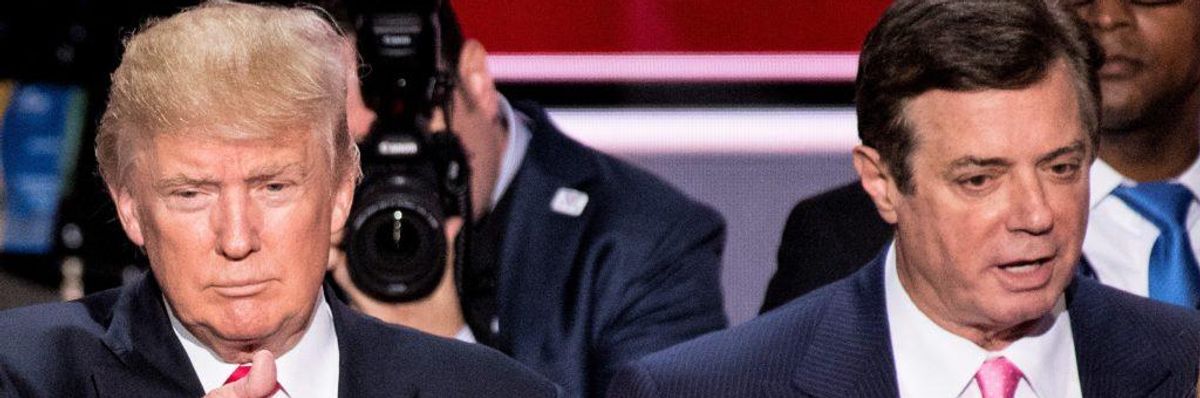
Then candidate Donald Trump standing next to his then campaign chairman Paul Manafort during the 2016 Republican National Convention. On Tuesday, Manafort was found guilty of 8 charges on tax and bank fraud. (Photo: Bill Clark/Getty Images)
After a jury returned guilty verdicts against Paul Manafort on eight counts stemming from the probe by Special Counsel Robert Mueller on Tuesday afternoon, the immediate question for many was whether the president will take the provocative step of pardoning his former campaign chairman.
According to NBC News, the federal jury in Virginia found Manafort guilty on "eight counts involving bank and tax fraud" though "no verdicts could be reached on the 10 other charges he faced."
To put it mildly, with his former personal attorney Michael Cohen also pleading guilty in a New York court room, it is not a good day for President Trump.
But even as the breaking news of the developments was blinking red on television screens and smartphones nationwide, the question about whether Trump might possibly pardon Manafort was quick to surface.
In the wake of Manafort's guilty verdicts, Sen. Mark Warner (D-Va.), vice chairman of the Senate Intelligence Committee, said that any attempt by Trump to pardon Manafort "would be a gross abuse of power," one that would require immediate congressional response.
As they have previously, progressives groups announced that any move by Trump to undermine the rule of law or thwart the Mueller probe would result in massive street protests:
Just last Friday, Trump told reporters that it was "very sad" what was happening to Manafort, who the president called a "very good person."
A statement issued by legal experts at Citizens for Responsibility and Ethics in Washington (CREW) over the weekend, Trump's exposure will not easily be solved--and could easily by made worse--with his pardon powers. According to CREW, which also published this legal paper on the issue earlier this year, there are serious barriers to trying to pardon Manafort, Cohen, or anyone within his close orbit who find themselves entangled in legal troubles.
"Such a pardon strategy, however tempting it might appear to the president, is fatally flawed," CREW warned. "There are two simple reasons for that. First, receiving a federal pardon will not protect key defendants from exposure to state criminal prosecution (as well as state and federal civil liability). In addition, granting a pardon with corrupt intent or for the purpose of interfering or preventing witness testimony could well expose President Trump to impeachment and personal criminal liability for obstruction of justice or bribery. In other words, pardoning key defendants will only complicate, not resolve, President Trump's legal predicaments."
Dear Common Dreams reader, It’s been nearly 30 years since I co-founded Common Dreams with my late wife, Lina Newhouser. We had the radical notion that journalism should serve the public good, not corporate profits. It was clear to us from the outset what it would take to build such a project. No paid advertisements. No corporate sponsors. No millionaire publisher telling us what to think or do. Many people said we wouldn't last a year, but we proved those doubters wrong. Together with a tremendous team of journalists and dedicated staff, we built an independent media outlet free from the constraints of profits and corporate control. Our mission has always been simple: To inform. To inspire. To ignite change for the common good. Building Common Dreams was not easy. Our survival was never guaranteed. When you take on the most powerful forces—Wall Street greed, fossil fuel industry destruction, Big Tech lobbyists, and uber-rich oligarchs who have spent billions upon billions rigging the economy and democracy in their favor—the only bulwark you have is supporters who believe in your work. But here’s the urgent message from me today. It's never been this bad out there. And it's never been this hard to keep us going. At the very moment Common Dreams is most needed, the threats we face are intensifying. We need your support now more than ever. We don't accept corporate advertising and never will. We don't have a paywall because we don't think people should be blocked from critical news based on their ability to pay. Everything we do is funded by the donations of readers like you. When everyone does the little they can afford, we are strong. But if that support retreats or dries up, so do we. Will you donate now to make sure Common Dreams not only survives but thrives? —Craig Brown, Co-founder |
After a jury returned guilty verdicts against Paul Manafort on eight counts stemming from the probe by Special Counsel Robert Mueller on Tuesday afternoon, the immediate question for many was whether the president will take the provocative step of pardoning his former campaign chairman.
According to NBC News, the federal jury in Virginia found Manafort guilty on "eight counts involving bank and tax fraud" though "no verdicts could be reached on the 10 other charges he faced."
To put it mildly, with his former personal attorney Michael Cohen also pleading guilty in a New York court room, it is not a good day for President Trump.
But even as the breaking news of the developments was blinking red on television screens and smartphones nationwide, the question about whether Trump might possibly pardon Manafort was quick to surface.
In the wake of Manafort's guilty verdicts, Sen. Mark Warner (D-Va.), vice chairman of the Senate Intelligence Committee, said that any attempt by Trump to pardon Manafort "would be a gross abuse of power," one that would require immediate congressional response.
As they have previously, progressives groups announced that any move by Trump to undermine the rule of law or thwart the Mueller probe would result in massive street protests:
Just last Friday, Trump told reporters that it was "very sad" what was happening to Manafort, who the president called a "very good person."
A statement issued by legal experts at Citizens for Responsibility and Ethics in Washington (CREW) over the weekend, Trump's exposure will not easily be solved--and could easily by made worse--with his pardon powers. According to CREW, which also published this legal paper on the issue earlier this year, there are serious barriers to trying to pardon Manafort, Cohen, or anyone within his close orbit who find themselves entangled in legal troubles.
"Such a pardon strategy, however tempting it might appear to the president, is fatally flawed," CREW warned. "There are two simple reasons for that. First, receiving a federal pardon will not protect key defendants from exposure to state criminal prosecution (as well as state and federal civil liability). In addition, granting a pardon with corrupt intent or for the purpose of interfering or preventing witness testimony could well expose President Trump to impeachment and personal criminal liability for obstruction of justice or bribery. In other words, pardoning key defendants will only complicate, not resolve, President Trump's legal predicaments."
After a jury returned guilty verdicts against Paul Manafort on eight counts stemming from the probe by Special Counsel Robert Mueller on Tuesday afternoon, the immediate question for many was whether the president will take the provocative step of pardoning his former campaign chairman.
According to NBC News, the federal jury in Virginia found Manafort guilty on "eight counts involving bank and tax fraud" though "no verdicts could be reached on the 10 other charges he faced."
To put it mildly, with his former personal attorney Michael Cohen also pleading guilty in a New York court room, it is not a good day for President Trump.
But even as the breaking news of the developments was blinking red on television screens and smartphones nationwide, the question about whether Trump might possibly pardon Manafort was quick to surface.
In the wake of Manafort's guilty verdicts, Sen. Mark Warner (D-Va.), vice chairman of the Senate Intelligence Committee, said that any attempt by Trump to pardon Manafort "would be a gross abuse of power," one that would require immediate congressional response.
As they have previously, progressives groups announced that any move by Trump to undermine the rule of law or thwart the Mueller probe would result in massive street protests:
Just last Friday, Trump told reporters that it was "very sad" what was happening to Manafort, who the president called a "very good person."
A statement issued by legal experts at Citizens for Responsibility and Ethics in Washington (CREW) over the weekend, Trump's exposure will not easily be solved--and could easily by made worse--with his pardon powers. According to CREW, which also published this legal paper on the issue earlier this year, there are serious barriers to trying to pardon Manafort, Cohen, or anyone within his close orbit who find themselves entangled in legal troubles.
"Such a pardon strategy, however tempting it might appear to the president, is fatally flawed," CREW warned. "There are two simple reasons for that. First, receiving a federal pardon will not protect key defendants from exposure to state criminal prosecution (as well as state and federal civil liability). In addition, granting a pardon with corrupt intent or for the purpose of interfering or preventing witness testimony could well expose President Trump to impeachment and personal criminal liability for obstruction of justice or bribery. In other words, pardoning key defendants will only complicate, not resolve, President Trump's legal predicaments."