SUBSCRIBE TO OUR FREE NEWSLETTER
Daily news & progressive opinion—funded by the people, not the corporations—delivered straight to your inbox.
5
#000000
#FFFFFF
To donate by check, phone, or other method, see our More Ways to Give page.
Daily news & progressive opinion—funded by the people, not the corporations—delivered straight to your inbox.
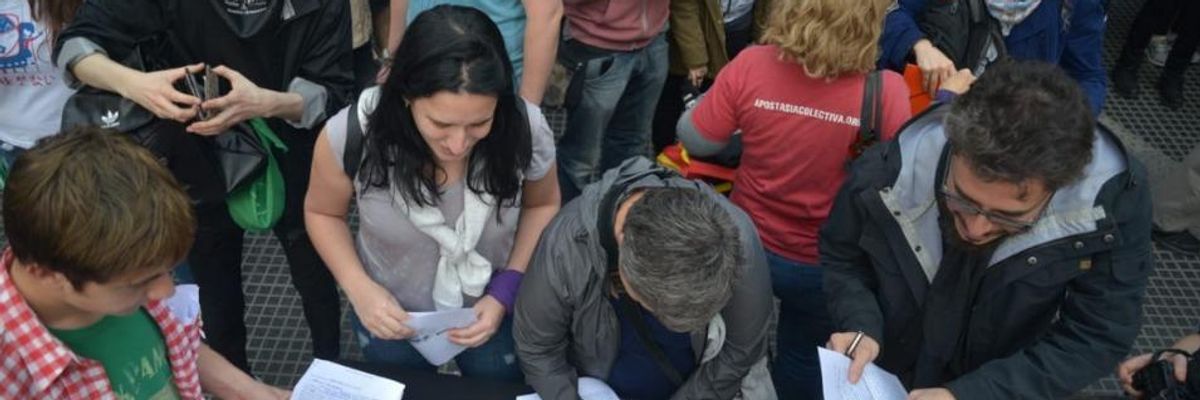
Hundreds of Argentines lined up in Buenos Aires this weekend to renounce their affiliation with the Catholic Church, in response to a recent vote against women's reproductive rights by the country's Senate. (Photo: @revistacitrica/Twitter)
Hundreds of Argentines stood in long lines in Buenos Aires and around Argentina this weekend to join a "Collective Apostasy" movement, renouncing their Catholic faith a week after an anti-choice Senate vote sent thousands of Argentines out into the streets to protest.
The forms signed by participants will be given to the Episcopal Conference in the Vatican, according to the Associated Press. Organizers told La Nacion that attendance at the events exceeded expectations.
The "Apostasia Colectiva" movement, begun by the Argentine Coalition for a Secular State, is aimed at weakening the hold of a church of which two-thirds of Argentinian people are members. The huge turnout at Saturday's events was brought on not only by the Senate's decision to uphold a ban on abortions for women up to 14 weeks into a pregnancy, but the Church's power over the nation and the numerous struggles Argentines have fought against the Church over the years.
"Obtaining the vote for women, the divorce law, marriage equality, the gender identity law, the assisted human fertilization law, the law of integral sexual education, the dignified death law were all done fighting clerical power, which seeks to have total dominion over our minds and bodies," the event's organizers wrote on social media.
The Catholic Church lobbied aggressively against the legalized abortion bill. Every year, about 500,000 illegal and unsafe abortions take place in the country, and since the abortion rights vote, at least one woman has died from an attempt to perform an abortion on herself.
"The discourse by the church to convince the people to not accept the law was so outrageous that I reached the height of my enmity toward the Catholic Church," Nora Cortinas, a human rights advocate, told the AP.
On social media, some indicated that numerous cases of sexual abuse in the Church, like the one a grand jury report revealed in Pennsylvania last week, also figured into the growth of the Apostasia Colectiva movement.
Dear Common Dreams reader, It’s been nearly 30 years since I co-founded Common Dreams with my late wife, Lina Newhouser. We had the radical notion that journalism should serve the public good, not corporate profits. It was clear to us from the outset what it would take to build such a project. No paid advertisements. No corporate sponsors. No millionaire publisher telling us what to think or do. Many people said we wouldn't last a year, but we proved those doubters wrong. Together with a tremendous team of journalists and dedicated staff, we built an independent media outlet free from the constraints of profits and corporate control. Our mission has always been simple: To inform. To inspire. To ignite change for the common good. Building Common Dreams was not easy. Our survival was never guaranteed. When you take on the most powerful forces—Wall Street greed, fossil fuel industry destruction, Big Tech lobbyists, and uber-rich oligarchs who have spent billions upon billions rigging the economy and democracy in their favor—the only bulwark you have is supporters who believe in your work. But here’s the urgent message from me today. It's never been this bad out there. And it's never been this hard to keep us going. At the very moment Common Dreams is most needed, the threats we face are intensifying. We need your support now more than ever. We don't accept corporate advertising and never will. We don't have a paywall because we don't think people should be blocked from critical news based on their ability to pay. Everything we do is funded by the donations of readers like you. When everyone does the little they can afford, we are strong. But if that support retreats or dries up, so do we. Will you donate now to make sure Common Dreams not only survives but thrives? —Craig Brown, Co-founder |
Hundreds of Argentines stood in long lines in Buenos Aires and around Argentina this weekend to join a "Collective Apostasy" movement, renouncing their Catholic faith a week after an anti-choice Senate vote sent thousands of Argentines out into the streets to protest.
The forms signed by participants will be given to the Episcopal Conference in the Vatican, according to the Associated Press. Organizers told La Nacion that attendance at the events exceeded expectations.
The "Apostasia Colectiva" movement, begun by the Argentine Coalition for a Secular State, is aimed at weakening the hold of a church of which two-thirds of Argentinian people are members. The huge turnout at Saturday's events was brought on not only by the Senate's decision to uphold a ban on abortions for women up to 14 weeks into a pregnancy, but the Church's power over the nation and the numerous struggles Argentines have fought against the Church over the years.
"Obtaining the vote for women, the divorce law, marriage equality, the gender identity law, the assisted human fertilization law, the law of integral sexual education, the dignified death law were all done fighting clerical power, which seeks to have total dominion over our minds and bodies," the event's organizers wrote on social media.
The Catholic Church lobbied aggressively against the legalized abortion bill. Every year, about 500,000 illegal and unsafe abortions take place in the country, and since the abortion rights vote, at least one woman has died from an attempt to perform an abortion on herself.
"The discourse by the church to convince the people to not accept the law was so outrageous that I reached the height of my enmity toward the Catholic Church," Nora Cortinas, a human rights advocate, told the AP.
On social media, some indicated that numerous cases of sexual abuse in the Church, like the one a grand jury report revealed in Pennsylvania last week, also figured into the growth of the Apostasia Colectiva movement.
Hundreds of Argentines stood in long lines in Buenos Aires and around Argentina this weekend to join a "Collective Apostasy" movement, renouncing their Catholic faith a week after an anti-choice Senate vote sent thousands of Argentines out into the streets to protest.
The forms signed by participants will be given to the Episcopal Conference in the Vatican, according to the Associated Press. Organizers told La Nacion that attendance at the events exceeded expectations.
The "Apostasia Colectiva" movement, begun by the Argentine Coalition for a Secular State, is aimed at weakening the hold of a church of which two-thirds of Argentinian people are members. The huge turnout at Saturday's events was brought on not only by the Senate's decision to uphold a ban on abortions for women up to 14 weeks into a pregnancy, but the Church's power over the nation and the numerous struggles Argentines have fought against the Church over the years.
"Obtaining the vote for women, the divorce law, marriage equality, the gender identity law, the assisted human fertilization law, the law of integral sexual education, the dignified death law were all done fighting clerical power, which seeks to have total dominion over our minds and bodies," the event's organizers wrote on social media.
The Catholic Church lobbied aggressively against the legalized abortion bill. Every year, about 500,000 illegal and unsafe abortions take place in the country, and since the abortion rights vote, at least one woman has died from an attempt to perform an abortion on herself.
"The discourse by the church to convince the people to not accept the law was so outrageous that I reached the height of my enmity toward the Catholic Church," Nora Cortinas, a human rights advocate, told the AP.
On social media, some indicated that numerous cases of sexual abuse in the Church, like the one a grand jury report revealed in Pennsylvania last week, also figured into the growth of the Apostasia Colectiva movement.