SUBSCRIBE TO OUR FREE NEWSLETTER
Daily news & progressive opinion—funded by the people, not the corporations—delivered straight to your inbox.
5
#000000
#FFFFFF
To donate by check, phone, or other method, see our More Ways to Give page.
Daily news & progressive opinion—funded by the people, not the corporations—delivered straight to your inbox.
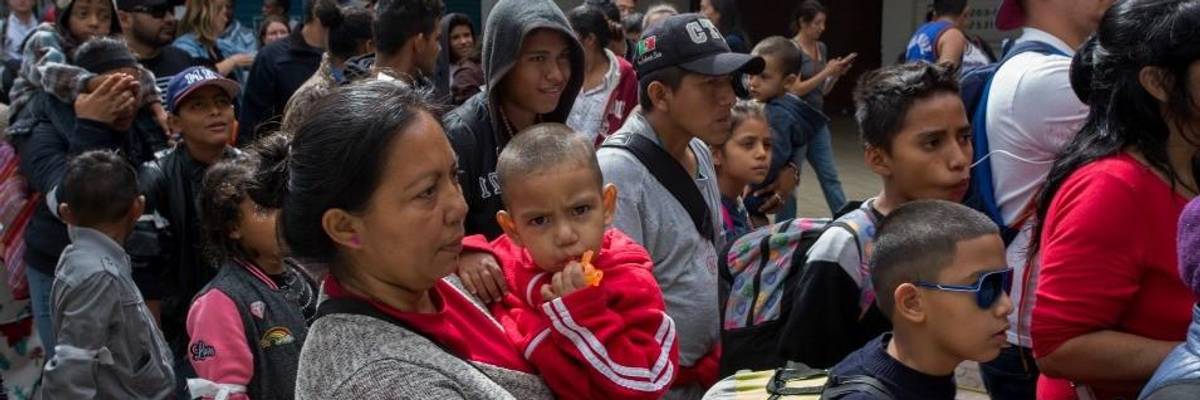
The ACLU filed a federal lawsuit Tuesday challenging Attorney General Jeff Sessions' decision to end asylum protections for victims of domestic and gang violence. (Photo: David McNew/Getty Images)
Calling the Trump administration's decision to end asylum protections for victims of violence one that "betrays our values," the American Civil Liberties Union (ACLU) filed a federal lawsuit against the government on Tuesday on behalf of several refugees.
Attorney General Jeff Sessions announced in June that victims of domestic and gang violence would no longer qualify for asylum protections, reversing decades of precedent.
"This is a naked attempt by the Trump administration to eviscerate our country's asylum protections," Jennifer Chang Newell, an attorney with the ACLU's Immigrants' Rights Project, said in a statement. "It's clear the administration's goal is to deny and deport as many people as possible, as quickly as possible."
"Providing shelter, safety, and a new life to the victims of persecution has long been part of our national identity, even if not always an ideal we have lived up to." --Cody Wofsky and Katrina Eiland, ACLU
Sessions' decision hinged on his claim that victims of such attacks should not be counted as members of "a particular social group," one of the classifications--along with race, religion, political beliefs, and nationality--that asylum-seekers can claim has made them targets for persecution in their home country.
The danger faced by those fleeing domestic abuse of gang violence is "merely personal," according to the attorney general.
Sessions' belief "reflects a fundamental misunderstanding of domestic violence, harkening back to an era when rape and partner abuse were viewed as private matters as well as of the brutality and scope of gang violence," wrote Cody Wofsky and Katrina Eiland, attorneys with the Immigrants' Rights Project.
"Gender-based persecution has been recognized as a basis for asylum for decades," they added, and victims of violence have long been eligible for asylum if they can credibly claim that their government cannot or will not to protect them.
Representing several plaintiffs in their case filed in the U.S. District Court for the District of Columbia, the ACLU and the Hastings Center for Gender and Refugee Studies at the University of California are arguing in their case that the Trump administration's decision violates the Refugee Act of 1980.
The 12 plaintiffs include a man from El Salvador whose life had been threatened by the gang which controlled his neighborhood and a woman who left Guatemala after years of abuse from her partner.
"Providing shelter, safety, and a new life to the victims of persecution has long been part of our national identity, even if not always an ideal we have lived up to," wrote Wofsky and Eiland. "The Trump administration's effort to eliminate that protection betrays our values and flouts our laws. The courts must step in to stop it."
Dear Common Dreams reader, It’s been nearly 30 years since I co-founded Common Dreams with my late wife, Lina Newhouser. We had the radical notion that journalism should serve the public good, not corporate profits. It was clear to us from the outset what it would take to build such a project. No paid advertisements. No corporate sponsors. No millionaire publisher telling us what to think or do. Many people said we wouldn't last a year, but we proved those doubters wrong. Together with a tremendous team of journalists and dedicated staff, we built an independent media outlet free from the constraints of profits and corporate control. Our mission has always been simple: To inform. To inspire. To ignite change for the common good. Building Common Dreams was not easy. Our survival was never guaranteed. When you take on the most powerful forces—Wall Street greed, fossil fuel industry destruction, Big Tech lobbyists, and uber-rich oligarchs who have spent billions upon billions rigging the economy and democracy in their favor—the only bulwark you have is supporters who believe in your work. But here’s the urgent message from me today. It's never been this bad out there. And it's never been this hard to keep us going. At the very moment Common Dreams is most needed, the threats we face are intensifying. We need your support now more than ever. We don't accept corporate advertising and never will. We don't have a paywall because we don't think people should be blocked from critical news based on their ability to pay. Everything we do is funded by the donations of readers like you. When everyone does the little they can afford, we are strong. But if that support retreats or dries up, so do we. Will you donate now to make sure Common Dreams not only survives but thrives? —Craig Brown, Co-founder |
Calling the Trump administration's decision to end asylum protections for victims of violence one that "betrays our values," the American Civil Liberties Union (ACLU) filed a federal lawsuit against the government on Tuesday on behalf of several refugees.
Attorney General Jeff Sessions announced in June that victims of domestic and gang violence would no longer qualify for asylum protections, reversing decades of precedent.
"This is a naked attempt by the Trump administration to eviscerate our country's asylum protections," Jennifer Chang Newell, an attorney with the ACLU's Immigrants' Rights Project, said in a statement. "It's clear the administration's goal is to deny and deport as many people as possible, as quickly as possible."
"Providing shelter, safety, and a new life to the victims of persecution has long been part of our national identity, even if not always an ideal we have lived up to." --Cody Wofsky and Katrina Eiland, ACLU
Sessions' decision hinged on his claim that victims of such attacks should not be counted as members of "a particular social group," one of the classifications--along with race, religion, political beliefs, and nationality--that asylum-seekers can claim has made them targets for persecution in their home country.
The danger faced by those fleeing domestic abuse of gang violence is "merely personal," according to the attorney general.
Sessions' belief "reflects a fundamental misunderstanding of domestic violence, harkening back to an era when rape and partner abuse were viewed as private matters as well as of the brutality and scope of gang violence," wrote Cody Wofsky and Katrina Eiland, attorneys with the Immigrants' Rights Project.
"Gender-based persecution has been recognized as a basis for asylum for decades," they added, and victims of violence have long been eligible for asylum if they can credibly claim that their government cannot or will not to protect them.
Representing several plaintiffs in their case filed in the U.S. District Court for the District of Columbia, the ACLU and the Hastings Center for Gender and Refugee Studies at the University of California are arguing in their case that the Trump administration's decision violates the Refugee Act of 1980.
The 12 plaintiffs include a man from El Salvador whose life had been threatened by the gang which controlled his neighborhood and a woman who left Guatemala after years of abuse from her partner.
"Providing shelter, safety, and a new life to the victims of persecution has long been part of our national identity, even if not always an ideal we have lived up to," wrote Wofsky and Eiland. "The Trump administration's effort to eliminate that protection betrays our values and flouts our laws. The courts must step in to stop it."
Calling the Trump administration's decision to end asylum protections for victims of violence one that "betrays our values," the American Civil Liberties Union (ACLU) filed a federal lawsuit against the government on Tuesday on behalf of several refugees.
Attorney General Jeff Sessions announced in June that victims of domestic and gang violence would no longer qualify for asylum protections, reversing decades of precedent.
"This is a naked attempt by the Trump administration to eviscerate our country's asylum protections," Jennifer Chang Newell, an attorney with the ACLU's Immigrants' Rights Project, said in a statement. "It's clear the administration's goal is to deny and deport as many people as possible, as quickly as possible."
"Providing shelter, safety, and a new life to the victims of persecution has long been part of our national identity, even if not always an ideal we have lived up to." --Cody Wofsky and Katrina Eiland, ACLU
Sessions' decision hinged on his claim that victims of such attacks should not be counted as members of "a particular social group," one of the classifications--along with race, religion, political beliefs, and nationality--that asylum-seekers can claim has made them targets for persecution in their home country.
The danger faced by those fleeing domestic abuse of gang violence is "merely personal," according to the attorney general.
Sessions' belief "reflects a fundamental misunderstanding of domestic violence, harkening back to an era when rape and partner abuse were viewed as private matters as well as of the brutality and scope of gang violence," wrote Cody Wofsky and Katrina Eiland, attorneys with the Immigrants' Rights Project.
"Gender-based persecution has been recognized as a basis for asylum for decades," they added, and victims of violence have long been eligible for asylum if they can credibly claim that their government cannot or will not to protect them.
Representing several plaintiffs in their case filed in the U.S. District Court for the District of Columbia, the ACLU and the Hastings Center for Gender and Refugee Studies at the University of California are arguing in their case that the Trump administration's decision violates the Refugee Act of 1980.
The 12 plaintiffs include a man from El Salvador whose life had been threatened by the gang which controlled his neighborhood and a woman who left Guatemala after years of abuse from her partner.
"Providing shelter, safety, and a new life to the victims of persecution has long been part of our national identity, even if not always an ideal we have lived up to," wrote Wofsky and Eiland. "The Trump administration's effort to eliminate that protection betrays our values and flouts our laws. The courts must step in to stop it."