SUBSCRIBE TO OUR FREE NEWSLETTER
Daily news & progressive opinion—funded by the people, not the corporations—delivered straight to your inbox.
5
#000000
#FFFFFF
To donate by check, phone, or other method, see our More Ways to Give page.
Daily news & progressive opinion—funded by the people, not the corporations—delivered straight to your inbox.
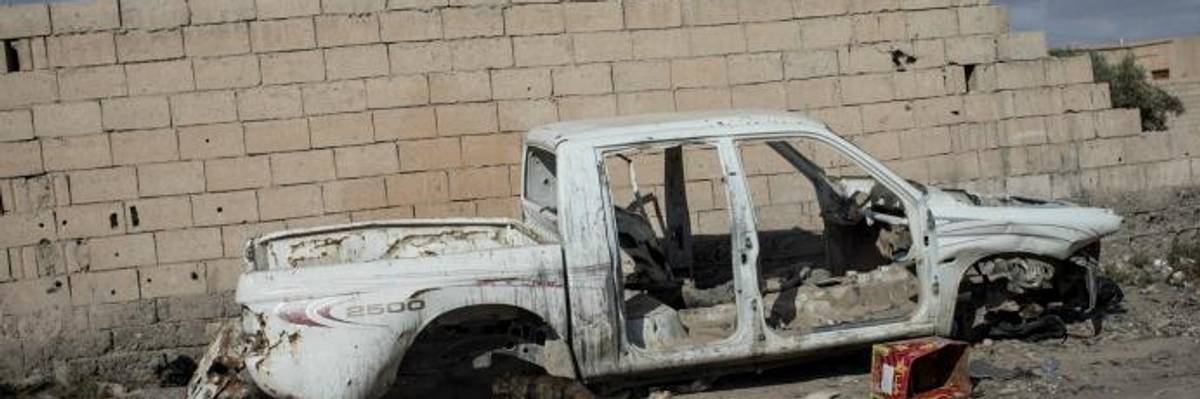
A destroyed car is seen in the western neighborhood of Jazrah on the outskirts of Raqqa, Syria on October 30, 2017. (Photo: Chris McGrath/Getty Images)
Amnesty International on Monday is urging the U.S.-led military coalition targeting the Islamic State in Syria to launch an independent investigation into the full scale of civilian carnage it may have caused in its brutal Raqqa offensive last year.
"As far as how do we know how many civilians were killed--I'm just being honest--no one will ever know."
--U.S. Army Col. Thomas Veale
The siege took place between June and October 2017--right after Defense Secretary James "Mad Dog" Mattis announced the military was shifting to "annihilation tactics" to defeat ISIS. "Every minute of every hour we were putting some kind of fire on ISIS in Raqqa, whether it was mortars, artillery, rockets, [High Mobility Artillery Rocket Systems], Hellfires, armed drones, you name it," according to one military advisor's account.
The call from the human rights group comes less than two weeks after the coalition admitted new civilian causalities during the time frame, including ones cited in Amnesty's report from June highlighting the devastation resulting from the so-called "war of annihilation" in Raqqa. The coalition now acknowledges killing 77 civilians, including 24 children and 25 women, Amnesty says.
But that figure is clearly "only the tip of the iceberg," said Donatella Rovera, senior crisis response adviser at Amnesty International, as "the many survivors and witnesses we spoke to on the ground pointed to a civilian death toll in the high hundreds."
The rights group notes, for example, that on July 18, 2017, the coalition says it killed 11 civilians with a strike, but there were 46 other strikes that day. It also admitted killing 42 civilians in two strikes on August 20, but there were 50 other strikes that day.
Among those killed on Aug. 20 was one-year-old Tulip, daughter of Rasha Badran. She told (pdf) told Amnesty:
Almost everybody was killed. Only I, my husband, and his brother and cousin survived. The strike happened at about 7pm. I fainted and when I regained consciousness I heard my husband's cousin, Mohammed, calling out. I could neither move nor speak. Then my husband and his brother found me. My husband was the most seriously injured [of the survivors]--he had a head wound and blood was pouring from his ears. It was dark and we could not see anything. We called out but nobody else answered; nobody moved. It was completely silent except for the planes circling above. We hid in the rubble until the morning because the planes were circling overhead. In the morning, we found Tulip's body; our baby was dead . We buried her near there, by a tree.
To make a step towards justice for the victims--and to prevent similar tragedies--Amnesty says the coalition needs to be transparent about its methodology for identifying targets and the actions it ostensibly took to prevent civilian harm.
"How can the coalition avoid inflicting high civilian death tolls in the future without accounting for what went wrong in Raqqa?" Rovera asked.
"Unless the thousands of coalition strikes in Raqqa are rigorously investigated, the true scale of civilian casualties will likely never be established and the coalition will continue to dismiss most allegations--a shocking denial of life and dignity for Raqqa's civilian population," she added.
In June, following the release of the report,. U.S. Army Col. Thomas Veale, a spokesperson for the coalition, said, "As far as how do we know how many civilians were killed--I'm just being honest--no one will ever know."
Dear Common Dreams reader, It’s been nearly 30 years since I co-founded Common Dreams with my late wife, Lina Newhouser. We had the radical notion that journalism should serve the public good, not corporate profits. It was clear to us from the outset what it would take to build such a project. No paid advertisements. No corporate sponsors. No millionaire publisher telling us what to think or do. Many people said we wouldn't last a year, but we proved those doubters wrong. Together with a tremendous team of journalists and dedicated staff, we built an independent media outlet free from the constraints of profits and corporate control. Our mission has always been simple: To inform. To inspire. To ignite change for the common good. Building Common Dreams was not easy. Our survival was never guaranteed. When you take on the most powerful forces—Wall Street greed, fossil fuel industry destruction, Big Tech lobbyists, and uber-rich oligarchs who have spent billions upon billions rigging the economy and democracy in their favor—the only bulwark you have is supporters who believe in your work. But here’s the urgent message from me today. It's never been this bad out there. And it's never been this hard to keep us going. At the very moment Common Dreams is most needed, the threats we face are intensifying. We need your support now more than ever. We don't accept corporate advertising and never will. We don't have a paywall because we don't think people should be blocked from critical news based on their ability to pay. Everything we do is funded by the donations of readers like you. When everyone does the little they can afford, we are strong. But if that support retreats or dries up, so do we. Will you donate now to make sure Common Dreams not only survives but thrives? —Craig Brown, Co-founder |
Amnesty International on Monday is urging the U.S.-led military coalition targeting the Islamic State in Syria to launch an independent investigation into the full scale of civilian carnage it may have caused in its brutal Raqqa offensive last year.
"As far as how do we know how many civilians were killed--I'm just being honest--no one will ever know."
--U.S. Army Col. Thomas Veale
The siege took place between June and October 2017--right after Defense Secretary James "Mad Dog" Mattis announced the military was shifting to "annihilation tactics" to defeat ISIS. "Every minute of every hour we were putting some kind of fire on ISIS in Raqqa, whether it was mortars, artillery, rockets, [High Mobility Artillery Rocket Systems], Hellfires, armed drones, you name it," according to one military advisor's account.
The call from the human rights group comes less than two weeks after the coalition admitted new civilian causalities during the time frame, including ones cited in Amnesty's report from June highlighting the devastation resulting from the so-called "war of annihilation" in Raqqa. The coalition now acknowledges killing 77 civilians, including 24 children and 25 women, Amnesty says.
But that figure is clearly "only the tip of the iceberg," said Donatella Rovera, senior crisis response adviser at Amnesty International, as "the many survivors and witnesses we spoke to on the ground pointed to a civilian death toll in the high hundreds."
The rights group notes, for example, that on July 18, 2017, the coalition says it killed 11 civilians with a strike, but there were 46 other strikes that day. It also admitted killing 42 civilians in two strikes on August 20, but there were 50 other strikes that day.
Among those killed on Aug. 20 was one-year-old Tulip, daughter of Rasha Badran. She told (pdf) told Amnesty:
Almost everybody was killed. Only I, my husband, and his brother and cousin survived. The strike happened at about 7pm. I fainted and when I regained consciousness I heard my husband's cousin, Mohammed, calling out. I could neither move nor speak. Then my husband and his brother found me. My husband was the most seriously injured [of the survivors]--he had a head wound and blood was pouring from his ears. It was dark and we could not see anything. We called out but nobody else answered; nobody moved. It was completely silent except for the planes circling above. We hid in the rubble until the morning because the planes were circling overhead. In the morning, we found Tulip's body; our baby was dead . We buried her near there, by a tree.
To make a step towards justice for the victims--and to prevent similar tragedies--Amnesty says the coalition needs to be transparent about its methodology for identifying targets and the actions it ostensibly took to prevent civilian harm.
"How can the coalition avoid inflicting high civilian death tolls in the future without accounting for what went wrong in Raqqa?" Rovera asked.
"Unless the thousands of coalition strikes in Raqqa are rigorously investigated, the true scale of civilian casualties will likely never be established and the coalition will continue to dismiss most allegations--a shocking denial of life and dignity for Raqqa's civilian population," she added.
In June, following the release of the report,. U.S. Army Col. Thomas Veale, a spokesperson for the coalition, said, "As far as how do we know how many civilians were killed--I'm just being honest--no one will ever know."
Amnesty International on Monday is urging the U.S.-led military coalition targeting the Islamic State in Syria to launch an independent investigation into the full scale of civilian carnage it may have caused in its brutal Raqqa offensive last year.
"As far as how do we know how many civilians were killed--I'm just being honest--no one will ever know."
--U.S. Army Col. Thomas Veale
The siege took place between June and October 2017--right after Defense Secretary James "Mad Dog" Mattis announced the military was shifting to "annihilation tactics" to defeat ISIS. "Every minute of every hour we were putting some kind of fire on ISIS in Raqqa, whether it was mortars, artillery, rockets, [High Mobility Artillery Rocket Systems], Hellfires, armed drones, you name it," according to one military advisor's account.
The call from the human rights group comes less than two weeks after the coalition admitted new civilian causalities during the time frame, including ones cited in Amnesty's report from June highlighting the devastation resulting from the so-called "war of annihilation" in Raqqa. The coalition now acknowledges killing 77 civilians, including 24 children and 25 women, Amnesty says.
But that figure is clearly "only the tip of the iceberg," said Donatella Rovera, senior crisis response adviser at Amnesty International, as "the many survivors and witnesses we spoke to on the ground pointed to a civilian death toll in the high hundreds."
The rights group notes, for example, that on July 18, 2017, the coalition says it killed 11 civilians with a strike, but there were 46 other strikes that day. It also admitted killing 42 civilians in two strikes on August 20, but there were 50 other strikes that day.
Among those killed on Aug. 20 was one-year-old Tulip, daughter of Rasha Badran. She told (pdf) told Amnesty:
Almost everybody was killed. Only I, my husband, and his brother and cousin survived. The strike happened at about 7pm. I fainted and when I regained consciousness I heard my husband's cousin, Mohammed, calling out. I could neither move nor speak. Then my husband and his brother found me. My husband was the most seriously injured [of the survivors]--he had a head wound and blood was pouring from his ears. It was dark and we could not see anything. We called out but nobody else answered; nobody moved. It was completely silent except for the planes circling above. We hid in the rubble until the morning because the planes were circling overhead. In the morning, we found Tulip's body; our baby was dead . We buried her near there, by a tree.
To make a step towards justice for the victims--and to prevent similar tragedies--Amnesty says the coalition needs to be transparent about its methodology for identifying targets and the actions it ostensibly took to prevent civilian harm.
"How can the coalition avoid inflicting high civilian death tolls in the future without accounting for what went wrong in Raqqa?" Rovera asked.
"Unless the thousands of coalition strikes in Raqqa are rigorously investigated, the true scale of civilian casualties will likely never be established and the coalition will continue to dismiss most allegations--a shocking denial of life and dignity for Raqqa's civilian population," she added.
In June, following the release of the report,. U.S. Army Col. Thomas Veale, a spokesperson for the coalition, said, "As far as how do we know how many civilians were killed--I'm just being honest--no one will ever know."