

SUBSCRIBE TO OUR FREE NEWSLETTER
Daily news & progressive opinion—funded by the people, not the corporations—delivered straight to your inbox.
5
#000000
#FFFFFF
To donate by check, phone, or other method, see our More Ways to Give page.
Daily news & progressive opinion—funded by the people, not the corporations—delivered straight to your inbox.
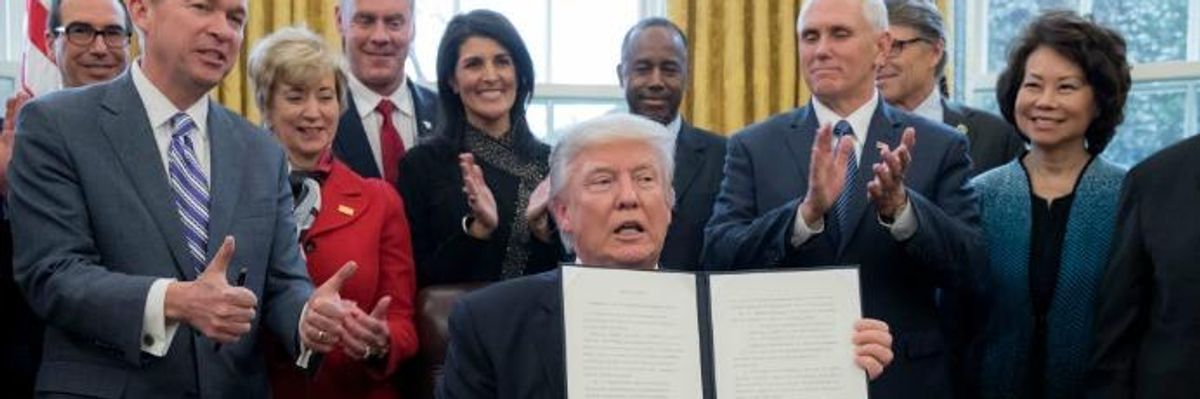
President Donald Trump shows an executive order after signing it beside members of his cabinet in the Oval Office of the White House on March 17, 2017 in Washington, D.C. (Photo: Michael Reynolds-Pool/Getty Images)
Infuriated by a scathing United Nations report estimating that over 18 million Americans are living in "extreme poverty" and accusing the Trump administration of "deliberately" making such destitution worse with its tax cuts for the rich, the White House insisted in its June response to the U.N. analysis that the United States is overflowing with "prosperity" and that claims of widespread poverty are "exaggerated."
"This is not as dramatic as Trump's tweets or bald-faced lies at press briefings. But in a way it is far more insidious; the contempt for facts is pervasive and maddening."
--Jeff Greenfield
But internal State Department emails and documents obtained by Foreign Policy and the non-profit journalism website Coda Story show that the Trump administration ignored advice of White House economic analysts and knowingly lied to the public about the severity of American poverty, which the U.N. Special Rapporteur on Extreme Poverty and Human Rights Philip Alston described as "shocking."
Foreign Policy reported on Thursday that officials who were consulted last-minute on a draft of the White House's rebuttal of the U.N. findings "questioned the accuracy of the data the administration was citing."
Despite the fact that the U.N. analysis cited government statistics to bolster its claims about poverty in America, the Trump administration opted to draw from a report by the right-wing Heritage Foundation, which concluded that 250,000 Americans are living in extreme poverty--a stark contrast to the U.N.'s conclusion that the correct number is 18.25 million.
The Heritage report cited by the White House also concluded that the conditions of the poor must be improving because many families living in deep poverty own cell phones and DVD players.
"What is your source for stating material hardship is down by 77 percent since 1980?" Trudi Renwick, an economist at the Census Bureau, wrote in an email questioning the Trump administration's rebuttal to the U.N.
Foreign Policy reports that it is unclear whether Renwick received a response, and the White House kept references to the Heritage report in the final version of its response.
One economic adviser also urged the White House to "not get into" America's steady economic growth, writing: "Already 8-9 years long... which started under Obama and we inherited and then expanded. But it will end prob[ably] in 1-2 years." The Trump administration ignored this advice, touting a "new era of economic growth."
While the White House brushed aside the concerns of some officials, they did modify parts of their response to the U.N. after advisers questioned how truly prosperous the American economy is under Trump.
"Wages haven't really picked up, other than for supervisors," an official from the Council of Economic Advisers wrote in response to a line in an early draft about workers' salaries rising. "This triggers the left--best to leave it off."
The line was deleted from the final document.
In contrast to the officials who raised questions about the White House's economic claims, Mari Stull, a senior State Department adviser, attacked the U.N. report as "propaganda" in emails and mocked the U.N.'s accurate claim that American child poverty rates are among the highest in the industrialized world.
"Based upon my own experience, my sons are destitute poor and living off the welfare state of Mom--so guess they contributed to the 'youth poverty' crisis in America," Stull wrote.
Bathsheba Crocker, a former U.S. diplomat and vice president of humanitarian policy at CARE, called Stull's comment "unbelievable" and wrote that it demonstrates once again the "contempt" the Trump administration has for poor Americans.
Dear Common Dreams reader, It’s been nearly 30 years since I co-founded Common Dreams with my late wife, Lina Newhouser. We had the radical notion that journalism should serve the public good, not corporate profits. It was clear to us from the outset what it would take to build such a project. No paid advertisements. No corporate sponsors. No millionaire publisher telling us what to think or do. Many people said we wouldn't last a year, but we proved those doubters wrong. Together with a tremendous team of journalists and dedicated staff, we built an independent media outlet free from the constraints of profits and corporate control. Our mission has always been simple: To inform. To inspire. To ignite change for the common good. Building Common Dreams was not easy. Our survival was never guaranteed. When you take on the most powerful forces—Wall Street greed, fossil fuel industry destruction, Big Tech lobbyists, and uber-rich oligarchs who have spent billions upon billions rigging the economy and democracy in their favor—the only bulwark you have is supporters who believe in your work. But here’s the urgent message from me today. It's never been this bad out there. And it's never been this hard to keep us going. At the very moment Common Dreams is most needed, the threats we face are intensifying. We need your support now more than ever. We don't accept corporate advertising and never will. We don't have a paywall because we don't think people should be blocked from critical news based on their ability to pay. Everything we do is funded by the donations of readers like you. When everyone does the little they can afford, we are strong. But if that support retreats or dries up, so do we. Will you donate now to make sure Common Dreams not only survives but thrives? —Craig Brown, Co-founder |
Infuriated by a scathing United Nations report estimating that over 18 million Americans are living in "extreme poverty" and accusing the Trump administration of "deliberately" making such destitution worse with its tax cuts for the rich, the White House insisted in its June response to the U.N. analysis that the United States is overflowing with "prosperity" and that claims of widespread poverty are "exaggerated."
"This is not as dramatic as Trump's tweets or bald-faced lies at press briefings. But in a way it is far more insidious; the contempt for facts is pervasive and maddening."
--Jeff Greenfield
But internal State Department emails and documents obtained by Foreign Policy and the non-profit journalism website Coda Story show that the Trump administration ignored advice of White House economic analysts and knowingly lied to the public about the severity of American poverty, which the U.N. Special Rapporteur on Extreme Poverty and Human Rights Philip Alston described as "shocking."
Foreign Policy reported on Thursday that officials who were consulted last-minute on a draft of the White House's rebuttal of the U.N. findings "questioned the accuracy of the data the administration was citing."
Despite the fact that the U.N. analysis cited government statistics to bolster its claims about poverty in America, the Trump administration opted to draw from a report by the right-wing Heritage Foundation, which concluded that 250,000 Americans are living in extreme poverty--a stark contrast to the U.N.'s conclusion that the correct number is 18.25 million.
The Heritage report cited by the White House also concluded that the conditions of the poor must be improving because many families living in deep poverty own cell phones and DVD players.
"What is your source for stating material hardship is down by 77 percent since 1980?" Trudi Renwick, an economist at the Census Bureau, wrote in an email questioning the Trump administration's rebuttal to the U.N.
Foreign Policy reports that it is unclear whether Renwick received a response, and the White House kept references to the Heritage report in the final version of its response.
One economic adviser also urged the White House to "not get into" America's steady economic growth, writing: "Already 8-9 years long... which started under Obama and we inherited and then expanded. But it will end prob[ably] in 1-2 years." The Trump administration ignored this advice, touting a "new era of economic growth."
While the White House brushed aside the concerns of some officials, they did modify parts of their response to the U.N. after advisers questioned how truly prosperous the American economy is under Trump.
"Wages haven't really picked up, other than for supervisors," an official from the Council of Economic Advisers wrote in response to a line in an early draft about workers' salaries rising. "This triggers the left--best to leave it off."
The line was deleted from the final document.
In contrast to the officials who raised questions about the White House's economic claims, Mari Stull, a senior State Department adviser, attacked the U.N. report as "propaganda" in emails and mocked the U.N.'s accurate claim that American child poverty rates are among the highest in the industrialized world.
"Based upon my own experience, my sons are destitute poor and living off the welfare state of Mom--so guess they contributed to the 'youth poverty' crisis in America," Stull wrote.
Bathsheba Crocker, a former U.S. diplomat and vice president of humanitarian policy at CARE, called Stull's comment "unbelievable" and wrote that it demonstrates once again the "contempt" the Trump administration has for poor Americans.
Infuriated by a scathing United Nations report estimating that over 18 million Americans are living in "extreme poverty" and accusing the Trump administration of "deliberately" making such destitution worse with its tax cuts for the rich, the White House insisted in its June response to the U.N. analysis that the United States is overflowing with "prosperity" and that claims of widespread poverty are "exaggerated."
"This is not as dramatic as Trump's tweets or bald-faced lies at press briefings. But in a way it is far more insidious; the contempt for facts is pervasive and maddening."
--Jeff Greenfield
But internal State Department emails and documents obtained by Foreign Policy and the non-profit journalism website Coda Story show that the Trump administration ignored advice of White House economic analysts and knowingly lied to the public about the severity of American poverty, which the U.N. Special Rapporteur on Extreme Poverty and Human Rights Philip Alston described as "shocking."
Foreign Policy reported on Thursday that officials who were consulted last-minute on a draft of the White House's rebuttal of the U.N. findings "questioned the accuracy of the data the administration was citing."
Despite the fact that the U.N. analysis cited government statistics to bolster its claims about poverty in America, the Trump administration opted to draw from a report by the right-wing Heritage Foundation, which concluded that 250,000 Americans are living in extreme poverty--a stark contrast to the U.N.'s conclusion that the correct number is 18.25 million.
The Heritage report cited by the White House also concluded that the conditions of the poor must be improving because many families living in deep poverty own cell phones and DVD players.
"What is your source for stating material hardship is down by 77 percent since 1980?" Trudi Renwick, an economist at the Census Bureau, wrote in an email questioning the Trump administration's rebuttal to the U.N.
Foreign Policy reports that it is unclear whether Renwick received a response, and the White House kept references to the Heritage report in the final version of its response.
One economic adviser also urged the White House to "not get into" America's steady economic growth, writing: "Already 8-9 years long... which started under Obama and we inherited and then expanded. But it will end prob[ably] in 1-2 years." The Trump administration ignored this advice, touting a "new era of economic growth."
While the White House brushed aside the concerns of some officials, they did modify parts of their response to the U.N. after advisers questioned how truly prosperous the American economy is under Trump.
"Wages haven't really picked up, other than for supervisors," an official from the Council of Economic Advisers wrote in response to a line in an early draft about workers' salaries rising. "This triggers the left--best to leave it off."
The line was deleted from the final document.
In contrast to the officials who raised questions about the White House's economic claims, Mari Stull, a senior State Department adviser, attacked the U.N. report as "propaganda" in emails and mocked the U.N.'s accurate claim that American child poverty rates are among the highest in the industrialized world.
"Based upon my own experience, my sons are destitute poor and living off the welfare state of Mom--so guess they contributed to the 'youth poverty' crisis in America," Stull wrote.
Bathsheba Crocker, a former U.S. diplomat and vice president of humanitarian policy at CARE, called Stull's comment "unbelievable" and wrote that it demonstrates once again the "contempt" the Trump administration has for poor Americans.

