SUBSCRIBE TO OUR FREE NEWSLETTER
Daily news & progressive opinion—funded by the people, not the corporations—delivered straight to your inbox.
5
#000000
#FFFFFF
To donate by check, phone, or other method, see our More Ways to Give page.
Daily news & progressive opinion—funded by the people, not the corporations—delivered straight to your inbox.
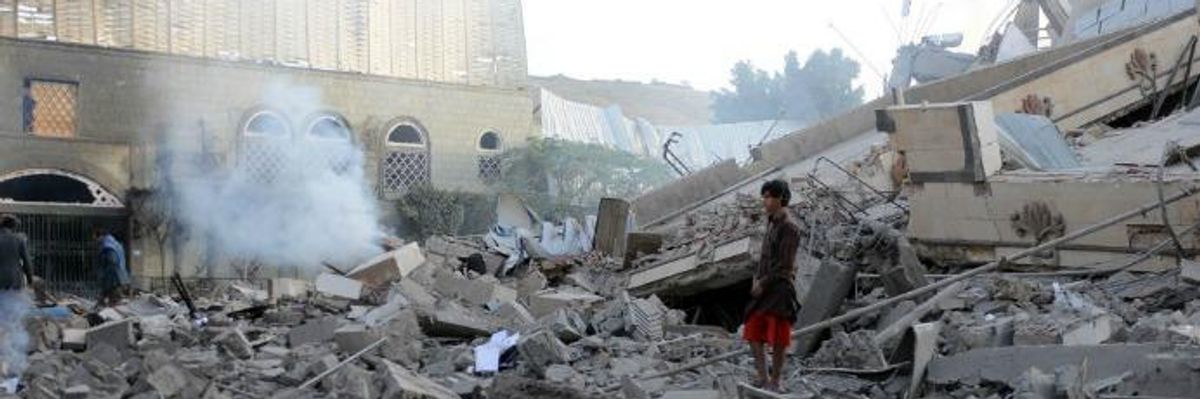
People inspect a building destroyed in airstrikes carried out by warplanes of the Saudi-led coalition hours after the U.N. Special Envoy to Yemen Martin Griffiths departed Sana'a on June 6, 2018 in Sana'a, Yemen. (Photo: Mohammed Hamoud/Getty Images)
As some of America's most prominent corporate media outlets continued their lengthy blackout of Yemen's deepening humanitarian crisis--a catastrophe made possible by the U.S. government's enthusiastic military and political support for Saudi Arabia's years-long assault on the starving nation--the Saudi-led coalition on Thursday reportedly killed more than 50 people and injured over 100 more in a massive bombing campaign targeting the Yemeni port city of Hodeidah.
"This crisis is a moral stain on all of us who are in a position of power and are failing."
--Rep. Ro Khanna Horrific images, videos, and witness accounts of the bombing quickly began circulating on social media after airstrikes pounded the vicinity of al-Thawra, Hodeidah's main public hospital.
"It is a very painful sight, parts of bodies are everywhere around the hospital gates," an eyewitness told Reuters, as Yemeni journalists and American activists intensified calls for the U.S. media to stop looking the other way while the Trump administration fuels the ongoing massacre of Yemenis with weaponry and intelligence.
Ahmad Algohbary, a Yemeni freelance journalist, offered a glimpse at the aftermath of the Saudi-led coalition's bombing campaign in an effort to "bring attention to the reality" of Yemen's situation, which has been described as the worst humanitarian crisis in the world.
Warning: The following images are disturbing.
Responding to Algohbary's photo of a Yemeni woman grasping her starving child, Rep. Ro Khanna (D-Calif.)--one of the few members of Congress who has been consistent and outspoken in his opposition to America's central role in Saudi Arabia's assault on Yemen--wrote on Twitter: "As a father, this absolutely breaks my heart. The world must act."
"We must stop Saudi's bombing of Hodeidah. We must demand that the violence end," Khanna added. "This crisis is a moral stain on all of us who are in a position of power and are failing."
Increasingly, activists and independent journalists have been using their social media platforms to pressure corporate media outlets that are failing to adequately cover the crisis in Yemen, which dates back to 2014.
"While [it's] disgraceful that MSNBC hasn't been covering the world's most significant humanitarian crisis, the problem runs much deeper," writer Walker Bragman noted on Twitter. "Corporate media, for the sake of ratings, has sanitized the news, allowing Americans to live in ignorant bliss of U.S.-linked war crimes."
"Instead of providing healthcare to sick Americans or education, this is what your tax dollars are going towards," noted one Twitter user following the Saudi-led coalition's latest attack on Yemen. "Enough is enough."
The latest massacre of Yemeni civilians comes amid the Saudi-led coalition's effort to seize Hodeidah from Yemen's Houthi rebels.
As Common Dreams reported, international aid groups have warned that an attempt by the Saudi-led coalition to take control of the port city could imperil shipments of life-saving food and medicine to millions of Yemenis as they face widespread food shortages and a worsening cholera epidemic.
The advocacy group Save the Children warned that 3,000 Yemeni children are being displaced from Hodeidah each day as the Saudi-led coalition continues to bomb and attack the city.
Soon after the Saudi-led coalition began bombing Hodeidah on Thursday, Martin Griffiths, the United Nations special envoy for Yemen, told the U.N. Security Council that he plans to bring representatives of the Saudi-led coalition--which includes the United Arab Emirates--and the Houthi rebels together for peace talks in September.
If the talks take place, they will be the first Yemen peace negotiations in two years.
Dear Common Dreams reader, It’s been nearly 30 years since I co-founded Common Dreams with my late wife, Lina Newhouser. We had the radical notion that journalism should serve the public good, not corporate profits. It was clear to us from the outset what it would take to build such a project. No paid advertisements. No corporate sponsors. No millionaire publisher telling us what to think or do. Many people said we wouldn't last a year, but we proved those doubters wrong. Together with a tremendous team of journalists and dedicated staff, we built an independent media outlet free from the constraints of profits and corporate control. Our mission has always been simple: To inform. To inspire. To ignite change for the common good. Building Common Dreams was not easy. Our survival was never guaranteed. When you take on the most powerful forces—Wall Street greed, fossil fuel industry destruction, Big Tech lobbyists, and uber-rich oligarchs who have spent billions upon billions rigging the economy and democracy in their favor—the only bulwark you have is supporters who believe in your work. But here’s the urgent message from me today. It's never been this bad out there. And it's never been this hard to keep us going. At the very moment Common Dreams is most needed, the threats we face are intensifying. We need your support now more than ever. We don't accept corporate advertising and never will. We don't have a paywall because we don't think people should be blocked from critical news based on their ability to pay. Everything we do is funded by the donations of readers like you. When everyone does the little they can afford, we are strong. But if that support retreats or dries up, so do we. Will you donate now to make sure Common Dreams not only survives but thrives? —Craig Brown, Co-founder |
As some of America's most prominent corporate media outlets continued their lengthy blackout of Yemen's deepening humanitarian crisis--a catastrophe made possible by the U.S. government's enthusiastic military and political support for Saudi Arabia's years-long assault on the starving nation--the Saudi-led coalition on Thursday reportedly killed more than 50 people and injured over 100 more in a massive bombing campaign targeting the Yemeni port city of Hodeidah.
"This crisis is a moral stain on all of us who are in a position of power and are failing."
--Rep. Ro Khanna Horrific images, videos, and witness accounts of the bombing quickly began circulating on social media after airstrikes pounded the vicinity of al-Thawra, Hodeidah's main public hospital.
"It is a very painful sight, parts of bodies are everywhere around the hospital gates," an eyewitness told Reuters, as Yemeni journalists and American activists intensified calls for the U.S. media to stop looking the other way while the Trump administration fuels the ongoing massacre of Yemenis with weaponry and intelligence.
Ahmad Algohbary, a Yemeni freelance journalist, offered a glimpse at the aftermath of the Saudi-led coalition's bombing campaign in an effort to "bring attention to the reality" of Yemen's situation, which has been described as the worst humanitarian crisis in the world.
Warning: The following images are disturbing.
Responding to Algohbary's photo of a Yemeni woman grasping her starving child, Rep. Ro Khanna (D-Calif.)--one of the few members of Congress who has been consistent and outspoken in his opposition to America's central role in Saudi Arabia's assault on Yemen--wrote on Twitter: "As a father, this absolutely breaks my heart. The world must act."
"We must stop Saudi's bombing of Hodeidah. We must demand that the violence end," Khanna added. "This crisis is a moral stain on all of us who are in a position of power and are failing."
Increasingly, activists and independent journalists have been using their social media platforms to pressure corporate media outlets that are failing to adequately cover the crisis in Yemen, which dates back to 2014.
"While [it's] disgraceful that MSNBC hasn't been covering the world's most significant humanitarian crisis, the problem runs much deeper," writer Walker Bragman noted on Twitter. "Corporate media, for the sake of ratings, has sanitized the news, allowing Americans to live in ignorant bliss of U.S.-linked war crimes."
"Instead of providing healthcare to sick Americans or education, this is what your tax dollars are going towards," noted one Twitter user following the Saudi-led coalition's latest attack on Yemen. "Enough is enough."
The latest massacre of Yemeni civilians comes amid the Saudi-led coalition's effort to seize Hodeidah from Yemen's Houthi rebels.
As Common Dreams reported, international aid groups have warned that an attempt by the Saudi-led coalition to take control of the port city could imperil shipments of life-saving food and medicine to millions of Yemenis as they face widespread food shortages and a worsening cholera epidemic.
The advocacy group Save the Children warned that 3,000 Yemeni children are being displaced from Hodeidah each day as the Saudi-led coalition continues to bomb and attack the city.
Soon after the Saudi-led coalition began bombing Hodeidah on Thursday, Martin Griffiths, the United Nations special envoy for Yemen, told the U.N. Security Council that he plans to bring representatives of the Saudi-led coalition--which includes the United Arab Emirates--and the Houthi rebels together for peace talks in September.
If the talks take place, they will be the first Yemen peace negotiations in two years.
As some of America's most prominent corporate media outlets continued their lengthy blackout of Yemen's deepening humanitarian crisis--a catastrophe made possible by the U.S. government's enthusiastic military and political support for Saudi Arabia's years-long assault on the starving nation--the Saudi-led coalition on Thursday reportedly killed more than 50 people and injured over 100 more in a massive bombing campaign targeting the Yemeni port city of Hodeidah.
"This crisis is a moral stain on all of us who are in a position of power and are failing."
--Rep. Ro Khanna Horrific images, videos, and witness accounts of the bombing quickly began circulating on social media after airstrikes pounded the vicinity of al-Thawra, Hodeidah's main public hospital.
"It is a very painful sight, parts of bodies are everywhere around the hospital gates," an eyewitness told Reuters, as Yemeni journalists and American activists intensified calls for the U.S. media to stop looking the other way while the Trump administration fuels the ongoing massacre of Yemenis with weaponry and intelligence.
Ahmad Algohbary, a Yemeni freelance journalist, offered a glimpse at the aftermath of the Saudi-led coalition's bombing campaign in an effort to "bring attention to the reality" of Yemen's situation, which has been described as the worst humanitarian crisis in the world.
Warning: The following images are disturbing.
Responding to Algohbary's photo of a Yemeni woman grasping her starving child, Rep. Ro Khanna (D-Calif.)--one of the few members of Congress who has been consistent and outspoken in his opposition to America's central role in Saudi Arabia's assault on Yemen--wrote on Twitter: "As a father, this absolutely breaks my heart. The world must act."
"We must stop Saudi's bombing of Hodeidah. We must demand that the violence end," Khanna added. "This crisis is a moral stain on all of us who are in a position of power and are failing."
Increasingly, activists and independent journalists have been using their social media platforms to pressure corporate media outlets that are failing to adequately cover the crisis in Yemen, which dates back to 2014.
"While [it's] disgraceful that MSNBC hasn't been covering the world's most significant humanitarian crisis, the problem runs much deeper," writer Walker Bragman noted on Twitter. "Corporate media, for the sake of ratings, has sanitized the news, allowing Americans to live in ignorant bliss of U.S.-linked war crimes."
"Instead of providing healthcare to sick Americans or education, this is what your tax dollars are going towards," noted one Twitter user following the Saudi-led coalition's latest attack on Yemen. "Enough is enough."
The latest massacre of Yemeni civilians comes amid the Saudi-led coalition's effort to seize Hodeidah from Yemen's Houthi rebels.
As Common Dreams reported, international aid groups have warned that an attempt by the Saudi-led coalition to take control of the port city could imperil shipments of life-saving food and medicine to millions of Yemenis as they face widespread food shortages and a worsening cholera epidemic.
The advocacy group Save the Children warned that 3,000 Yemeni children are being displaced from Hodeidah each day as the Saudi-led coalition continues to bomb and attack the city.
Soon after the Saudi-led coalition began bombing Hodeidah on Thursday, Martin Griffiths, the United Nations special envoy for Yemen, told the U.N. Security Council that he plans to bring representatives of the Saudi-led coalition--which includes the United Arab Emirates--and the Houthi rebels together for peace talks in September.
If the talks take place, they will be the first Yemen peace negotiations in two years.