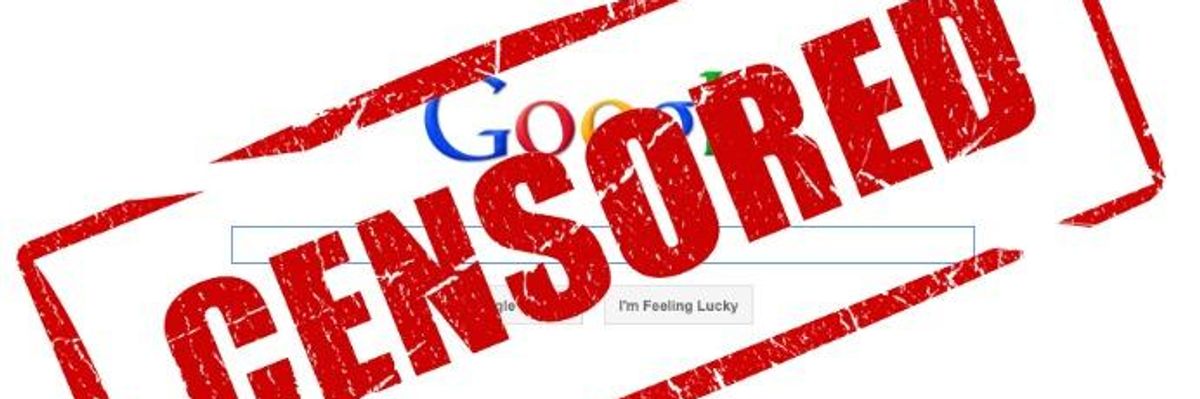
"This has very serious implications not just for China, but for all of us, for freedom of information and internet freedom," said Patrick Poon, a Hong Kong-based researcher with Amnesty International. (Photo: Digital Trends)
"Don't Be Evil, Unless It's Worth Untold New Riches": Whistleblower Reveals Google Plan to Launch Censored Search Engine in China
"If Google goes through with this, effectively normalizing and Americanizing authoritarian censorship, this will be the Waterloo in the global battle for a free internet as a norm."
In a move human rights groups are warning could have grave implications for internet freedom across the globe, Google is reportedly preparing to launch a "censored version" of its search engine in China that will automatically blacklist terms and websites related to peaceful dissent, free expression, and democracy.
"I'm against large companies and governments collaborating in the oppression of their people, and feel like transparency around what's being done is in the public interest."
--Google whistleblower
According to The Intercept's Ryan Gallagher, who first reported on the tech giant's plans on Wednesday, "The project--code-named Dragonfly--has been underway since spring of last year, and accelerated following a December 2017 meeting between Google's CEO Sundar Pichai and a top Chinese government official."
Citing anonymous sources familiar with the plan--including a Google whistleblower who has "moral and ethical concerns" about his company's role in censorship--as well as confidential company documents, Gallagher reported that "programmers and engineers at Google have created a custom Android app" which "has already been demonstrated to the Chinese government; the finalized version could be launched in the next six to nine months, pending approval from Chinese officials."
"Don't Be Evil, unless it's worth untold new riches," wrote Mother Jones national affairs editor Mark Follman in response to Gallagher's reporting, referencing Google's longstanding unofficial motto.
Speaking out due to fear that "what is done in China will become a template for many other nations," a Google whistleblower told The Intercept, "I'm against large companies and governments collaborating in the oppression of their people, and feel like transparency around what's being done is in the public interest."
Patrick Poon, a Hong Kong-based researcher with Amnesty International, told The Intercept that Google's apparent decision to go along with the Chinese government's repressive demands in pursuit of profit is "a big disaster for the information age."
"The biggest search engine in the world obeying the censorship in China is a victory for the Chinese government--it sends a signal that nobody will bother to challenge the censorship any more."
--Patrick Poon, Amnesty International
"This has very serious implications not just for China, but for all of us, for freedom of information and internet freedom," Poon said. "It will set a terrible precedent for many other companies who are still trying to do business in China while maintaining the principles of not succumbing to China's censorship. The biggest search engine in the world obeying the censorship in China is a victory for the Chinese government--it sends a signal that nobody will bother to challenge the censorship any more."
Google's search engine hasn't operated in China since 2010, when the tech behemoth decided to withdraw from the country due to the very censorship concerns the company now appears to be sweeping aside at Beijing's behest.
"Google's search service cannot currently be accessed by most internet users in China because it is blocked by the country's so-called Great Firewall. The app Google is building for China will comply with the country's strict censorship laws, restricting access to content that Xi Jinping's Communist Party regime deems unfavorable," Gallagher notes. "Documents seen by The Intercept, marked 'Google confidential,' say that Google's Chinese search app will automatically identify and filter websites blocked by the Great Firewall."
While it is unclear how many sites will be filtered out by Google's censored search engine, Wikipedia and the BBC were specifically mentioned in company documents as websites that would be blacklisted.
We are at a crossroads
This country and this world are at a monumental crossroads. In a few short weeks, US voters will have an opportunity to beat back the forces of fascism and confront the billionaires who are rigging the economy, our media system, and our democracy, making it increasingly impossible for ordinary people to get by. We’re not just talking about the election. We’re talking about what must be done once these fascist elements are vanquished from power. We need a bolder set of solutions than what either major party has so far been willing to offer and a working-class movement ready to fight like hell for it. Trump didn't emerge from nowhere. The conditions that fueled MAGA authoritarianism were created by decades of radical neoliberal economic policies and a corrupt political system dominated by corporate interests. They slashed taxes on the super-rich, promising that the benefits would trickle down. They said giveaways to the corporate titans would make life more affordable for the rest of us. It was all bullshit. And when a bitter, betrayed populace searches for someone to blame, right-wing demagogues have little trouble finding scapegoats. People know when they're being lied to, but you won't hear any of this from the corporate media. Only independent journalism—powered and funded by people who believe in building a better world—can deliver truly trustworthy daily news. Our Fall Campaign is underway, and we need your help. To power our newsroom through the rest of the year, we need to raise $125,000 by midnight on October 31. So if you share our vision, please contribute whatever you can to sustain our work. |
In a move human rights groups are warning could have grave implications for internet freedom across the globe, Google is reportedly preparing to launch a "censored version" of its search engine in China that will automatically blacklist terms and websites related to peaceful dissent, free expression, and democracy.
"I'm against large companies and governments collaborating in the oppression of their people, and feel like transparency around what's being done is in the public interest."
--Google whistleblower
According to The Intercept's Ryan Gallagher, who first reported on the tech giant's plans on Wednesday, "The project--code-named Dragonfly--has been underway since spring of last year, and accelerated following a December 2017 meeting between Google's CEO Sundar Pichai and a top Chinese government official."
Citing anonymous sources familiar with the plan--including a Google whistleblower who has "moral and ethical concerns" about his company's role in censorship--as well as confidential company documents, Gallagher reported that "programmers and engineers at Google have created a custom Android app" which "has already been demonstrated to the Chinese government; the finalized version could be launched in the next six to nine months, pending approval from Chinese officials."
"Don't Be Evil, unless it's worth untold new riches," wrote Mother Jones national affairs editor Mark Follman in response to Gallagher's reporting, referencing Google's longstanding unofficial motto.
Speaking out due to fear that "what is done in China will become a template for many other nations," a Google whistleblower told The Intercept, "I'm against large companies and governments collaborating in the oppression of their people, and feel like transparency around what's being done is in the public interest."
Patrick Poon, a Hong Kong-based researcher with Amnesty International, told The Intercept that Google's apparent decision to go along with the Chinese government's repressive demands in pursuit of profit is "a big disaster for the information age."
"The biggest search engine in the world obeying the censorship in China is a victory for the Chinese government--it sends a signal that nobody will bother to challenge the censorship any more."
--Patrick Poon, Amnesty International
"This has very serious implications not just for China, but for all of us, for freedom of information and internet freedom," Poon said. "It will set a terrible precedent for many other companies who are still trying to do business in China while maintaining the principles of not succumbing to China's censorship. The biggest search engine in the world obeying the censorship in China is a victory for the Chinese government--it sends a signal that nobody will bother to challenge the censorship any more."
Google's search engine hasn't operated in China since 2010, when the tech behemoth decided to withdraw from the country due to the very censorship concerns the company now appears to be sweeping aside at Beijing's behest.
"Google's search service cannot currently be accessed by most internet users in China because it is blocked by the country's so-called Great Firewall. The app Google is building for China will comply with the country's strict censorship laws, restricting access to content that Xi Jinping's Communist Party regime deems unfavorable," Gallagher notes. "Documents seen by The Intercept, marked 'Google confidential,' say that Google's Chinese search app will automatically identify and filter websites blocked by the Great Firewall."
While it is unclear how many sites will be filtered out by Google's censored search engine, Wikipedia and the BBC were specifically mentioned in company documents as websites that would be blacklisted.
In a move human rights groups are warning could have grave implications for internet freedom across the globe, Google is reportedly preparing to launch a "censored version" of its search engine in China that will automatically blacklist terms and websites related to peaceful dissent, free expression, and democracy.
"I'm against large companies and governments collaborating in the oppression of their people, and feel like transparency around what's being done is in the public interest."
--Google whistleblower
According to The Intercept's Ryan Gallagher, who first reported on the tech giant's plans on Wednesday, "The project--code-named Dragonfly--has been underway since spring of last year, and accelerated following a December 2017 meeting between Google's CEO Sundar Pichai and a top Chinese government official."
Citing anonymous sources familiar with the plan--including a Google whistleblower who has "moral and ethical concerns" about his company's role in censorship--as well as confidential company documents, Gallagher reported that "programmers and engineers at Google have created a custom Android app" which "has already been demonstrated to the Chinese government; the finalized version could be launched in the next six to nine months, pending approval from Chinese officials."
"Don't Be Evil, unless it's worth untold new riches," wrote Mother Jones national affairs editor Mark Follman in response to Gallagher's reporting, referencing Google's longstanding unofficial motto.
Speaking out due to fear that "what is done in China will become a template for many other nations," a Google whistleblower told The Intercept, "I'm against large companies and governments collaborating in the oppression of their people, and feel like transparency around what's being done is in the public interest."
Patrick Poon, a Hong Kong-based researcher with Amnesty International, told The Intercept that Google's apparent decision to go along with the Chinese government's repressive demands in pursuit of profit is "a big disaster for the information age."
"The biggest search engine in the world obeying the censorship in China is a victory for the Chinese government--it sends a signal that nobody will bother to challenge the censorship any more."
--Patrick Poon, Amnesty International
"This has very serious implications not just for China, but for all of us, for freedom of information and internet freedom," Poon said. "It will set a terrible precedent for many other companies who are still trying to do business in China while maintaining the principles of not succumbing to China's censorship. The biggest search engine in the world obeying the censorship in China is a victory for the Chinese government--it sends a signal that nobody will bother to challenge the censorship any more."
Google's search engine hasn't operated in China since 2010, when the tech behemoth decided to withdraw from the country due to the very censorship concerns the company now appears to be sweeping aside at Beijing's behest.
"Google's search service cannot currently be accessed by most internet users in China because it is blocked by the country's so-called Great Firewall. The app Google is building for China will comply with the country's strict censorship laws, restricting access to content that Xi Jinping's Communist Party regime deems unfavorable," Gallagher notes. "Documents seen by The Intercept, marked 'Google confidential,' say that Google's Chinese search app will automatically identify and filter websites blocked by the Great Firewall."
While it is unclear how many sites will be filtered out by Google's censored search engine, Wikipedia and the BBC were specifically mentioned in company documents as websites that would be blacklisted.