SUBSCRIBE TO OUR FREE NEWSLETTER
Daily news & progressive opinion—funded by the people, not the corporations—delivered straight to your inbox.
5
#000000
#FFFFFF
To donate by check, phone, or other method, see our More Ways to Give page.
Daily news & progressive opinion—funded by the people, not the corporations—delivered straight to your inbox.
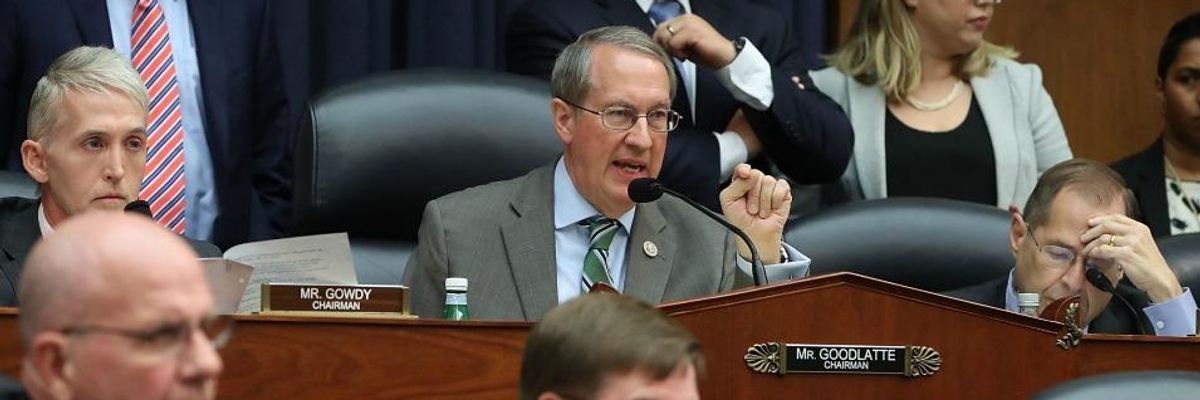
Chairman Bob Goodlatte (R-VA), center, questions Deputy Assistant FBI Director Peter Strzok during a joint committee hearing of the House Judiciary and Oversight committees on Capitol Hill on July 12, 2018 in Washington, D.C. (Photo: Mark Wilson/Getty Images)
A hearing regarding text messages sent by FBI agent Peter Strzok during the 2016 presidential campaign devolved into a chaotic shouting match between Republican and Democratic members of the House after the very first question when Strzok informed Rep. Trey Gowdy (R-S.C.) that the FBI had told him there were specific questions about ongoing investigations that he was not at liberty to answer.
Rep. Bob Goodlatte (R-Va.), the chairman presiding over the joint committee hearing, tried to force Strzok to answer the question from Gowdy regarding the number of witnesses interviewed as part of Special Counsel Robert Mueller's investigation into President Donald Trump's campaign last summer. Strzok said he could not answer any questions about the ongoing investigation based on advice from the FBI's general counsel.
Goodlatte threatened the witness with contempt over his refusal to answer the question, prompting angry responses from Democrats and demands for "points of order" and that the hearing be adjourned.
Watch:
In his opening statement to the House Judiciary and Oversight Committees, Strzok condemned the Republican Party for its characterization of his private messages as evidence that his agency was biased against President Donald Trump, and for holding a hearing that he said amounted to "another milestone in our enemies' campaign to tear America apart."
Strzok noted that he sent text messages critical of other 2016 candidates including Sen. Bernie Sanders (I-Vt.) and Hillary Clinton. He and an FBI lawyer he sent the messages to briefly worked on Special Counsel Robert Mueller's investigation into the Trump campaign's contacts with Russia, but were dismissed from the team last year even though FBI agents are not prohibited from privately expressing political views.
"Like many people, I had and expressed personal political opinions during an extraordinary presidential election," Strzok said. "Many contained expressions of concern for the security of our country--opinions that were not always expressed in terms I am proud of...But let me be clear, unequivocally and under oath: not once in my 26 years of defending my nation did my personal opinions impact any official action I took."
At Emptywheel, national security journalist Marcy Wheeler characterized the Strzok hearing as a "sideshow," weeks after Wheeler herself was interviewed by the FBI about evidence that was then incorporated into the Mueller probe.
"As House Judiciary Republicans spend half the day or longer publicly flogging Peter Strzok," wrote Wheeler, "know that all that flogging cannot change the fact that key evidence in Mueller's possession, evidence which I suspect implicates the president directly, has absolutely no tie to Peter Strzok at all. None. Tomorrow will be just one big giant show that in no way can alter the provenance of key, damning evidence in Mueller's possession."
Dear Common Dreams reader, It’s been nearly 30 years since I co-founded Common Dreams with my late wife, Lina Newhouser. We had the radical notion that journalism should serve the public good, not corporate profits. It was clear to us from the outset what it would take to build such a project. No paid advertisements. No corporate sponsors. No millionaire publisher telling us what to think or do. Many people said we wouldn't last a year, but we proved those doubters wrong. Together with a tremendous team of journalists and dedicated staff, we built an independent media outlet free from the constraints of profits and corporate control. Our mission has always been simple: To inform. To inspire. To ignite change for the common good. Building Common Dreams was not easy. Our survival was never guaranteed. When you take on the most powerful forces—Wall Street greed, fossil fuel industry destruction, Big Tech lobbyists, and uber-rich oligarchs who have spent billions upon billions rigging the economy and democracy in their favor—the only bulwark you have is supporters who believe in your work. But here’s the urgent message from me today. It's never been this bad out there. And it's never been this hard to keep us going. At the very moment Common Dreams is most needed, the threats we face are intensifying. We need your support now more than ever. We don't accept corporate advertising and never will. We don't have a paywall because we don't think people should be blocked from critical news based on their ability to pay. Everything we do is funded by the donations of readers like you. When everyone does the little they can afford, we are strong. But if that support retreats or dries up, so do we. Will you donate now to make sure Common Dreams not only survives but thrives? —Craig Brown, Co-founder |
A hearing regarding text messages sent by FBI agent Peter Strzok during the 2016 presidential campaign devolved into a chaotic shouting match between Republican and Democratic members of the House after the very first question when Strzok informed Rep. Trey Gowdy (R-S.C.) that the FBI had told him there were specific questions about ongoing investigations that he was not at liberty to answer.
Rep. Bob Goodlatte (R-Va.), the chairman presiding over the joint committee hearing, tried to force Strzok to answer the question from Gowdy regarding the number of witnesses interviewed as part of Special Counsel Robert Mueller's investigation into President Donald Trump's campaign last summer. Strzok said he could not answer any questions about the ongoing investigation based on advice from the FBI's general counsel.
Goodlatte threatened the witness with contempt over his refusal to answer the question, prompting angry responses from Democrats and demands for "points of order" and that the hearing be adjourned.
Watch:
In his opening statement to the House Judiciary and Oversight Committees, Strzok condemned the Republican Party for its characterization of his private messages as evidence that his agency was biased against President Donald Trump, and for holding a hearing that he said amounted to "another milestone in our enemies' campaign to tear America apart."
Strzok noted that he sent text messages critical of other 2016 candidates including Sen. Bernie Sanders (I-Vt.) and Hillary Clinton. He and an FBI lawyer he sent the messages to briefly worked on Special Counsel Robert Mueller's investigation into the Trump campaign's contacts with Russia, but were dismissed from the team last year even though FBI agents are not prohibited from privately expressing political views.
"Like many people, I had and expressed personal political opinions during an extraordinary presidential election," Strzok said. "Many contained expressions of concern for the security of our country--opinions that were not always expressed in terms I am proud of...But let me be clear, unequivocally and under oath: not once in my 26 years of defending my nation did my personal opinions impact any official action I took."
At Emptywheel, national security journalist Marcy Wheeler characterized the Strzok hearing as a "sideshow," weeks after Wheeler herself was interviewed by the FBI about evidence that was then incorporated into the Mueller probe.
"As House Judiciary Republicans spend half the day or longer publicly flogging Peter Strzok," wrote Wheeler, "know that all that flogging cannot change the fact that key evidence in Mueller's possession, evidence which I suspect implicates the president directly, has absolutely no tie to Peter Strzok at all. None. Tomorrow will be just one big giant show that in no way can alter the provenance of key, damning evidence in Mueller's possession."
A hearing regarding text messages sent by FBI agent Peter Strzok during the 2016 presidential campaign devolved into a chaotic shouting match between Republican and Democratic members of the House after the very first question when Strzok informed Rep. Trey Gowdy (R-S.C.) that the FBI had told him there were specific questions about ongoing investigations that he was not at liberty to answer.
Rep. Bob Goodlatte (R-Va.), the chairman presiding over the joint committee hearing, tried to force Strzok to answer the question from Gowdy regarding the number of witnesses interviewed as part of Special Counsel Robert Mueller's investigation into President Donald Trump's campaign last summer. Strzok said he could not answer any questions about the ongoing investigation based on advice from the FBI's general counsel.
Goodlatte threatened the witness with contempt over his refusal to answer the question, prompting angry responses from Democrats and demands for "points of order" and that the hearing be adjourned.
Watch:
In his opening statement to the House Judiciary and Oversight Committees, Strzok condemned the Republican Party for its characterization of his private messages as evidence that his agency was biased against President Donald Trump, and for holding a hearing that he said amounted to "another milestone in our enemies' campaign to tear America apart."
Strzok noted that he sent text messages critical of other 2016 candidates including Sen. Bernie Sanders (I-Vt.) and Hillary Clinton. He and an FBI lawyer he sent the messages to briefly worked on Special Counsel Robert Mueller's investigation into the Trump campaign's contacts with Russia, but were dismissed from the team last year even though FBI agents are not prohibited from privately expressing political views.
"Like many people, I had and expressed personal political opinions during an extraordinary presidential election," Strzok said. "Many contained expressions of concern for the security of our country--opinions that were not always expressed in terms I am proud of...But let me be clear, unequivocally and under oath: not once in my 26 years of defending my nation did my personal opinions impact any official action I took."
At Emptywheel, national security journalist Marcy Wheeler characterized the Strzok hearing as a "sideshow," weeks after Wheeler herself was interviewed by the FBI about evidence that was then incorporated into the Mueller probe.
"As House Judiciary Republicans spend half the day or longer publicly flogging Peter Strzok," wrote Wheeler, "know that all that flogging cannot change the fact that key evidence in Mueller's possession, evidence which I suspect implicates the president directly, has absolutely no tie to Peter Strzok at all. None. Tomorrow will be just one big giant show that in no way can alter the provenance of key, damning evidence in Mueller's possession."