

SUBSCRIBE TO OUR FREE NEWSLETTER
Daily news & progressive opinion—funded by the people, not the corporations—delivered straight to your inbox.
5
#000000
#FFFFFF
To donate by check, phone, or other method, see our More Ways to Give page.
Daily news & progressive opinion—funded by the people, not the corporations—delivered straight to your inbox.
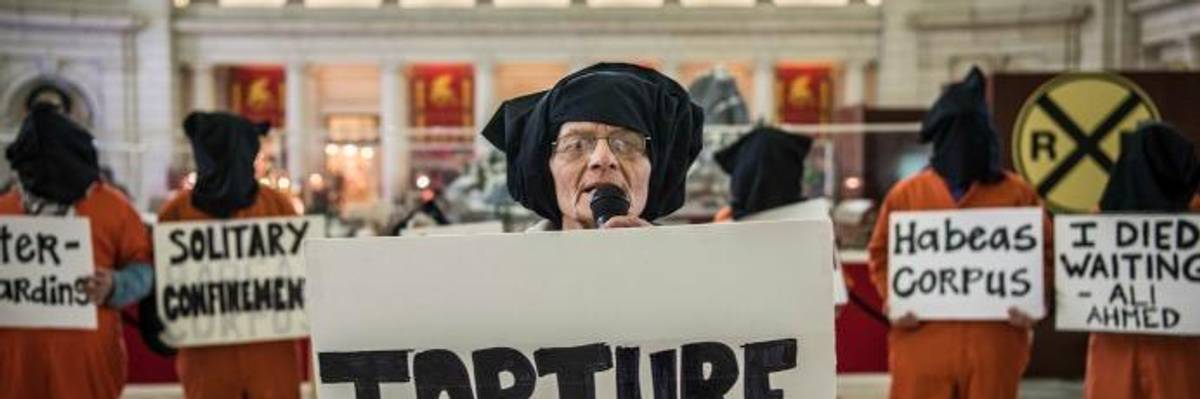
"Due process of law does not permit the arbitrary detention of individuals, particularly at the hands of a president like Donald Trump, who has pledged to prevent any releases from Guantanamo," said CCR's Baher Azmy. (Photo: Justin Norman/flickr/cc)
Lawyers representing a group of men held for over a decade without charge at Guantanamo asked a federal court on Wednesday to provide judicial intervention to stop the men's arbitrary and unlawful imprisonment--continued detention, the legal team says, that is fueled by President Donald Trump's "executive hubris and raw animus."
"Our dangerous experiment in indefinite detention, after 16 years, has run its course," said Baher Azmy, legal director at the Center for Constitutional Rights (CCR), who argued before Judge Thomas Hogan of the U.S. District Court for the District of Columbia.
CCR, human rights organization Reprieve, and other counsel filed on January 11--the offshore prison's 16th anniversary--a challenge to the men's indefinite detention. The habeas corpus motion (pdf) references the "devastating psychological and physiological consequences" and "conditions devised to break human beings" the men continue to experience. In addition to violating the constitutional right to due process, the motion argues:
[Trump's] defiant policy exceeds his authority under the 2001 Authorization for "Use of Military Force ("AUMF"), which permits detention only for the narrow purpose of preventing the return of detainees to the battlefield. Instead, the policy is a symbolic, indifferentiated assertion of this president's expectation of absolute executive authority and a rejection of the policy framework that has governed Guantanamo detentions for years. Not least, it is a demonstration of his antipathy to ward this prisoner population, all foreign-born Muslim men, and toward Muslims more broadly, of the kind courts have properly rejected in recent months.
"The government says my detention is legal because of the indefinite war against terrorism. When terrorism ends, the war will end. So, never," said 43-year-old Sharqawi Al Hajj, a Yemeni who's been detained without charge since 2002. His is among the separate 8 motions Judge Hogan heard.
Al Hajj and the other petitioners, however, were not allowed to listen to their own hearing. The government, which spends over $10 million a year per detainee at Guantanamo, said it didn't have a room to accommodate all the shackled men listening to a live feed. The court agreed with the government that a transcript would suffice.
According to a press statement from Reprieve, Judge Hogan asked U.S. Justice Department attorney Ronald Wiltsie if the AUMF justification would allow the government to detain the men for 116 years.
"Yes," Wiltsie said. "We are still engaged with the same battle foes in the same battle space."
As Azmy stressed, "Due process of law does not permit the arbitrary detention of individuals, particularly at the hands of a president like Donald Trump, who has pledged to prevent any releases from Guantanamo. That position is based not on a meaningful assessment of any actual threat, but on Trump's animosity towards Muslims, including these foreign-born prisoners at Guantanamo--the height of arbitrariness. Short of judicial intervention, Trump will succeed."
Dear Common Dreams reader, It’s been nearly 30 years since I co-founded Common Dreams with my late wife, Lina Newhouser. We had the radical notion that journalism should serve the public good, not corporate profits. It was clear to us from the outset what it would take to build such a project. No paid advertisements. No corporate sponsors. No millionaire publisher telling us what to think or do. Many people said we wouldn't last a year, but we proved those doubters wrong. Together with a tremendous team of journalists and dedicated staff, we built an independent media outlet free from the constraints of profits and corporate control. Our mission has always been simple: To inform. To inspire. To ignite change for the common good. Building Common Dreams was not easy. Our survival was never guaranteed. When you take on the most powerful forces—Wall Street greed, fossil fuel industry destruction, Big Tech lobbyists, and uber-rich oligarchs who have spent billions upon billions rigging the economy and democracy in their favor—the only bulwark you have is supporters who believe in your work. But here’s the urgent message from me today. It's never been this bad out there. And it's never been this hard to keep us going. At the very moment Common Dreams is most needed, the threats we face are intensifying. We need your support now more than ever. We don't accept corporate advertising and never will. We don't have a paywall because we don't think people should be blocked from critical news based on their ability to pay. Everything we do is funded by the donations of readers like you. When everyone does the little they can afford, we are strong. But if that support retreats or dries up, so do we. Will you donate now to make sure Common Dreams not only survives but thrives? —Craig Brown, Co-founder |
Lawyers representing a group of men held for over a decade without charge at Guantanamo asked a federal court on Wednesday to provide judicial intervention to stop the men's arbitrary and unlawful imprisonment--continued detention, the legal team says, that is fueled by President Donald Trump's "executive hubris and raw animus."
"Our dangerous experiment in indefinite detention, after 16 years, has run its course," said Baher Azmy, legal director at the Center for Constitutional Rights (CCR), who argued before Judge Thomas Hogan of the U.S. District Court for the District of Columbia.
CCR, human rights organization Reprieve, and other counsel filed on January 11--the offshore prison's 16th anniversary--a challenge to the men's indefinite detention. The habeas corpus motion (pdf) references the "devastating psychological and physiological consequences" and "conditions devised to break human beings" the men continue to experience. In addition to violating the constitutional right to due process, the motion argues:
[Trump's] defiant policy exceeds his authority under the 2001 Authorization for "Use of Military Force ("AUMF"), which permits detention only for the narrow purpose of preventing the return of detainees to the battlefield. Instead, the policy is a symbolic, indifferentiated assertion of this president's expectation of absolute executive authority and a rejection of the policy framework that has governed Guantanamo detentions for years. Not least, it is a demonstration of his antipathy to ward this prisoner population, all foreign-born Muslim men, and toward Muslims more broadly, of the kind courts have properly rejected in recent months.
"The government says my detention is legal because of the indefinite war against terrorism. When terrorism ends, the war will end. So, never," said 43-year-old Sharqawi Al Hajj, a Yemeni who's been detained without charge since 2002. His is among the separate 8 motions Judge Hogan heard.
Al Hajj and the other petitioners, however, were not allowed to listen to their own hearing. The government, which spends over $10 million a year per detainee at Guantanamo, said it didn't have a room to accommodate all the shackled men listening to a live feed. The court agreed with the government that a transcript would suffice.
According to a press statement from Reprieve, Judge Hogan asked U.S. Justice Department attorney Ronald Wiltsie if the AUMF justification would allow the government to detain the men for 116 years.
"Yes," Wiltsie said. "We are still engaged with the same battle foes in the same battle space."
As Azmy stressed, "Due process of law does not permit the arbitrary detention of individuals, particularly at the hands of a president like Donald Trump, who has pledged to prevent any releases from Guantanamo. That position is based not on a meaningful assessment of any actual threat, but on Trump's animosity towards Muslims, including these foreign-born prisoners at Guantanamo--the height of arbitrariness. Short of judicial intervention, Trump will succeed."
Lawyers representing a group of men held for over a decade without charge at Guantanamo asked a federal court on Wednesday to provide judicial intervention to stop the men's arbitrary and unlawful imprisonment--continued detention, the legal team says, that is fueled by President Donald Trump's "executive hubris and raw animus."
"Our dangerous experiment in indefinite detention, after 16 years, has run its course," said Baher Azmy, legal director at the Center for Constitutional Rights (CCR), who argued before Judge Thomas Hogan of the U.S. District Court for the District of Columbia.
CCR, human rights organization Reprieve, and other counsel filed on January 11--the offshore prison's 16th anniversary--a challenge to the men's indefinite detention. The habeas corpus motion (pdf) references the "devastating psychological and physiological consequences" and "conditions devised to break human beings" the men continue to experience. In addition to violating the constitutional right to due process, the motion argues:
[Trump's] defiant policy exceeds his authority under the 2001 Authorization for "Use of Military Force ("AUMF"), which permits detention only for the narrow purpose of preventing the return of detainees to the battlefield. Instead, the policy is a symbolic, indifferentiated assertion of this president's expectation of absolute executive authority and a rejection of the policy framework that has governed Guantanamo detentions for years. Not least, it is a demonstration of his antipathy to ward this prisoner population, all foreign-born Muslim men, and toward Muslims more broadly, of the kind courts have properly rejected in recent months.
"The government says my detention is legal because of the indefinite war against terrorism. When terrorism ends, the war will end. So, never," said 43-year-old Sharqawi Al Hajj, a Yemeni who's been detained without charge since 2002. His is among the separate 8 motions Judge Hogan heard.
Al Hajj and the other petitioners, however, were not allowed to listen to their own hearing. The government, which spends over $10 million a year per detainee at Guantanamo, said it didn't have a room to accommodate all the shackled men listening to a live feed. The court agreed with the government that a transcript would suffice.
According to a press statement from Reprieve, Judge Hogan asked U.S. Justice Department attorney Ronald Wiltsie if the AUMF justification would allow the government to detain the men for 116 years.
"Yes," Wiltsie said. "We are still engaged with the same battle foes in the same battle space."
As Azmy stressed, "Due process of law does not permit the arbitrary detention of individuals, particularly at the hands of a president like Donald Trump, who has pledged to prevent any releases from Guantanamo. That position is based not on a meaningful assessment of any actual threat, but on Trump's animosity towards Muslims, including these foreign-born prisoners at Guantanamo--the height of arbitrariness. Short of judicial intervention, Trump will succeed."

