SUBSCRIBE TO OUR FREE NEWSLETTER
Daily news & progressive opinion—funded by the people, not the corporations—delivered straight to your inbox.
5
#000000
#FFFFFF
To donate by check, phone, or other method, see our More Ways to Give page.
Daily news & progressive opinion—funded by the people, not the corporations—delivered straight to your inbox.
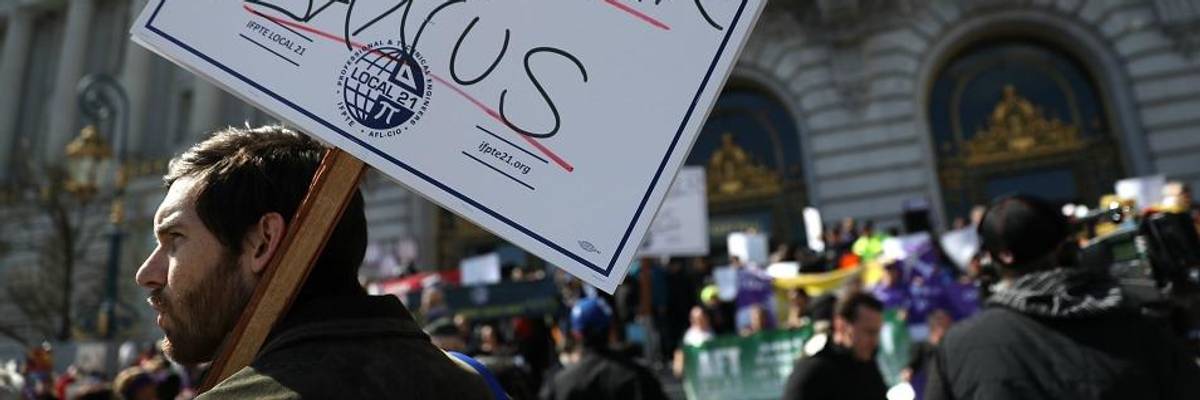
Hundreds of union members held a rally outside of San Francisco City Hall as the U.S. Supreme Court begins to hear oral arguments in the Janus vs. AFSCME case that union memebers and supporters claim would limit their right to union representation by allowing members to not pay dues but still receive representation. (Photo: Justin Sullivan/Getty Images)
Progressive voices in Congress spoke out on Wednesday against the U.S. Supreme Court's attack on public sector unions, as the nation's top justices ruled 5-4 against the largest public sector union in the country in a landmark case over union fees--and vowed to continue fighting for workers' rights alongside working Americans.
Progressive voices in Congress vowed to stand with workers and defend labor rights on Wednesday after the U.S. Supreme Court ruled 5-4 against the largest public sector union in the country in a landmark case over union fees.
Rep. Keith Ellison (D-Minn.) highlighted the infectious energy of protests and strikes by teachers across the country this past spring--with educators and supporters in red states including West Virginia, Kentucky, Oklahoma, and Arizona walking off their jobs to demand higher wages, education funding to make up for years of cuts, and an end to corporate tax cuts.
The protests resulted in raises for teachers in West Virginia and Oklahoma as well as more than $130 million in funding for schools in Arizona.
Under the Supreme Court's ruling in Janus vs. AFSCME, public sector workers who opt not to join unions will not be required to pay union fees--a decision that could drastically undermine union representatives' ability to negotiate on behalf of workers.
As Ellison alluded to his tweet, the case of Mark Janus, an employee of Illinois's health department, against AFSCME received backing from the right-wing Illinois Policy Institute. One of the group's largest supporters is Richard Uihlein, a wealthy Republican megadonor who has also given over $1 million to groups working to create a more conservative Supreme Court.
Sen. Elizabeth Warren (D-Mass.) released a video featuring labor leaders including American Federation of Teachers president Randi Weingarten and Lee Saunders, president of AFSCME, and attacking the corporate interests which helped deliver a crushing blow to public sector workers.
"Unions built America's middle class and unions will rebuild America's middle class," Warren said. "Working people deserve fair pay, good benefits, predictable schedules, and a real voice in the workplace. That's why I stand with unions all the way. We're not going anywhere."
"No one wanted this case," Weingarten told the New York Times regarding Janus. "But the gestalt around the country has been to turn an existential threat into an opportunity to engage with our members like never before."
Sen. Bernie Sanders (I-Vt.) also denounced the Supreme Court's decision, while issuing a rallying cry to workers across the country.
Journalist Sarah Jaffe joined the lawmakers in urging American workers to look to the recent teachers' movement as a guide for how weakened unions can secure fair treatment.
"The court has decided that labor peace will no longer be traded for fees; labor can look to West Virginia for an example of what the end of labor peace looks like," wrote Jaffe in the Times. "Healthcare and education workers in particular--but also public employees in general--have a distinct ability to bring the community together around their demands...The recent strike wave has reminded us that unions win more when they bargain with politicians from a place of strength. And the power that unions have--the power they have always had--is in people, not in dollars spent."
Dear Common Dreams reader, It’s been nearly 30 years since I co-founded Common Dreams with my late wife, Lina Newhouser. We had the radical notion that journalism should serve the public good, not corporate profits. It was clear to us from the outset what it would take to build such a project. No paid advertisements. No corporate sponsors. No millionaire publisher telling us what to think or do. Many people said we wouldn't last a year, but we proved those doubters wrong. Together with a tremendous team of journalists and dedicated staff, we built an independent media outlet free from the constraints of profits and corporate control. Our mission has always been simple: To inform. To inspire. To ignite change for the common good. Building Common Dreams was not easy. Our survival was never guaranteed. When you take on the most powerful forces—Wall Street greed, fossil fuel industry destruction, Big Tech lobbyists, and uber-rich oligarchs who have spent billions upon billions rigging the economy and democracy in their favor—the only bulwark you have is supporters who believe in your work. But here’s the urgent message from me today. It's never been this bad out there. And it's never been this hard to keep us going. At the very moment Common Dreams is most needed, the threats we face are intensifying. We need your support now more than ever. We don't accept corporate advertising and never will. We don't have a paywall because we don't think people should be blocked from critical news based on their ability to pay. Everything we do is funded by the donations of readers like you. When everyone does the little they can afford, we are strong. But if that support retreats or dries up, so do we. Will you donate now to make sure Common Dreams not only survives but thrives? —Craig Brown, Co-founder |
Progressive voices in Congress spoke out on Wednesday against the U.S. Supreme Court's attack on public sector unions, as the nation's top justices ruled 5-4 against the largest public sector union in the country in a landmark case over union fees--and vowed to continue fighting for workers' rights alongside working Americans.
Progressive voices in Congress vowed to stand with workers and defend labor rights on Wednesday after the U.S. Supreme Court ruled 5-4 against the largest public sector union in the country in a landmark case over union fees.
Rep. Keith Ellison (D-Minn.) highlighted the infectious energy of protests and strikes by teachers across the country this past spring--with educators and supporters in red states including West Virginia, Kentucky, Oklahoma, and Arizona walking off their jobs to demand higher wages, education funding to make up for years of cuts, and an end to corporate tax cuts.
The protests resulted in raises for teachers in West Virginia and Oklahoma as well as more than $130 million in funding for schools in Arizona.
Under the Supreme Court's ruling in Janus vs. AFSCME, public sector workers who opt not to join unions will not be required to pay union fees--a decision that could drastically undermine union representatives' ability to negotiate on behalf of workers.
As Ellison alluded to his tweet, the case of Mark Janus, an employee of Illinois's health department, against AFSCME received backing from the right-wing Illinois Policy Institute. One of the group's largest supporters is Richard Uihlein, a wealthy Republican megadonor who has also given over $1 million to groups working to create a more conservative Supreme Court.
Sen. Elizabeth Warren (D-Mass.) released a video featuring labor leaders including American Federation of Teachers president Randi Weingarten and Lee Saunders, president of AFSCME, and attacking the corporate interests which helped deliver a crushing blow to public sector workers.
"Unions built America's middle class and unions will rebuild America's middle class," Warren said. "Working people deserve fair pay, good benefits, predictable schedules, and a real voice in the workplace. That's why I stand with unions all the way. We're not going anywhere."
"No one wanted this case," Weingarten told the New York Times regarding Janus. "But the gestalt around the country has been to turn an existential threat into an opportunity to engage with our members like never before."
Sen. Bernie Sanders (I-Vt.) also denounced the Supreme Court's decision, while issuing a rallying cry to workers across the country.
Journalist Sarah Jaffe joined the lawmakers in urging American workers to look to the recent teachers' movement as a guide for how weakened unions can secure fair treatment.
"The court has decided that labor peace will no longer be traded for fees; labor can look to West Virginia for an example of what the end of labor peace looks like," wrote Jaffe in the Times. "Healthcare and education workers in particular--but also public employees in general--have a distinct ability to bring the community together around their demands...The recent strike wave has reminded us that unions win more when they bargain with politicians from a place of strength. And the power that unions have--the power they have always had--is in people, not in dollars spent."
Progressive voices in Congress spoke out on Wednesday against the U.S. Supreme Court's attack on public sector unions, as the nation's top justices ruled 5-4 against the largest public sector union in the country in a landmark case over union fees--and vowed to continue fighting for workers' rights alongside working Americans.
Progressive voices in Congress vowed to stand with workers and defend labor rights on Wednesday after the U.S. Supreme Court ruled 5-4 against the largest public sector union in the country in a landmark case over union fees.
Rep. Keith Ellison (D-Minn.) highlighted the infectious energy of protests and strikes by teachers across the country this past spring--with educators and supporters in red states including West Virginia, Kentucky, Oklahoma, and Arizona walking off their jobs to demand higher wages, education funding to make up for years of cuts, and an end to corporate tax cuts.
The protests resulted in raises for teachers in West Virginia and Oklahoma as well as more than $130 million in funding for schools in Arizona.
Under the Supreme Court's ruling in Janus vs. AFSCME, public sector workers who opt not to join unions will not be required to pay union fees--a decision that could drastically undermine union representatives' ability to negotiate on behalf of workers.
As Ellison alluded to his tweet, the case of Mark Janus, an employee of Illinois's health department, against AFSCME received backing from the right-wing Illinois Policy Institute. One of the group's largest supporters is Richard Uihlein, a wealthy Republican megadonor who has also given over $1 million to groups working to create a more conservative Supreme Court.
Sen. Elizabeth Warren (D-Mass.) released a video featuring labor leaders including American Federation of Teachers president Randi Weingarten and Lee Saunders, president of AFSCME, and attacking the corporate interests which helped deliver a crushing blow to public sector workers.
"Unions built America's middle class and unions will rebuild America's middle class," Warren said. "Working people deserve fair pay, good benefits, predictable schedules, and a real voice in the workplace. That's why I stand with unions all the way. We're not going anywhere."
"No one wanted this case," Weingarten told the New York Times regarding Janus. "But the gestalt around the country has been to turn an existential threat into an opportunity to engage with our members like never before."
Sen. Bernie Sanders (I-Vt.) also denounced the Supreme Court's decision, while issuing a rallying cry to workers across the country.
Journalist Sarah Jaffe joined the lawmakers in urging American workers to look to the recent teachers' movement as a guide for how weakened unions can secure fair treatment.
"The court has decided that labor peace will no longer be traded for fees; labor can look to West Virginia for an example of what the end of labor peace looks like," wrote Jaffe in the Times. "Healthcare and education workers in particular--but also public employees in general--have a distinct ability to bring the community together around their demands...The recent strike wave has reminded us that unions win more when they bargain with politicians from a place of strength. And the power that unions have--the power they have always had--is in people, not in dollars spent."