SUBSCRIBE TO OUR FREE NEWSLETTER
Daily news & progressive opinion—funded by the people, not the corporations—delivered straight to your inbox.
5
#000000
#FFFFFF
To donate by check, phone, or other method, see our More Ways to Give page.
Daily news & progressive opinion—funded by the people, not the corporations—delivered straight to your inbox.
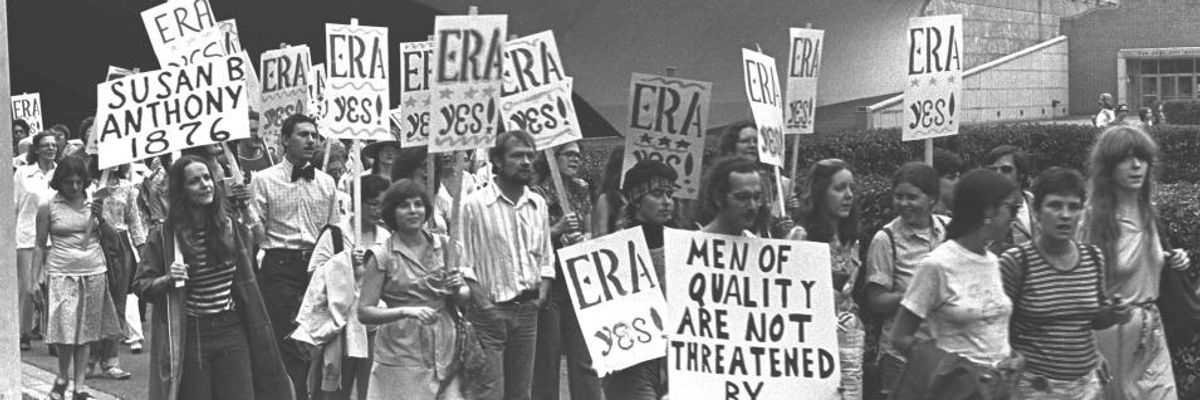
Thirty-six years after Congress approved the Equal Rights Amendment (ERA), Illinois became the 37th state to ratify it--leaving 13 states still failing to make the amendment official. (Photo: Barbara Freeman/Getty Images)
Following Illinois's long-awaited ratification of the Equal Rights Amendment (ERA) this week, women's rights advocates turned their attention to the 13 states that have yet to pass the amendment, 46 years after it was overwhelmingly passed by Congress and 36 years after a deadline for ratification passed.
With 37 states now having ratified the ERA, just one more state needs to take the step to win the approval of two-thirds of the states, which would bring the amendment one step closer to being added to the U.S. Constitution.
"Anything is possible," Bettina Hager, the Washington, D.C. director of the ERA Coalition, told Virginia's Richmond Times-Dispatch of the amendment's chances at the federal level. "We haven't had the momentum we have now."
Alabama, Arizona, Arkansas, Florida, Georgia, Louisiana, Mississippi, Missouri, North Carolina, Oklahoma, South Carolina, Utah, and Virginia have yet to sign off on the ERA. An effort to ratify it in Virginia's Republican-controlled legislature failed in February, with nine male lawmakers on the state's Senate Rules Committee overruling the five senators who supported the amendment.
Still, activists are now focusing their energy on Virginia as well as North Carolina and Georgia according to the Times-Dispatch, in an attempt to find the 38th state that will pass the amendment. Once 38 states ratify the ERA, Congress could vote to extend the ratification deadline--which passed in 1982--clearing the way for the amendment to become constitutional law.
Advocates from some of the 13 remaining states posted on social media about efforts to become the 38th state.
The ERA states that "Equality of rights under the law shall not be denied or abridged by the United States or by any state on account of sex." The first ERA was proposed in Congress in 1923, three years after the 19th amendment gave women the right to vote. However, it was not passed until 1972.
The National Organization for Women (NOW) noted that the #MeToo movement deserved credit for mobilizing nationwide efforts to ensure equal rights for women in recent months, contributing to a resurgence of ERA advocacy.
"The #MeToo movement has underscored the importance of strong legal protections for women's rights, and our resolve to secure these Constitutional guarantees is unwavering," NOW's President Toni Van Pelt told NPR on Wednesday.
Dear Common Dreams reader, It’s been nearly 30 years since I co-founded Common Dreams with my late wife, Lina Newhouser. We had the radical notion that journalism should serve the public good, not corporate profits. It was clear to us from the outset what it would take to build such a project. No paid advertisements. No corporate sponsors. No millionaire publisher telling us what to think or do. Many people said we wouldn't last a year, but we proved those doubters wrong. Together with a tremendous team of journalists and dedicated staff, we built an independent media outlet free from the constraints of profits and corporate control. Our mission has always been simple: To inform. To inspire. To ignite change for the common good. Building Common Dreams was not easy. Our survival was never guaranteed. When you take on the most powerful forces—Wall Street greed, fossil fuel industry destruction, Big Tech lobbyists, and uber-rich oligarchs who have spent billions upon billions rigging the economy and democracy in their favor—the only bulwark you have is supporters who believe in your work. But here’s the urgent message from me today. It's never been this bad out there. And it's never been this hard to keep us going. At the very moment Common Dreams is most needed, the threats we face are intensifying. We need your support now more than ever. We don't accept corporate advertising and never will. We don't have a paywall because we don't think people should be blocked from critical news based on their ability to pay. Everything we do is funded by the donations of readers like you. When everyone does the little they can afford, we are strong. But if that support retreats or dries up, so do we. Will you donate now to make sure Common Dreams not only survives but thrives? —Craig Brown, Co-founder |
Following Illinois's long-awaited ratification of the Equal Rights Amendment (ERA) this week, women's rights advocates turned their attention to the 13 states that have yet to pass the amendment, 46 years after it was overwhelmingly passed by Congress and 36 years after a deadline for ratification passed.
With 37 states now having ratified the ERA, just one more state needs to take the step to win the approval of two-thirds of the states, which would bring the amendment one step closer to being added to the U.S. Constitution.
"Anything is possible," Bettina Hager, the Washington, D.C. director of the ERA Coalition, told Virginia's Richmond Times-Dispatch of the amendment's chances at the federal level. "We haven't had the momentum we have now."
Alabama, Arizona, Arkansas, Florida, Georgia, Louisiana, Mississippi, Missouri, North Carolina, Oklahoma, South Carolina, Utah, and Virginia have yet to sign off on the ERA. An effort to ratify it in Virginia's Republican-controlled legislature failed in February, with nine male lawmakers on the state's Senate Rules Committee overruling the five senators who supported the amendment.
Still, activists are now focusing their energy on Virginia as well as North Carolina and Georgia according to the Times-Dispatch, in an attempt to find the 38th state that will pass the amendment. Once 38 states ratify the ERA, Congress could vote to extend the ratification deadline--which passed in 1982--clearing the way for the amendment to become constitutional law.
Advocates from some of the 13 remaining states posted on social media about efforts to become the 38th state.
The ERA states that "Equality of rights under the law shall not be denied or abridged by the United States or by any state on account of sex." The first ERA was proposed in Congress in 1923, three years after the 19th amendment gave women the right to vote. However, it was not passed until 1972.
The National Organization for Women (NOW) noted that the #MeToo movement deserved credit for mobilizing nationwide efforts to ensure equal rights for women in recent months, contributing to a resurgence of ERA advocacy.
"The #MeToo movement has underscored the importance of strong legal protections for women's rights, and our resolve to secure these Constitutional guarantees is unwavering," NOW's President Toni Van Pelt told NPR on Wednesday.
Following Illinois's long-awaited ratification of the Equal Rights Amendment (ERA) this week, women's rights advocates turned their attention to the 13 states that have yet to pass the amendment, 46 years after it was overwhelmingly passed by Congress and 36 years after a deadline for ratification passed.
With 37 states now having ratified the ERA, just one more state needs to take the step to win the approval of two-thirds of the states, which would bring the amendment one step closer to being added to the U.S. Constitution.
"Anything is possible," Bettina Hager, the Washington, D.C. director of the ERA Coalition, told Virginia's Richmond Times-Dispatch of the amendment's chances at the federal level. "We haven't had the momentum we have now."
Alabama, Arizona, Arkansas, Florida, Georgia, Louisiana, Mississippi, Missouri, North Carolina, Oklahoma, South Carolina, Utah, and Virginia have yet to sign off on the ERA. An effort to ratify it in Virginia's Republican-controlled legislature failed in February, with nine male lawmakers on the state's Senate Rules Committee overruling the five senators who supported the amendment.
Still, activists are now focusing their energy on Virginia as well as North Carolina and Georgia according to the Times-Dispatch, in an attempt to find the 38th state that will pass the amendment. Once 38 states ratify the ERA, Congress could vote to extend the ratification deadline--which passed in 1982--clearing the way for the amendment to become constitutional law.
Advocates from some of the 13 remaining states posted on social media about efforts to become the 38th state.
The ERA states that "Equality of rights under the law shall not be denied or abridged by the United States or by any state on account of sex." The first ERA was proposed in Congress in 1923, three years after the 19th amendment gave women the right to vote. However, it was not passed until 1972.
The National Organization for Women (NOW) noted that the #MeToo movement deserved credit for mobilizing nationwide efforts to ensure equal rights for women in recent months, contributing to a resurgence of ERA advocacy.
"The #MeToo movement has underscored the importance of strong legal protections for women's rights, and our resolve to secure these Constitutional guarantees is unwavering," NOW's President Toni Van Pelt told NPR on Wednesday.