SUBSCRIBE TO OUR FREE NEWSLETTER
Daily news & progressive opinion—funded by the people, not the corporations—delivered straight to your inbox.
5
#000000
#FFFFFF
To donate by check, phone, or other method, see our More Ways to Give page.
Daily news & progressive opinion—funded by the people, not the corporations—delivered straight to your inbox.
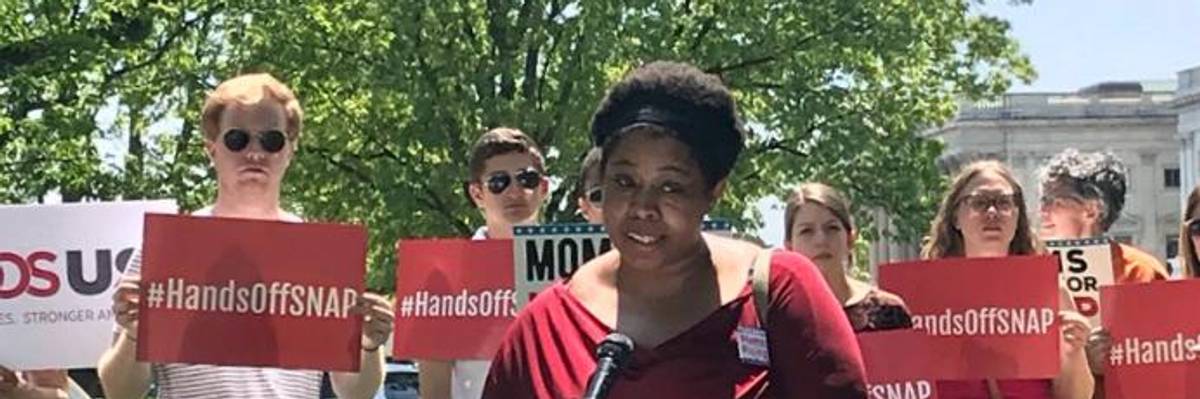
"Right now I need SNAP to get by," Tina Keys, a mother from Washington, explained at a #HandsOffSnap rally outsite the Captiol on May 8. (Photo: @TalkPoverty/Twitter)
While social welfare advocates have launched a #HandsOffSNAP campaign to protest Republican lawmakers' latest attempt to make Supplemental Nutrition Assistance Program (SNAP) benefits--often called food stamps--less accessible, President Donald Trump is reportedly planning to pressure them to include even stricter work requirements in the 2018 Farm Bill.
"What I find just so ludicrous is that we would pass a tax bill, a tax scam, a tax swindle that literally transfers trillions of dollars from working people and those who are most in need to the wealthiest 1%... then somehow come back and say that we can't afford to pay for a program that puts food on the tables of 42 million families."
--Rep. Pramila Jayapal (D-Wash.)
"Trump is expected to tell senior lawmakers in a meeting this week that he will veto the farm bill if it doesn't include tighter work requirements for people receiving food stamps," two people familiar with the president's deliberations told the Wall Street Journal.
While the newspaper notes "it isn't yet clear exactly what type of work requirements Mr. Trump will insist on," the legislation (pdf) unveiled by House Republicans last month already includes a provision requiring adults aged of 18 and 59 who don't have any dependents to work at least 20 hours per week, as Common Dreams has reported.
That measure, spearheaded by House Agriculture Committee Chairman K. Michael Conaway (R-Texas), could kick upwards of a million people out of the SNAP program over the next decade, according to preliminary analysis by the Congressional Budget Office (CBO). In turn, the GOP bill has been met with contempt by social welfare advocates and some Democrats in Congress.
And critics have responded with the #HandsOffSNAP campaign, which included a digital day of action and a rally on Capitol Hill Tuesday. Speaking at the event, Rep. Pramila Jayapal (D-Wash.) referenced the tax bill that Republicans forced through Congress last December, which slashed the corporate tax rate from 35 to 21 percent.
"What I find just so ludicrous is that we would pass a tax bill, a tax scam, a tax swindle that literally transfers trillions of dollars from working people and those who are most in need to the wealthiest 1% and wealthiest corporations--drive up the deficit by a trillion dollars just for next year--and then somehow come back and say that we can't afford to pay for a program that puts food on the tables of 42 million families across our country," Jayapal said. "That is just wrong. "
"Right now I need SNAP to get by," explained Tina Keys, a mother from Washington. "As a single parent my schedule was often unpredictable. If my child got sick I missed a shift and didn't get paid for those hours...it became impossible to raise my son and earn a living wage."
The Center on Budget and Policy Priorities (CBPP) has published a series of policy briefs outlining how the farm bill will harm workers, veterans, older Americans, women, people with disabilities, and children. "SNAP is the country's most effective anti-hunger program, helping one in eight Americans afford a basic diet," according to the CBPP. "For over 15 years, state and federal policymakers have worked on a bipartisan basis to strengthen SNAP. This bill would take a large step backward, reducing or eliminating benefits for more than 1 million households with more than 2 million people."
Dear Common Dreams reader, It’s been nearly 30 years since I co-founded Common Dreams with my late wife, Lina Newhouser. We had the radical notion that journalism should serve the public good, not corporate profits. It was clear to us from the outset what it would take to build such a project. No paid advertisements. No corporate sponsors. No millionaire publisher telling us what to think or do. Many people said we wouldn't last a year, but we proved those doubters wrong. Together with a tremendous team of journalists and dedicated staff, we built an independent media outlet free from the constraints of profits and corporate control. Our mission has always been simple: To inform. To inspire. To ignite change for the common good. Building Common Dreams was not easy. Our survival was never guaranteed. When you take on the most powerful forces—Wall Street greed, fossil fuel industry destruction, Big Tech lobbyists, and uber-rich oligarchs who have spent billions upon billions rigging the economy and democracy in their favor—the only bulwark you have is supporters who believe in your work. But here’s the urgent message from me today. It's never been this bad out there. And it's never been this hard to keep us going. At the very moment Common Dreams is most needed, the threats we face are intensifying. We need your support now more than ever. We don't accept corporate advertising and never will. We don't have a paywall because we don't think people should be blocked from critical news based on their ability to pay. Everything we do is funded by the donations of readers like you. When everyone does the little they can afford, we are strong. But if that support retreats or dries up, so do we. Will you donate now to make sure Common Dreams not only survives but thrives? —Craig Brown, Co-founder |
While social welfare advocates have launched a #HandsOffSNAP campaign to protest Republican lawmakers' latest attempt to make Supplemental Nutrition Assistance Program (SNAP) benefits--often called food stamps--less accessible, President Donald Trump is reportedly planning to pressure them to include even stricter work requirements in the 2018 Farm Bill.
"What I find just so ludicrous is that we would pass a tax bill, a tax scam, a tax swindle that literally transfers trillions of dollars from working people and those who are most in need to the wealthiest 1%... then somehow come back and say that we can't afford to pay for a program that puts food on the tables of 42 million families."
--Rep. Pramila Jayapal (D-Wash.)
"Trump is expected to tell senior lawmakers in a meeting this week that he will veto the farm bill if it doesn't include tighter work requirements for people receiving food stamps," two people familiar with the president's deliberations told the Wall Street Journal.
While the newspaper notes "it isn't yet clear exactly what type of work requirements Mr. Trump will insist on," the legislation (pdf) unveiled by House Republicans last month already includes a provision requiring adults aged of 18 and 59 who don't have any dependents to work at least 20 hours per week, as Common Dreams has reported.
That measure, spearheaded by House Agriculture Committee Chairman K. Michael Conaway (R-Texas), could kick upwards of a million people out of the SNAP program over the next decade, according to preliminary analysis by the Congressional Budget Office (CBO). In turn, the GOP bill has been met with contempt by social welfare advocates and some Democrats in Congress.
And critics have responded with the #HandsOffSNAP campaign, which included a digital day of action and a rally on Capitol Hill Tuesday. Speaking at the event, Rep. Pramila Jayapal (D-Wash.) referenced the tax bill that Republicans forced through Congress last December, which slashed the corporate tax rate from 35 to 21 percent.
"What I find just so ludicrous is that we would pass a tax bill, a tax scam, a tax swindle that literally transfers trillions of dollars from working people and those who are most in need to the wealthiest 1% and wealthiest corporations--drive up the deficit by a trillion dollars just for next year--and then somehow come back and say that we can't afford to pay for a program that puts food on the tables of 42 million families across our country," Jayapal said. "That is just wrong. "
"Right now I need SNAP to get by," explained Tina Keys, a mother from Washington. "As a single parent my schedule was often unpredictable. If my child got sick I missed a shift and didn't get paid for those hours...it became impossible to raise my son and earn a living wage."
The Center on Budget and Policy Priorities (CBPP) has published a series of policy briefs outlining how the farm bill will harm workers, veterans, older Americans, women, people with disabilities, and children. "SNAP is the country's most effective anti-hunger program, helping one in eight Americans afford a basic diet," according to the CBPP. "For over 15 years, state and federal policymakers have worked on a bipartisan basis to strengthen SNAP. This bill would take a large step backward, reducing or eliminating benefits for more than 1 million households with more than 2 million people."
While social welfare advocates have launched a #HandsOffSNAP campaign to protest Republican lawmakers' latest attempt to make Supplemental Nutrition Assistance Program (SNAP) benefits--often called food stamps--less accessible, President Donald Trump is reportedly planning to pressure them to include even stricter work requirements in the 2018 Farm Bill.
"What I find just so ludicrous is that we would pass a tax bill, a tax scam, a tax swindle that literally transfers trillions of dollars from working people and those who are most in need to the wealthiest 1%... then somehow come back and say that we can't afford to pay for a program that puts food on the tables of 42 million families."
--Rep. Pramila Jayapal (D-Wash.)
"Trump is expected to tell senior lawmakers in a meeting this week that he will veto the farm bill if it doesn't include tighter work requirements for people receiving food stamps," two people familiar with the president's deliberations told the Wall Street Journal.
While the newspaper notes "it isn't yet clear exactly what type of work requirements Mr. Trump will insist on," the legislation (pdf) unveiled by House Republicans last month already includes a provision requiring adults aged of 18 and 59 who don't have any dependents to work at least 20 hours per week, as Common Dreams has reported.
That measure, spearheaded by House Agriculture Committee Chairman K. Michael Conaway (R-Texas), could kick upwards of a million people out of the SNAP program over the next decade, according to preliminary analysis by the Congressional Budget Office (CBO). In turn, the GOP bill has been met with contempt by social welfare advocates and some Democrats in Congress.
And critics have responded with the #HandsOffSNAP campaign, which included a digital day of action and a rally on Capitol Hill Tuesday. Speaking at the event, Rep. Pramila Jayapal (D-Wash.) referenced the tax bill that Republicans forced through Congress last December, which slashed the corporate tax rate from 35 to 21 percent.
"What I find just so ludicrous is that we would pass a tax bill, a tax scam, a tax swindle that literally transfers trillions of dollars from working people and those who are most in need to the wealthiest 1% and wealthiest corporations--drive up the deficit by a trillion dollars just for next year--and then somehow come back and say that we can't afford to pay for a program that puts food on the tables of 42 million families across our country," Jayapal said. "That is just wrong. "
"Right now I need SNAP to get by," explained Tina Keys, a mother from Washington. "As a single parent my schedule was often unpredictable. If my child got sick I missed a shift and didn't get paid for those hours...it became impossible to raise my son and earn a living wage."
The Center on Budget and Policy Priorities (CBPP) has published a series of policy briefs outlining how the farm bill will harm workers, veterans, older Americans, women, people with disabilities, and children. "SNAP is the country's most effective anti-hunger program, helping one in eight Americans afford a basic diet," according to the CBPP. "For over 15 years, state and federal policymakers have worked on a bipartisan basis to strengthen SNAP. This bill would take a large step backward, reducing or eliminating benefits for more than 1 million households with more than 2 million people."