SUBSCRIBE TO OUR FREE NEWSLETTER
Daily news & progressive opinion—funded by the people, not the corporations—delivered straight to your inbox.
5
#000000
#FFFFFF
To donate by check, phone, or other method, see our More Ways to Give page.
Daily news & progressive opinion—funded by the people, not the corporations—delivered straight to your inbox.
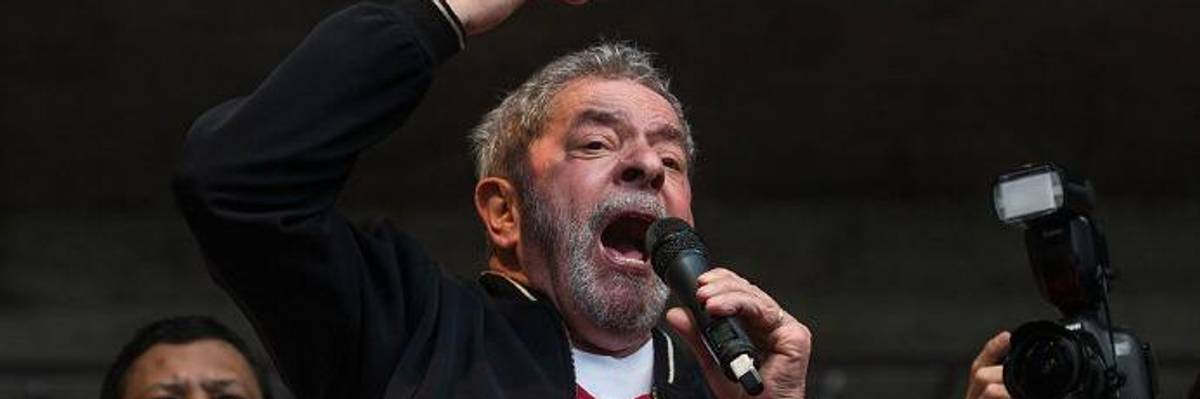
Union members celebrate May Day at the ''Vale do Anhangabau'' in Sao Paulo, Brazil. (Photo by Victor Moriyama/Getty Images)
In what has been denounced as an "assault on democracy," Brazil's Supreme Court on Thursday narrowly ruled that former President Luiz Inacio Lula da Silva must begin serving a 12-year sentence on corruption charges that many have argued are part of a false and politically motivated campaign against the nation's most popular political figure.
"Brazil's rightwing knows that it wouldn't stand a chance against Lula in this year's elections."
-- Mark Weisbrot, Center for Economic and Policy Research"This latest move to circumvent democratic process and keep a popular candidate out of office is another serious blow to Brazil's democratic institutions," Mark Weisbrot, co-director for the Center for Economic and Policy Research (CEPR), said in a statement responding to the ruling. "It's the second in a one-two punch, the first being the unconstitutional impeachment and removal of elected president Dilma Rousseff in 2016 for something that had been done by previous administrations and was not even a crime."
"Brazil's rightwing knows that it wouldn't stand a chance against Lula in this year's elections, just as it twice lost elections to Lula before, and then twice more to Dilma," Weisbrot added. "So, as with Dilma, they are using other means to keep him out of office."
The court's ruling on Thursday--which was accompanied by massive demonstrations in support of Lula--further destabilizes Brazil's already chaotic political scene, as Lula was widely viewed as the frontrunner heading into the October elections.
Responding to the Supreme Court's ruling in a statement on Thursday, Brazil's Workers' Party--which was launched in 1980 by Lula and a group of left-wing intellectuals and unionists--said Lula's campaign for the presidency will continue, even if he is behind bars.
"The Brazilian people have the right to vote for Lula, the candidate of hope," the statement reads. "The Workers' Party will defend his candidacy in the streets in all circumstances, until the end."
In a letter published in the Guardian on Thursday, a group of British members of parliament, academics, and activists denounced the "concerted campaign against [Lula], where his basic human rights have been breached" and said he should be allowed to continue his presidential campaign.
"Lula has been subjected to a political prosecution and conviction, ignoring evidence of his innocence, and triggering a crisis of confidence in the rule of law," the letter contines. "This is not just about one man but the future of democracy in Brazil. We believe he should be allowed to stand and the Brazilian people allowed to decide their own future."
Dear Common Dreams reader, It’s been nearly 30 years since I co-founded Common Dreams with my late wife, Lina Newhouser. We had the radical notion that journalism should serve the public good, not corporate profits. It was clear to us from the outset what it would take to build such a project. No paid advertisements. No corporate sponsors. No millionaire publisher telling us what to think or do. Many people said we wouldn't last a year, but we proved those doubters wrong. Together with a tremendous team of journalists and dedicated staff, we built an independent media outlet free from the constraints of profits and corporate control. Our mission has always been simple: To inform. To inspire. To ignite change for the common good. Building Common Dreams was not easy. Our survival was never guaranteed. When you take on the most powerful forces—Wall Street greed, fossil fuel industry destruction, Big Tech lobbyists, and uber-rich oligarchs who have spent billions upon billions rigging the economy and democracy in their favor—the only bulwark you have is supporters who believe in your work. But here’s the urgent message from me today. It's never been this bad out there. And it's never been this hard to keep us going. At the very moment Common Dreams is most needed, the threats we face are intensifying. We need your support now more than ever. We don't accept corporate advertising and never will. We don't have a paywall because we don't think people should be blocked from critical news based on their ability to pay. Everything we do is funded by the donations of readers like you. When everyone does the little they can afford, we are strong. But if that support retreats or dries up, so do we. Will you donate now to make sure Common Dreams not only survives but thrives? —Craig Brown, Co-founder |
In what has been denounced as an "assault on democracy," Brazil's Supreme Court on Thursday narrowly ruled that former President Luiz Inacio Lula da Silva must begin serving a 12-year sentence on corruption charges that many have argued are part of a false and politically motivated campaign against the nation's most popular political figure.
"Brazil's rightwing knows that it wouldn't stand a chance against Lula in this year's elections."
-- Mark Weisbrot, Center for Economic and Policy Research"This latest move to circumvent democratic process and keep a popular candidate out of office is another serious blow to Brazil's democratic institutions," Mark Weisbrot, co-director for the Center for Economic and Policy Research (CEPR), said in a statement responding to the ruling. "It's the second in a one-two punch, the first being the unconstitutional impeachment and removal of elected president Dilma Rousseff in 2016 for something that had been done by previous administrations and was not even a crime."
"Brazil's rightwing knows that it wouldn't stand a chance against Lula in this year's elections, just as it twice lost elections to Lula before, and then twice more to Dilma," Weisbrot added. "So, as with Dilma, they are using other means to keep him out of office."
The court's ruling on Thursday--which was accompanied by massive demonstrations in support of Lula--further destabilizes Brazil's already chaotic political scene, as Lula was widely viewed as the frontrunner heading into the October elections.
Responding to the Supreme Court's ruling in a statement on Thursday, Brazil's Workers' Party--which was launched in 1980 by Lula and a group of left-wing intellectuals and unionists--said Lula's campaign for the presidency will continue, even if he is behind bars.
"The Brazilian people have the right to vote for Lula, the candidate of hope," the statement reads. "The Workers' Party will defend his candidacy in the streets in all circumstances, until the end."
In a letter published in the Guardian on Thursday, a group of British members of parliament, academics, and activists denounced the "concerted campaign against [Lula], where his basic human rights have been breached" and said he should be allowed to continue his presidential campaign.
"Lula has been subjected to a political prosecution and conviction, ignoring evidence of his innocence, and triggering a crisis of confidence in the rule of law," the letter contines. "This is not just about one man but the future of democracy in Brazil. We believe he should be allowed to stand and the Brazilian people allowed to decide their own future."
In what has been denounced as an "assault on democracy," Brazil's Supreme Court on Thursday narrowly ruled that former President Luiz Inacio Lula da Silva must begin serving a 12-year sentence on corruption charges that many have argued are part of a false and politically motivated campaign against the nation's most popular political figure.
"Brazil's rightwing knows that it wouldn't stand a chance against Lula in this year's elections."
-- Mark Weisbrot, Center for Economic and Policy Research"This latest move to circumvent democratic process and keep a popular candidate out of office is another serious blow to Brazil's democratic institutions," Mark Weisbrot, co-director for the Center for Economic and Policy Research (CEPR), said in a statement responding to the ruling. "It's the second in a one-two punch, the first being the unconstitutional impeachment and removal of elected president Dilma Rousseff in 2016 for something that had been done by previous administrations and was not even a crime."
"Brazil's rightwing knows that it wouldn't stand a chance against Lula in this year's elections, just as it twice lost elections to Lula before, and then twice more to Dilma," Weisbrot added. "So, as with Dilma, they are using other means to keep him out of office."
The court's ruling on Thursday--which was accompanied by massive demonstrations in support of Lula--further destabilizes Brazil's already chaotic political scene, as Lula was widely viewed as the frontrunner heading into the October elections.
Responding to the Supreme Court's ruling in a statement on Thursday, Brazil's Workers' Party--which was launched in 1980 by Lula and a group of left-wing intellectuals and unionists--said Lula's campaign for the presidency will continue, even if he is behind bars.
"The Brazilian people have the right to vote for Lula, the candidate of hope," the statement reads. "The Workers' Party will defend his candidacy in the streets in all circumstances, until the end."
In a letter published in the Guardian on Thursday, a group of British members of parliament, academics, and activists denounced the "concerted campaign against [Lula], where his basic human rights have been breached" and said he should be allowed to continue his presidential campaign.
"Lula has been subjected to a political prosecution and conviction, ignoring evidence of his innocence, and triggering a crisis of confidence in the rule of law," the letter contines. "This is not just about one man but the future of democracy in Brazil. We believe he should be allowed to stand and the Brazilian people allowed to decide their own future."