

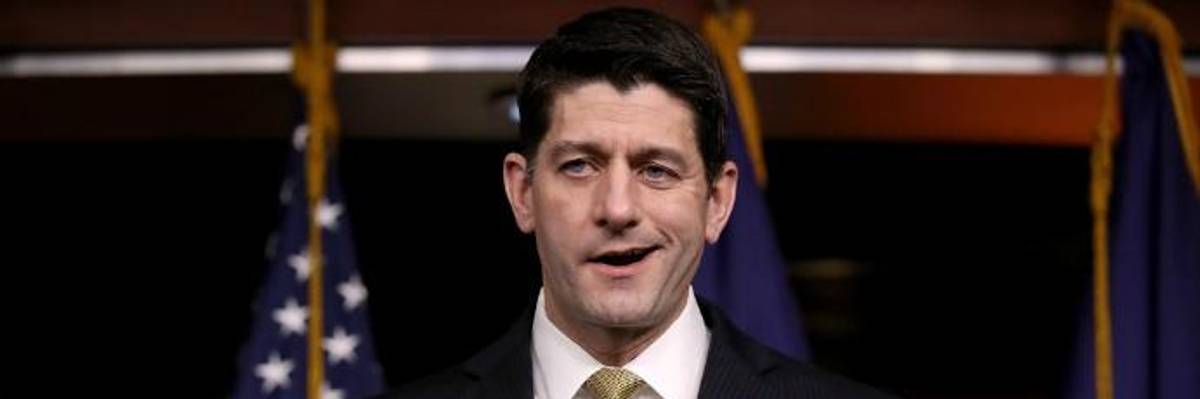
Speaker of the House Paul Ryan (R-Wis.) answers questions on the possibility of a government shutdown at the U.S. Capitol on January 18, 2018 in Washington, D.C. (Photo: Win McNamee/Getty Images)
In Ploy to 'Force' Deep Safety Net Cuts, GOP Reportedly Planning Vote on Balanced Budget Amendment
"Lying, ultra-hypocritical Republicans to take up a balanced budget amendment to deflect attention from their massive $2 trillion increase in the deficit with their tax give-away to the wealthy."
Sparking fresh alarm that the GOP is preparing to take an axe to America's already inadequate safety net, Politico reported on Wednesday that House Republicans are planning to take up a "balanced budget amendment" when Congress returns from recess--news that comes just months after the GOP passed a tax bill that analysts say could add nearly $2 trillion to the deficit over the next decade.
"A balanced budget amendment is the GOP dream, because it means every tax cut for the rich will 'force' them to cut programs for the poor."
--Josh Mound"A balanced budget amendment is the GOP dream, because it means every tax cut for the rich will 'force' them to cut programs for the poor and middle-class," observed journalist and academic Josh Mound in response to news of the Republican plan, which coincides with reports that GOP is reportedly mulling yet another round of tax cuts later this year.
As Politico notes, the desire to force a vote on a balanced budget amendment--which has been a right-wing goal for decades--is likely the result of Republicans wanting to "be able to say they voted to support balancing the federal budget" ahead of the 2018 midterm elections.
Since the beginning of the GOP's push to deliver massive tax cuts to the rich and major corporations disguised as relief for the working class, progressives have warned that key programs like Medicare, Medicaid, and Social Security are in Republican crosshairs.
Indivisible, an advocacy group that mobilized against the $1.5 trillion tax cut package, termed the GOP's long-term strategy the "tax two step": Explode the deficit by slashing taxes for the wealthy, then use the ballooning deficit to justify deep cuts to the safety net.
In the wake of Wednesday's reports, economists and other commentators argued that the Republicans' desire to gut programs that serve poor and middle class Americans--a goal that has formed the foundation of House Speaker Paul Ryan's (R-Wis.) policy agenda since he was elected--is likely at the center of the party's "balanced budget" push.
Bruce Bartlett--a historian who by his own admission helped create the GOP myth that tax cuts lead to economic growth--argued that Republicans are also demonstrating their eagerness to "deflect attention" from the fact that their tax bill will dramatically increase the deficit by expressing support for a balanced budget amendment that is unlikely to pass Congress.
In an analysis published earlier this month, Richard Kogan, a senior fellow at the Center on Budget and Policy Priorities, argued that in addition to threatening programs like Social Security, a balanced budget amendment to the Constitution would be "economically dangerous."
"By requiring a balanced budget every year, no matter the state of the economy, such an amendment would raise serious risks of tipping weak economies into recession and making recessions longer and deeper, causing very large job losses," Kogan noted. "That's because the amendment would force policymakers to cut federal programs, raise taxes, or both when the economy is weak or already in recession--the exact opposite of what good economic policy would advise."
An Urgent Message From Our Co-Founder
Dear Common Dreams reader, It’s been nearly 30 years since I co-founded Common Dreams with my late wife, Lina Newhouser. We had the radical notion that journalism should serve the public good, not corporate profits. It was clear to us from the outset what it would take to build such a project. No paid advertisements. No corporate sponsors. No millionaire publisher telling us what to think or do. Many people said we wouldn't last a year, but we proved those doubters wrong. Together with a tremendous team of journalists and dedicated staff, we built an independent media outlet free from the constraints of profits and corporate control. Our mission has always been simple: To inform. To inspire. To ignite change for the common good. Building Common Dreams was not easy. Our survival was never guaranteed. When you take on the most powerful forces—Wall Street greed, fossil fuel industry destruction, Big Tech lobbyists, and uber-rich oligarchs who have spent billions upon billions rigging the economy and democracy in their favor—the only bulwark you have is supporters who believe in your work. But here’s the urgent message from me today. It's never been this bad out there. And it's never been this hard to keep us going. At the very moment Common Dreams is most needed, the threats we face are intensifying. We need your support now more than ever. We don't accept corporate advertising and never will. We don't have a paywall because we don't think people should be blocked from critical news based on their ability to pay. Everything we do is funded by the donations of readers like you. When everyone does the little they can afford, we are strong. But if that support retreats or dries up, so do we. Will you donate now to make sure Common Dreams not only survives but thrives? —Craig Brown, Co-founder |
Sparking fresh alarm that the GOP is preparing to take an axe to America's already inadequate safety net, Politico reported on Wednesday that House Republicans are planning to take up a "balanced budget amendment" when Congress returns from recess--news that comes just months after the GOP passed a tax bill that analysts say could add nearly $2 trillion to the deficit over the next decade.
"A balanced budget amendment is the GOP dream, because it means every tax cut for the rich will 'force' them to cut programs for the poor."
--Josh Mound"A balanced budget amendment is the GOP dream, because it means every tax cut for the rich will 'force' them to cut programs for the poor and middle-class," observed journalist and academic Josh Mound in response to news of the Republican plan, which coincides with reports that GOP is reportedly mulling yet another round of tax cuts later this year.
As Politico notes, the desire to force a vote on a balanced budget amendment--which has been a right-wing goal for decades--is likely the result of Republicans wanting to "be able to say they voted to support balancing the federal budget" ahead of the 2018 midterm elections.
Since the beginning of the GOP's push to deliver massive tax cuts to the rich and major corporations disguised as relief for the working class, progressives have warned that key programs like Medicare, Medicaid, and Social Security are in Republican crosshairs.
Indivisible, an advocacy group that mobilized against the $1.5 trillion tax cut package, termed the GOP's long-term strategy the "tax two step": Explode the deficit by slashing taxes for the wealthy, then use the ballooning deficit to justify deep cuts to the safety net.
In the wake of Wednesday's reports, economists and other commentators argued that the Republicans' desire to gut programs that serve poor and middle class Americans--a goal that has formed the foundation of House Speaker Paul Ryan's (R-Wis.) policy agenda since he was elected--is likely at the center of the party's "balanced budget" push.
Bruce Bartlett--a historian who by his own admission helped create the GOP myth that tax cuts lead to economic growth--argued that Republicans are also demonstrating their eagerness to "deflect attention" from the fact that their tax bill will dramatically increase the deficit by expressing support for a balanced budget amendment that is unlikely to pass Congress.
In an analysis published earlier this month, Richard Kogan, a senior fellow at the Center on Budget and Policy Priorities, argued that in addition to threatening programs like Social Security, a balanced budget amendment to the Constitution would be "economically dangerous."
"By requiring a balanced budget every year, no matter the state of the economy, such an amendment would raise serious risks of tipping weak economies into recession and making recessions longer and deeper, causing very large job losses," Kogan noted. "That's because the amendment would force policymakers to cut federal programs, raise taxes, or both when the economy is weak or already in recession--the exact opposite of what good economic policy would advise."
Sparking fresh alarm that the GOP is preparing to take an axe to America's already inadequate safety net, Politico reported on Wednesday that House Republicans are planning to take up a "balanced budget amendment" when Congress returns from recess--news that comes just months after the GOP passed a tax bill that analysts say could add nearly $2 trillion to the deficit over the next decade.
"A balanced budget amendment is the GOP dream, because it means every tax cut for the rich will 'force' them to cut programs for the poor."
--Josh Mound"A balanced budget amendment is the GOP dream, because it means every tax cut for the rich will 'force' them to cut programs for the poor and middle-class," observed journalist and academic Josh Mound in response to news of the Republican plan, which coincides with reports that GOP is reportedly mulling yet another round of tax cuts later this year.
As Politico notes, the desire to force a vote on a balanced budget amendment--which has been a right-wing goal for decades--is likely the result of Republicans wanting to "be able to say they voted to support balancing the federal budget" ahead of the 2018 midterm elections.
Since the beginning of the GOP's push to deliver massive tax cuts to the rich and major corporations disguised as relief for the working class, progressives have warned that key programs like Medicare, Medicaid, and Social Security are in Republican crosshairs.
Indivisible, an advocacy group that mobilized against the $1.5 trillion tax cut package, termed the GOP's long-term strategy the "tax two step": Explode the deficit by slashing taxes for the wealthy, then use the ballooning deficit to justify deep cuts to the safety net.
In the wake of Wednesday's reports, economists and other commentators argued that the Republicans' desire to gut programs that serve poor and middle class Americans--a goal that has formed the foundation of House Speaker Paul Ryan's (R-Wis.) policy agenda since he was elected--is likely at the center of the party's "balanced budget" push.
Bruce Bartlett--a historian who by his own admission helped create the GOP myth that tax cuts lead to economic growth--argued that Republicans are also demonstrating their eagerness to "deflect attention" from the fact that their tax bill will dramatically increase the deficit by expressing support for a balanced budget amendment that is unlikely to pass Congress.
In an analysis published earlier this month, Richard Kogan, a senior fellow at the Center on Budget and Policy Priorities, argued that in addition to threatening programs like Social Security, a balanced budget amendment to the Constitution would be "economically dangerous."
"By requiring a balanced budget every year, no matter the state of the economy, such an amendment would raise serious risks of tipping weak economies into recession and making recessions longer and deeper, causing very large job losses," Kogan noted. "That's because the amendment would force policymakers to cut federal programs, raise taxes, or both when the economy is weak or already in recession--the exact opposite of what good economic policy would advise."