SUBSCRIBE TO OUR FREE NEWSLETTER
Daily news & progressive opinion—funded by the people, not the corporations—delivered straight to your inbox.
5
#000000
#FFFFFF
To donate by check, phone, or other method, see our More Ways to Give page.
Daily news & progressive opinion—funded by the people, not the corporations—delivered straight to your inbox.
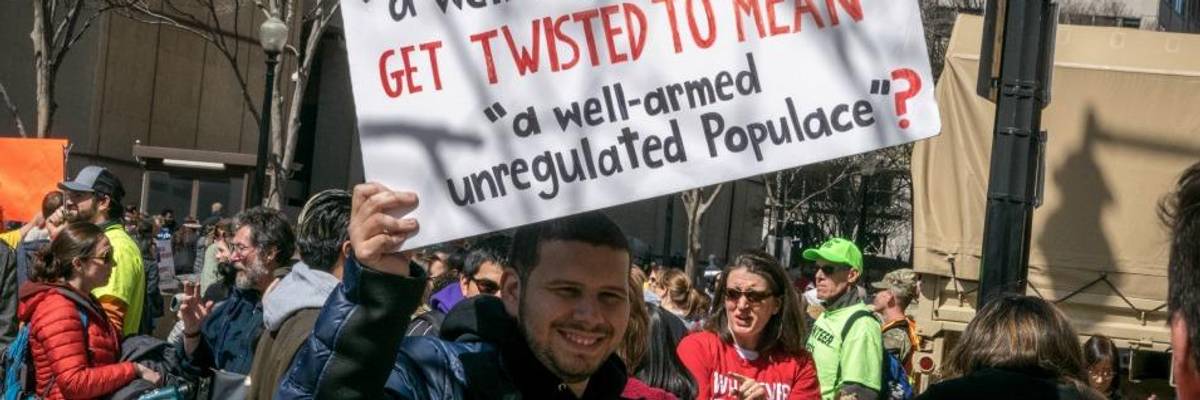
The NRA has actively twisted the meaning of the Second Amendment through aggressive propaganda campaigns, wrote retired Supreme Court Justice John Paul Stevens on Tuesday, leaving some Americans with the belief that the Founding Fathers fought for an individual right to bear arms.
Former Supreme Court Justice John Paul Stevens took to the New York Times op-ed pages on Tuesday to call for a full repeal of the Second Amendment, calling it a "relic of the 18th century" wielded by the gun lobby as a "propaganda weapon of immense power."
Though championing other demands for stricter gun control laws receiving attention amid outcry over mass shootings and gun violence, Stevens said "demonstrators should seek more effective and more lasting reform."
"They should demand a repeal of the Second Amendment," the judge argued. "That simple but dramatic action would move Saturday's marchers closer to their objective than any other possible reform."
Though the amendment is enshrined in the Bill of Rights, the National Rifle Association (NRA) has been able to deploy massive political and cultural influence over recent decades in order to twist its meaning and has pushed the notion that any regulation of firearms is an infringement of an unalienable right.
Stevens reminded readers of the views of former Chief Justice Warren Burger, who led the Supreme Court from 1969 to 1986. Burger said in 1991 that the NRA's efforts amounted to "one of the greatest pieces of fraud, I repeat the word fraud, on the American public by special interest groups that I have ever seen in my lifetime."
"There wouldn't be any such thing as the Second Amendment," if he were writing the Bill of Rights in the present day, said Burger at the time.
Amid the dissent of Stevens and three other justices, in 2008 the Supreme Court decided that the Second Amendment should be understood to guarantee individual civilians the right to bear arms.
"Overturning that decision via a constitutional amendment to get rid of the Second Amendment would be simple and would do more to weaken the N.R.A.'s ability to stymie legislative debate and block constructive gun control legislation than any other available option," wrote Stevens. "It would eliminate the only legal rule that protects sellers of firearms in the United States--unlike every other market in the world. It would make our schoolchildren safer than they have been since 2008 and honor the memories of the many, indeed far too many, victims of recent gun violence."
Dear Common Dreams reader, It’s been nearly 30 years since I co-founded Common Dreams with my late wife, Lina Newhouser. We had the radical notion that journalism should serve the public good, not corporate profits. It was clear to us from the outset what it would take to build such a project. No paid advertisements. No corporate sponsors. No millionaire publisher telling us what to think or do. Many people said we wouldn't last a year, but we proved those doubters wrong. Together with a tremendous team of journalists and dedicated staff, we built an independent media outlet free from the constraints of profits and corporate control. Our mission has always been simple: To inform. To inspire. To ignite change for the common good. Building Common Dreams was not easy. Our survival was never guaranteed. When you take on the most powerful forces—Wall Street greed, fossil fuel industry destruction, Big Tech lobbyists, and uber-rich oligarchs who have spent billions upon billions rigging the economy and democracy in their favor—the only bulwark you have is supporters who believe in your work. But here’s the urgent message from me today. It's never been this bad out there. And it's never been this hard to keep us going. At the very moment Common Dreams is most needed, the threats we face are intensifying. We need your support now more than ever. We don't accept corporate advertising and never will. We don't have a paywall because we don't think people should be blocked from critical news based on their ability to pay. Everything we do is funded by the donations of readers like you. When everyone does the little they can afford, we are strong. But if that support retreats or dries up, so do we. Will you donate now to make sure Common Dreams not only survives but thrives? —Craig Brown, Co-founder |
Former Supreme Court Justice John Paul Stevens took to the New York Times op-ed pages on Tuesday to call for a full repeal of the Second Amendment, calling it a "relic of the 18th century" wielded by the gun lobby as a "propaganda weapon of immense power."
Though championing other demands for stricter gun control laws receiving attention amid outcry over mass shootings and gun violence, Stevens said "demonstrators should seek more effective and more lasting reform."
"They should demand a repeal of the Second Amendment," the judge argued. "That simple but dramatic action would move Saturday's marchers closer to their objective than any other possible reform."
Though the amendment is enshrined in the Bill of Rights, the National Rifle Association (NRA) has been able to deploy massive political and cultural influence over recent decades in order to twist its meaning and has pushed the notion that any regulation of firearms is an infringement of an unalienable right.
Stevens reminded readers of the views of former Chief Justice Warren Burger, who led the Supreme Court from 1969 to 1986. Burger said in 1991 that the NRA's efforts amounted to "one of the greatest pieces of fraud, I repeat the word fraud, on the American public by special interest groups that I have ever seen in my lifetime."
"There wouldn't be any such thing as the Second Amendment," if he were writing the Bill of Rights in the present day, said Burger at the time.
Amid the dissent of Stevens and three other justices, in 2008 the Supreme Court decided that the Second Amendment should be understood to guarantee individual civilians the right to bear arms.
"Overturning that decision via a constitutional amendment to get rid of the Second Amendment would be simple and would do more to weaken the N.R.A.'s ability to stymie legislative debate and block constructive gun control legislation than any other available option," wrote Stevens. "It would eliminate the only legal rule that protects sellers of firearms in the United States--unlike every other market in the world. It would make our schoolchildren safer than they have been since 2008 and honor the memories of the many, indeed far too many, victims of recent gun violence."
Former Supreme Court Justice John Paul Stevens took to the New York Times op-ed pages on Tuesday to call for a full repeal of the Second Amendment, calling it a "relic of the 18th century" wielded by the gun lobby as a "propaganda weapon of immense power."
Though championing other demands for stricter gun control laws receiving attention amid outcry over mass shootings and gun violence, Stevens said "demonstrators should seek more effective and more lasting reform."
"They should demand a repeal of the Second Amendment," the judge argued. "That simple but dramatic action would move Saturday's marchers closer to their objective than any other possible reform."
Though the amendment is enshrined in the Bill of Rights, the National Rifle Association (NRA) has been able to deploy massive political and cultural influence over recent decades in order to twist its meaning and has pushed the notion that any regulation of firearms is an infringement of an unalienable right.
Stevens reminded readers of the views of former Chief Justice Warren Burger, who led the Supreme Court from 1969 to 1986. Burger said in 1991 that the NRA's efforts amounted to "one of the greatest pieces of fraud, I repeat the word fraud, on the American public by special interest groups that I have ever seen in my lifetime."
"There wouldn't be any such thing as the Second Amendment," if he were writing the Bill of Rights in the present day, said Burger at the time.
Amid the dissent of Stevens and three other justices, in 2008 the Supreme Court decided that the Second Amendment should be understood to guarantee individual civilians the right to bear arms.
"Overturning that decision via a constitutional amendment to get rid of the Second Amendment would be simple and would do more to weaken the N.R.A.'s ability to stymie legislative debate and block constructive gun control legislation than any other available option," wrote Stevens. "It would eliminate the only legal rule that protects sellers of firearms in the United States--unlike every other market in the world. It would make our schoolchildren safer than they have been since 2008 and honor the memories of the many, indeed far too many, victims of recent gun violence."