SUBSCRIBE TO OUR FREE NEWSLETTER
Daily news & progressive opinion—funded by the people, not the corporations—delivered straight to your inbox.
5
#000000
#FFFFFF
To donate by check, phone, or other method, see our More Ways to Give page.
Daily news & progressive opinion—funded by the people, not the corporations—delivered straight to your inbox.
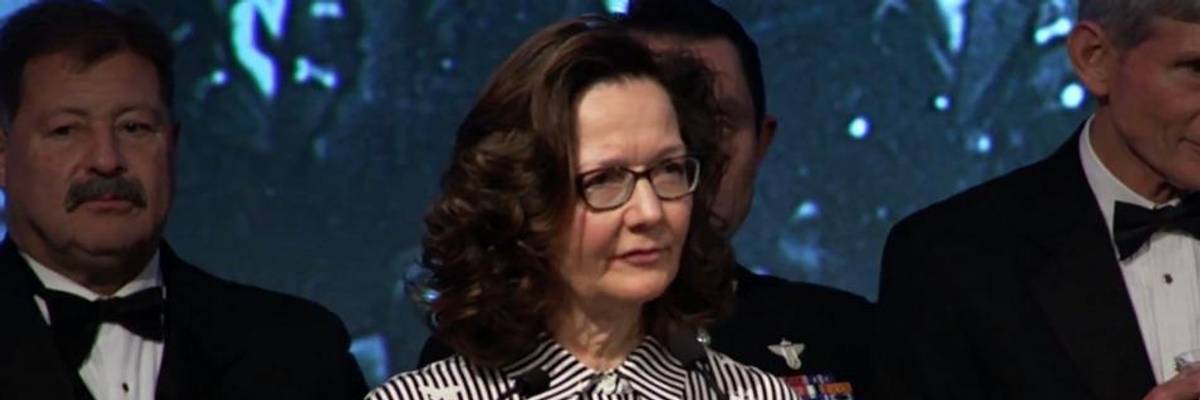
Gina Haspel, President Donald Trump's nominee for CIA Director, ran a secret prison in Thailand where detainees were tortured during the Bush administration, and was involved in destroying evidence of the torture. (Photo: @TheOnion/Twitter)
Journalists and civil liberties advocates are cautioning against the derailing of the debate over CIA Director nominee Gina Haspel's history of overseeing torture and her fitness to lead the agency, after ProPublica retracted portions of its reporting on her role in the Bush-era program.
According to critics, the real scandal continues to be Haspel's participation in torture and the subsequent cover-up--not the news outlet's error.
In February 2017, ProPublica reported on Haspel's career at the CIA during the George W. Bush administration, when she ran a clandestine prison in Thailand, overseeing the waterboarding of detainees and pushed senior officers to destroy evidence of the torture.
The investigative news outlet incorrectly reported that she oversaw the black site when al Qaeda suspect Abu Zubaydah was waterboarded there 83 times, and that she privately mocked the prisoner.
ProPublica corrected those two details on Thursday evening and issued an apology, with editor-in-chief Stephen Engelberg writing, "Neither of these assertions is correct and we retract them. It is now clear that Haspel did not take charge of the base until after the interrogation of Zubaydah ended."
However, Haspel's participation in the CIA's torture program and her history of covering up proof of torture is not disputed, and critics are demanding that her actions disqualify her from leading the agency--and that she be held accountable for torturing detainees.
"Once Abu Zubaydah and [detainee] Nashiri were shipped to their next stop in a series of black sites, Haspel started her multiyear campaign to destroy the videos that showed their torture, which indisputably contradicted written authorizations and records," wrote Marcy Wheeler at the Huffington Post. "Defying the warnings of multiple Democrats, the director of national intelligence, and several judges, Haspel in November 2005, as chief of staff for the director of clandestine services, sent a cable ordering officers to stick the tapes into an industrial-strength shredder."
"America continues to suffer the consequences of those twin acts, the torture and the cover-up," she added.
Meanwhile, NSA whistleblower Edward Snowden denounced the characterization of Haspel by torture supporters including Rep. Liz Cheney (R-Wy.) as someone who has "spent her career defending the American people" while those who criticize her are "defending terrorists." Cheney also claimed that the CIA's use of torture produced valuable intelligence that saved American lives.
At the Washington Post, former CIA counterterrorism officer John Kiriakou, who served 23 months in prison for publicly confirming the existence of the agency's torture program in 2007, wrote about the message Haspel's promotion to CIA Director would send to Americans and the international community.
"Trump's move hurts morale among CIA officers who recognize that torture is wrong. It comforts people at the agency who still believe 'enhanced interrogation' is somehow acceptable," Kiriakou wrote. "And the message it sends to our friends and allies (and the countries we criticize in the State Department's annual human rights reports) is this: We say we're a shining city on a hill, a beacon of respect for human rights, civil rights, civil liberties, and the rule of law. But actually, that's nonsense...when push comes to shove, we do what we want, international law be damned."
Dear Common Dreams reader, It’s been nearly 30 years since I co-founded Common Dreams with my late wife, Lina Newhouser. We had the radical notion that journalism should serve the public good, not corporate profits. It was clear to us from the outset what it would take to build such a project. No paid advertisements. No corporate sponsors. No millionaire publisher telling us what to think or do. Many people said we wouldn't last a year, but we proved those doubters wrong. Together with a tremendous team of journalists and dedicated staff, we built an independent media outlet free from the constraints of profits and corporate control. Our mission has always been simple: To inform. To inspire. To ignite change for the common good. Building Common Dreams was not easy. Our survival was never guaranteed. When you take on the most powerful forces—Wall Street greed, fossil fuel industry destruction, Big Tech lobbyists, and uber-rich oligarchs who have spent billions upon billions rigging the economy and democracy in their favor—the only bulwark you have is supporters who believe in your work. But here’s the urgent message from me today. It's never been this bad out there. And it's never been this hard to keep us going. At the very moment Common Dreams is most needed, the threats we face are intensifying. We need your support now more than ever. We don't accept corporate advertising and never will. We don't have a paywall because we don't think people should be blocked from critical news based on their ability to pay. Everything we do is funded by the donations of readers like you. When everyone does the little they can afford, we are strong. But if that support retreats or dries up, so do we. Will you donate now to make sure Common Dreams not only survives but thrives? —Craig Brown, Co-founder |
Journalists and civil liberties advocates are cautioning against the derailing of the debate over CIA Director nominee Gina Haspel's history of overseeing torture and her fitness to lead the agency, after ProPublica retracted portions of its reporting on her role in the Bush-era program.
According to critics, the real scandal continues to be Haspel's participation in torture and the subsequent cover-up--not the news outlet's error.
In February 2017, ProPublica reported on Haspel's career at the CIA during the George W. Bush administration, when she ran a clandestine prison in Thailand, overseeing the waterboarding of detainees and pushed senior officers to destroy evidence of the torture.
The investigative news outlet incorrectly reported that she oversaw the black site when al Qaeda suspect Abu Zubaydah was waterboarded there 83 times, and that she privately mocked the prisoner.
ProPublica corrected those two details on Thursday evening and issued an apology, with editor-in-chief Stephen Engelberg writing, "Neither of these assertions is correct and we retract them. It is now clear that Haspel did not take charge of the base until after the interrogation of Zubaydah ended."
However, Haspel's participation in the CIA's torture program and her history of covering up proof of torture is not disputed, and critics are demanding that her actions disqualify her from leading the agency--and that she be held accountable for torturing detainees.
"Once Abu Zubaydah and [detainee] Nashiri were shipped to their next stop in a series of black sites, Haspel started her multiyear campaign to destroy the videos that showed their torture, which indisputably contradicted written authorizations and records," wrote Marcy Wheeler at the Huffington Post. "Defying the warnings of multiple Democrats, the director of national intelligence, and several judges, Haspel in November 2005, as chief of staff for the director of clandestine services, sent a cable ordering officers to stick the tapes into an industrial-strength shredder."
"America continues to suffer the consequences of those twin acts, the torture and the cover-up," she added.
Meanwhile, NSA whistleblower Edward Snowden denounced the characterization of Haspel by torture supporters including Rep. Liz Cheney (R-Wy.) as someone who has "spent her career defending the American people" while those who criticize her are "defending terrorists." Cheney also claimed that the CIA's use of torture produced valuable intelligence that saved American lives.
At the Washington Post, former CIA counterterrorism officer John Kiriakou, who served 23 months in prison for publicly confirming the existence of the agency's torture program in 2007, wrote about the message Haspel's promotion to CIA Director would send to Americans and the international community.
"Trump's move hurts morale among CIA officers who recognize that torture is wrong. It comforts people at the agency who still believe 'enhanced interrogation' is somehow acceptable," Kiriakou wrote. "And the message it sends to our friends and allies (and the countries we criticize in the State Department's annual human rights reports) is this: We say we're a shining city on a hill, a beacon of respect for human rights, civil rights, civil liberties, and the rule of law. But actually, that's nonsense...when push comes to shove, we do what we want, international law be damned."
Journalists and civil liberties advocates are cautioning against the derailing of the debate over CIA Director nominee Gina Haspel's history of overseeing torture and her fitness to lead the agency, after ProPublica retracted portions of its reporting on her role in the Bush-era program.
According to critics, the real scandal continues to be Haspel's participation in torture and the subsequent cover-up--not the news outlet's error.
In February 2017, ProPublica reported on Haspel's career at the CIA during the George W. Bush administration, when she ran a clandestine prison in Thailand, overseeing the waterboarding of detainees and pushed senior officers to destroy evidence of the torture.
The investigative news outlet incorrectly reported that she oversaw the black site when al Qaeda suspect Abu Zubaydah was waterboarded there 83 times, and that she privately mocked the prisoner.
ProPublica corrected those two details on Thursday evening and issued an apology, with editor-in-chief Stephen Engelberg writing, "Neither of these assertions is correct and we retract them. It is now clear that Haspel did not take charge of the base until after the interrogation of Zubaydah ended."
However, Haspel's participation in the CIA's torture program and her history of covering up proof of torture is not disputed, and critics are demanding that her actions disqualify her from leading the agency--and that she be held accountable for torturing detainees.
"Once Abu Zubaydah and [detainee] Nashiri were shipped to their next stop in a series of black sites, Haspel started her multiyear campaign to destroy the videos that showed their torture, which indisputably contradicted written authorizations and records," wrote Marcy Wheeler at the Huffington Post. "Defying the warnings of multiple Democrats, the director of national intelligence, and several judges, Haspel in November 2005, as chief of staff for the director of clandestine services, sent a cable ordering officers to stick the tapes into an industrial-strength shredder."
"America continues to suffer the consequences of those twin acts, the torture and the cover-up," she added.
Meanwhile, NSA whistleblower Edward Snowden denounced the characterization of Haspel by torture supporters including Rep. Liz Cheney (R-Wy.) as someone who has "spent her career defending the American people" while those who criticize her are "defending terrorists." Cheney also claimed that the CIA's use of torture produced valuable intelligence that saved American lives.
At the Washington Post, former CIA counterterrorism officer John Kiriakou, who served 23 months in prison for publicly confirming the existence of the agency's torture program in 2007, wrote about the message Haspel's promotion to CIA Director would send to Americans and the international community.
"Trump's move hurts morale among CIA officers who recognize that torture is wrong. It comforts people at the agency who still believe 'enhanced interrogation' is somehow acceptable," Kiriakou wrote. "And the message it sends to our friends and allies (and the countries we criticize in the State Department's annual human rights reports) is this: We say we're a shining city on a hill, a beacon of respect for human rights, civil rights, civil liberties, and the rule of law. But actually, that's nonsense...when push comes to shove, we do what we want, international law be damned."