
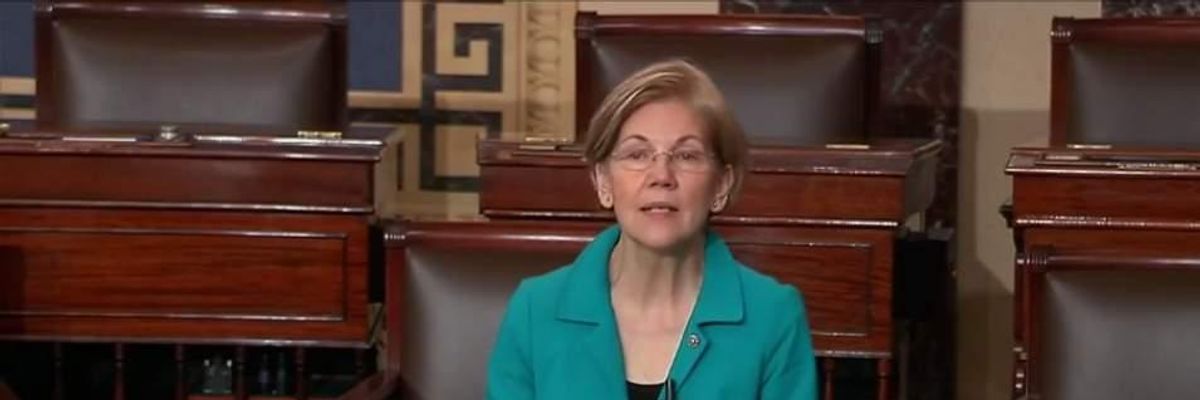
"The fight over the Bank Lobbyist Act isn't over yet," Warren wrote on Twitter, unveiling 17 amendments that, if passed, would uphold strict oversight of big banks. (Photo: Sen. Elizabeth Warren/Facebook)
Refusing to 'Play Dead for Big Banks,' Warren Gives Fellow Senators 17 Chances to Put Consumers First
"The Senate is expected to pass the #BankLobbyistAct—with Democratic support. But I'm not going down without a fight."
Thanks to the help of 16 Senate Democrats and Sen. Angus King (I-Maine), a Wall Street deregulation measure disguised as a "community banking" bill is barreling toward passage--but Sen. Elizabeth Warren (D-Mass.) vowed Wednesday to not let the bill sail through without forcing votes on a series of amendments aimed at showing Americans whose side their lawmakers are really on.
"The Senate is expected to pass the #BankLobbyistAct--with Democratic support. But I'm not going down without a fight."
--Sen. Elizabeth Warren"The fight over the Bank Lobbyist Act isn't over yet," Warren wrote on Twitter, unveiling 17 amendments that, if approved, would uphold strict oversight of big banks and shield consumers from Wall Street fraud and abuse. "I'm not going to roll over and play dead for the big banks."
First introduced last November by Sen. Mike Crapo (R-Idaho), the officially named "Economic Growth, Regulatory Relief, and Consumer Protection Act" (S.2155) could hit the Senate floor for a final vote as soon as Thursday after it easily cleared a procedural hurdle earlier this week.
Far from what its title suggests, progressive lawmakers and independent analysts argue the legislation would dismantle many consumer protections, provide huge gifts to Wall Street firms, and--according to the Congressional Budget Office (CBO)--significantly increase the likelihood of future taxpayer-funded bank bailouts.
In an effort to let the American people know whether their senators are on the side of "working families or the big banks," Warren announced her plan on Wednesday to push for votes on amendments to the bill that, if implemented in its current form, would "turn over the keys to our economy to the same people who crashed it ten years ago."
"The Senate is expected to pass the #BankLobbyistAct--with Democratic support. But I'm not going down without a fight," Warren declared.
Below is a full list of the amendments accompanied by a short summary of their contents. The full amendments can be viewed on Warren's Twitter page.
1. (#2056) BAILOUTS: This amendment ensures that banks that received more than $1 billion in bailout money during the 2008 financial crisis are still subject to tougher federal oversight.
2. (#2064) DEFERRED PROSECUTION AGREEMENTS: This amendment ensures that banks that are currently operating under a deferred prosecution agreement or a consent order are not deregulated by the bill.
3. (#2063) FINES: This amendment ensures that big banks that have been assessed more than $10 million in fines in the last ten years remain subject to stricter federal oversight.
4. (#2061) OUTSOURCING: This amendment ensures that banks that have outsourced more than 50 jobs in any of the last five years remain subject to stricter federal oversight. The Communications Workers of America support this amendment.
5. (#2060) STOCK BUYBACKS: This amendment prohibits any big bank that gets deregulated under the bill from buying back its stock for the next five years. If the purpose of this bill is to promote lending and economic growth, the banks that benefit from it should not be permitted to funnel any savings into additional stock buybacks.
6. (#2058) MERGERS: This amendment prohibits any big bank that gets deregulated under the bill from merging with or acquiring another bank for five years. Supporters of the bill claim it is intended to reduce consolidation in the banking industry, but experts agree that the bill, as currently written, will spark a wave of new mergers. This amendment will limit that consolidation.
7. (#2067) FREE CREDIT FREEZES: This amendment amends section 301 of the bill to include the full text of Senator Warren's FREE Act. The FREE Act provides for a more consumer-friendly free credit freeze process than the current bill and prohibits credit bureaus from selling data to third parties when a freeze is in effect.
8. (#2065) MANDATORY PENALTIES FOR CREDIT BUREAU DATA BREACHES: This amendment inserts the Warren-Warner Data Breach Prevention and Compensation Act of 2018 into the bill. The bill imposes large, mandatory penalties on credit bureaus that allow personal consumer data to be accessed or stolen.
9. (#2057) NO CREDIT REPORTS IN JOB APPLICATIONS: This amendment inserts Senator Warren's Equal Opportunity for All Act into the bill. The bill prohibits employers from requesting a job applicant's credit report.
10. (#2069) GLASS-STEAGALL: This amendment inserts Warren-McCain-Cantwell-King 21st Century Glass-Steagall Act into the bill. The bill would re-establish the divide between commercial and investment banking.
11. (#2062) CARD ACT EXPANSION: This amendment expands the CARD Act to include other financial products marketed on college campus, including debit cards and checking accounts.
12. (#2059) STUDENT LOAN ARBITRATION: This amendment bans the use of mandatory arbitration clauses in contracts for private student loans.
13. (#2066) DISCLOSING SEXUAL HARRASSMENT: This amendment inserts Senator Warren's Sunlight in Workplace Harassment Act into the bill, which would require publicly-traded companies to disclose the number and dollar amount of workplace harassment and discrimination settlements.
14. (#2070) STUDENT LOAN SERVICING: This amendment grants student borrowers a private right of action against student loan servicers, lenders, and holders, and adds additional requirements for loan servicers to support borrowers throughout the repayment process.
15. (#2068) PRIVATE STUDENT LOANS: This amendment offers consumer protections for private education loan borrowers, including servicing transfer protections, fee prohibitions and protections, and private student loan discharge for borrower death or disability.
16. (#2054) LIMITING IMMUNITY: This amendment amends section 303 of the bill to limit the immunity provided to bank personnel so that they do not receive immunity for violations unrelated to the reporting of financial exploitation of seniors.
17. (#2055) CLOSING WALL STREET LOOPHOLE: Section 165 of Dodd-Frank currently states that the Fed "may" tailor the enhanced prudential standards depending on the size, risk, complexity, and activities of specific banks or categories of banks. Section 401 of S. 2155 says the Fed "shall" tailor these requirements - which, under the bill, now only apply to banks bigger than $250 billion in assets. That one word change gives the biggest Wall Street banks a massive legal hook to challenge Fed requirements and systematically weaken the rules. This amendment would strike the "may" to "shall" change.
We are at a crossroads
This country and this world are at a monumental crossroads. In a few short weeks, US voters will have an opportunity to beat back the forces of fascism and confront the billionaires who are rigging the economy, our media system, and our democracy, making it increasingly impossible for ordinary people to get by. We’re not just talking about the election. We’re talking about what must be done once these fascist elements are vanquished from power. We need a bolder set of solutions than what either major party has so far been willing to offer and a working-class movement ready to fight like hell for it. Trump didn't emerge from nowhere. The conditions that fueled MAGA authoritarianism were created by decades of radical neoliberal economic policies and a corrupt political system dominated by corporate interests. They slashed taxes on the super-rich, promising that the benefits would trickle down. They said giveaways to the corporate titans would make life more affordable for the rest of us. It was all bullshit. And when a bitter, betrayed populace searches for someone to blame, right-wing demagogues have little trouble finding scapegoats. People know when they're being lied to, but you won't hear any of this from the corporate media. Only independent journalism—powered and funded by people who believe in building a better world—can deliver truly trustworthy daily news. Our Fall Campaign is underway, and we need your help. To power our newsroom through the rest of the year, we need to raise $125,000 by midnight on October 31. So if you share our vision, please contribute whatever you can to sustain our work. |
Thanks to the help of 16 Senate Democrats and Sen. Angus King (I-Maine), a Wall Street deregulation measure disguised as a "community banking" bill is barreling toward passage--but Sen. Elizabeth Warren (D-Mass.) vowed Wednesday to not let the bill sail through without forcing votes on a series of amendments aimed at showing Americans whose side their lawmakers are really on.
"The Senate is expected to pass the #BankLobbyistAct--with Democratic support. But I'm not going down without a fight."
--Sen. Elizabeth Warren"The fight over the Bank Lobbyist Act isn't over yet," Warren wrote on Twitter, unveiling 17 amendments that, if approved, would uphold strict oversight of big banks and shield consumers from Wall Street fraud and abuse. "I'm not going to roll over and play dead for the big banks."
First introduced last November by Sen. Mike Crapo (R-Idaho), the officially named "Economic Growth, Regulatory Relief, and Consumer Protection Act" (S.2155) could hit the Senate floor for a final vote as soon as Thursday after it easily cleared a procedural hurdle earlier this week.
Far from what its title suggests, progressive lawmakers and independent analysts argue the legislation would dismantle many consumer protections, provide huge gifts to Wall Street firms, and--according to the Congressional Budget Office (CBO)--significantly increase the likelihood of future taxpayer-funded bank bailouts.
In an effort to let the American people know whether their senators are on the side of "working families or the big banks," Warren announced her plan on Wednesday to push for votes on amendments to the bill that, if implemented in its current form, would "turn over the keys to our economy to the same people who crashed it ten years ago."
"The Senate is expected to pass the #BankLobbyistAct--with Democratic support. But I'm not going down without a fight," Warren declared.
Below is a full list of the amendments accompanied by a short summary of their contents. The full amendments can be viewed on Warren's Twitter page.
1. (#2056) BAILOUTS: This amendment ensures that banks that received more than $1 billion in bailout money during the 2008 financial crisis are still subject to tougher federal oversight.
2. (#2064) DEFERRED PROSECUTION AGREEMENTS: This amendment ensures that banks that are currently operating under a deferred prosecution agreement or a consent order are not deregulated by the bill.
3. (#2063) FINES: This amendment ensures that big banks that have been assessed more than $10 million in fines in the last ten years remain subject to stricter federal oversight.
4. (#2061) OUTSOURCING: This amendment ensures that banks that have outsourced more than 50 jobs in any of the last five years remain subject to stricter federal oversight. The Communications Workers of America support this amendment.
5. (#2060) STOCK BUYBACKS: This amendment prohibits any big bank that gets deregulated under the bill from buying back its stock for the next five years. If the purpose of this bill is to promote lending and economic growth, the banks that benefit from it should not be permitted to funnel any savings into additional stock buybacks.
6. (#2058) MERGERS: This amendment prohibits any big bank that gets deregulated under the bill from merging with or acquiring another bank for five years. Supporters of the bill claim it is intended to reduce consolidation in the banking industry, but experts agree that the bill, as currently written, will spark a wave of new mergers. This amendment will limit that consolidation.
7. (#2067) FREE CREDIT FREEZES: This amendment amends section 301 of the bill to include the full text of Senator Warren's FREE Act. The FREE Act provides for a more consumer-friendly free credit freeze process than the current bill and prohibits credit bureaus from selling data to third parties when a freeze is in effect.
8. (#2065) MANDATORY PENALTIES FOR CREDIT BUREAU DATA BREACHES: This amendment inserts the Warren-Warner Data Breach Prevention and Compensation Act of 2018 into the bill. The bill imposes large, mandatory penalties on credit bureaus that allow personal consumer data to be accessed or stolen.
9. (#2057) NO CREDIT REPORTS IN JOB APPLICATIONS: This amendment inserts Senator Warren's Equal Opportunity for All Act into the bill. The bill prohibits employers from requesting a job applicant's credit report.
10. (#2069) GLASS-STEAGALL: This amendment inserts Warren-McCain-Cantwell-King 21st Century Glass-Steagall Act into the bill. The bill would re-establish the divide between commercial and investment banking.
11. (#2062) CARD ACT EXPANSION: This amendment expands the CARD Act to include other financial products marketed on college campus, including debit cards and checking accounts.
12. (#2059) STUDENT LOAN ARBITRATION: This amendment bans the use of mandatory arbitration clauses in contracts for private student loans.
13. (#2066) DISCLOSING SEXUAL HARRASSMENT: This amendment inserts Senator Warren's Sunlight in Workplace Harassment Act into the bill, which would require publicly-traded companies to disclose the number and dollar amount of workplace harassment and discrimination settlements.
14. (#2070) STUDENT LOAN SERVICING: This amendment grants student borrowers a private right of action against student loan servicers, lenders, and holders, and adds additional requirements for loan servicers to support borrowers throughout the repayment process.
15. (#2068) PRIVATE STUDENT LOANS: This amendment offers consumer protections for private education loan borrowers, including servicing transfer protections, fee prohibitions and protections, and private student loan discharge for borrower death or disability.
16. (#2054) LIMITING IMMUNITY: This amendment amends section 303 of the bill to limit the immunity provided to bank personnel so that they do not receive immunity for violations unrelated to the reporting of financial exploitation of seniors.
17. (#2055) CLOSING WALL STREET LOOPHOLE: Section 165 of Dodd-Frank currently states that the Fed "may" tailor the enhanced prudential standards depending on the size, risk, complexity, and activities of specific banks or categories of banks. Section 401 of S. 2155 says the Fed "shall" tailor these requirements - which, under the bill, now only apply to banks bigger than $250 billion in assets. That one word change gives the biggest Wall Street banks a massive legal hook to challenge Fed requirements and systematically weaken the rules. This amendment would strike the "may" to "shall" change.
Thanks to the help of 16 Senate Democrats and Sen. Angus King (I-Maine), a Wall Street deregulation measure disguised as a "community banking" bill is barreling toward passage--but Sen. Elizabeth Warren (D-Mass.) vowed Wednesday to not let the bill sail through without forcing votes on a series of amendments aimed at showing Americans whose side their lawmakers are really on.
"The Senate is expected to pass the #BankLobbyistAct--with Democratic support. But I'm not going down without a fight."
--Sen. Elizabeth Warren"The fight over the Bank Lobbyist Act isn't over yet," Warren wrote on Twitter, unveiling 17 amendments that, if approved, would uphold strict oversight of big banks and shield consumers from Wall Street fraud and abuse. "I'm not going to roll over and play dead for the big banks."
First introduced last November by Sen. Mike Crapo (R-Idaho), the officially named "Economic Growth, Regulatory Relief, and Consumer Protection Act" (S.2155) could hit the Senate floor for a final vote as soon as Thursday after it easily cleared a procedural hurdle earlier this week.
Far from what its title suggests, progressive lawmakers and independent analysts argue the legislation would dismantle many consumer protections, provide huge gifts to Wall Street firms, and--according to the Congressional Budget Office (CBO)--significantly increase the likelihood of future taxpayer-funded bank bailouts.
In an effort to let the American people know whether their senators are on the side of "working families or the big banks," Warren announced her plan on Wednesday to push for votes on amendments to the bill that, if implemented in its current form, would "turn over the keys to our economy to the same people who crashed it ten years ago."
"The Senate is expected to pass the #BankLobbyistAct--with Democratic support. But I'm not going down without a fight," Warren declared.
Below is a full list of the amendments accompanied by a short summary of their contents. The full amendments can be viewed on Warren's Twitter page.
1. (#2056) BAILOUTS: This amendment ensures that banks that received more than $1 billion in bailout money during the 2008 financial crisis are still subject to tougher federal oversight.
2. (#2064) DEFERRED PROSECUTION AGREEMENTS: This amendment ensures that banks that are currently operating under a deferred prosecution agreement or a consent order are not deregulated by the bill.
3. (#2063) FINES: This amendment ensures that big banks that have been assessed more than $10 million in fines in the last ten years remain subject to stricter federal oversight.
4. (#2061) OUTSOURCING: This amendment ensures that banks that have outsourced more than 50 jobs in any of the last five years remain subject to stricter federal oversight. The Communications Workers of America support this amendment.
5. (#2060) STOCK BUYBACKS: This amendment prohibits any big bank that gets deregulated under the bill from buying back its stock for the next five years. If the purpose of this bill is to promote lending and economic growth, the banks that benefit from it should not be permitted to funnel any savings into additional stock buybacks.
6. (#2058) MERGERS: This amendment prohibits any big bank that gets deregulated under the bill from merging with or acquiring another bank for five years. Supporters of the bill claim it is intended to reduce consolidation in the banking industry, but experts agree that the bill, as currently written, will spark a wave of new mergers. This amendment will limit that consolidation.
7. (#2067) FREE CREDIT FREEZES: This amendment amends section 301 of the bill to include the full text of Senator Warren's FREE Act. The FREE Act provides for a more consumer-friendly free credit freeze process than the current bill and prohibits credit bureaus from selling data to third parties when a freeze is in effect.
8. (#2065) MANDATORY PENALTIES FOR CREDIT BUREAU DATA BREACHES: This amendment inserts the Warren-Warner Data Breach Prevention and Compensation Act of 2018 into the bill. The bill imposes large, mandatory penalties on credit bureaus that allow personal consumer data to be accessed or stolen.
9. (#2057) NO CREDIT REPORTS IN JOB APPLICATIONS: This amendment inserts Senator Warren's Equal Opportunity for All Act into the bill. The bill prohibits employers from requesting a job applicant's credit report.
10. (#2069) GLASS-STEAGALL: This amendment inserts Warren-McCain-Cantwell-King 21st Century Glass-Steagall Act into the bill. The bill would re-establish the divide between commercial and investment banking.
11. (#2062) CARD ACT EXPANSION: This amendment expands the CARD Act to include other financial products marketed on college campus, including debit cards and checking accounts.
12. (#2059) STUDENT LOAN ARBITRATION: This amendment bans the use of mandatory arbitration clauses in contracts for private student loans.
13. (#2066) DISCLOSING SEXUAL HARRASSMENT: This amendment inserts Senator Warren's Sunlight in Workplace Harassment Act into the bill, which would require publicly-traded companies to disclose the number and dollar amount of workplace harassment and discrimination settlements.
14. (#2070) STUDENT LOAN SERVICING: This amendment grants student borrowers a private right of action against student loan servicers, lenders, and holders, and adds additional requirements for loan servicers to support borrowers throughout the repayment process.
15. (#2068) PRIVATE STUDENT LOANS: This amendment offers consumer protections for private education loan borrowers, including servicing transfer protections, fee prohibitions and protections, and private student loan discharge for borrower death or disability.
16. (#2054) LIMITING IMMUNITY: This amendment amends section 303 of the bill to limit the immunity provided to bank personnel so that they do not receive immunity for violations unrelated to the reporting of financial exploitation of seniors.
17. (#2055) CLOSING WALL STREET LOOPHOLE: Section 165 of Dodd-Frank currently states that the Fed "may" tailor the enhanced prudential standards depending on the size, risk, complexity, and activities of specific banks or categories of banks. Section 401 of S. 2155 says the Fed "shall" tailor these requirements - which, under the bill, now only apply to banks bigger than $250 billion in assets. That one word change gives the biggest Wall Street banks a massive legal hook to challenge Fed requirements and systematically weaken the rules. This amendment would strike the "may" to "shall" change.