SUBSCRIBE TO OUR FREE NEWSLETTER
Daily news & progressive opinion—funded by the people, not the corporations—delivered straight to your inbox.
5
#000000
#FFFFFF
To donate by check, phone, or other method, see our More Ways to Give page.
Daily news & progressive opinion—funded by the people, not the corporations—delivered straight to your inbox.
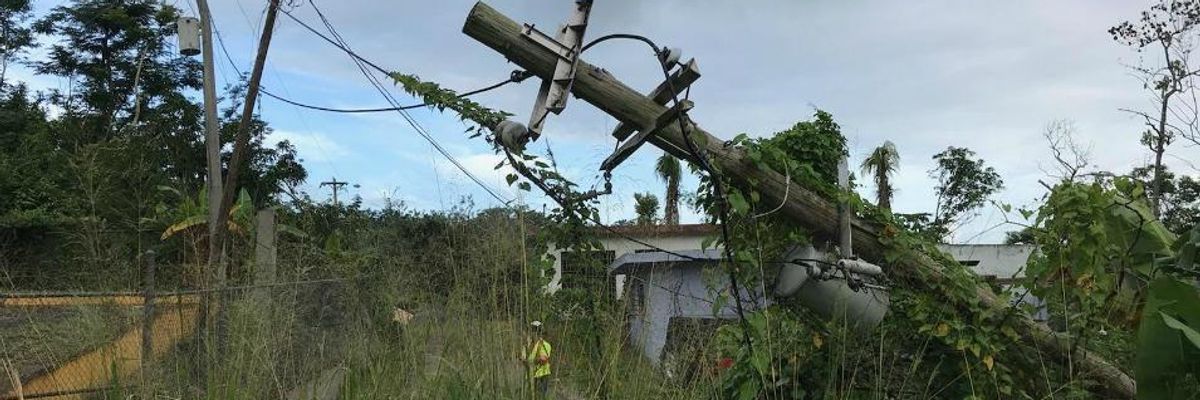
Many rural areas in Puerto Rico remain without power, and San Juan Mayor Carmen Yulin Cruz said Monday that privatization has directly resulted in delays to restoration. (Photo: Western Area Power/Flickr/cc)
As nearly 250,000 Puerto Ricans remain without power five months after Hurricane Maria struck the island territory--the longest blackout in U.S. history--the Puerto Rico Electric Power Authority (PREPA) said Sunday it will reduce its operating reserve to save money, as the island's government moves toward privatizing the authority.
A federal judge denied PREPA a $1 billion loan over the weekend, saying the authority could not prove it needed the additional cash injection. The company will now reduce its reserve by 450 megawatts, saving $9 million per month but likely resulting in more power outages.
The additional instability comes as many residents are waiting for service to be restored, only to be told, according to San Juan Mayor Carmen Yulin Cruz, that repair work has been subcontracted out to companies that have yet to arrive.
Yulin Cruz pushed back against the privatization plan when it was announced last month, saying, "The privatization of PREPA puts the economic development of the country in private hands. The authority will serve interests."
Mayors including Jose Santiago of Comerio, Yulin Cruz told Democracy Now! on Monday, have been told by those working to restore the electric grid, that work can't be completed until subcontractors arrive.
"They have been told, 'You cannot open this road for us to go and do what we need to do because the Army Corps of Engineers has subcontracted that, and the Army Corps of Engineers is waiting for the company they've subcontracted it to, to bring their equipment and get the job done,'" said the mayor, who has been sharply critical of the response of the Trump administration to Hurricane Maria.
Yulin Cruz has also disagreed with Gov. Ricardo Rossello, who has praised the federal government's response and who announced the plans last month to privatize PREPA. Privatization, she said, is delaying the restoration of the power grid, which was originally promised by December and is now expected to be complete by mid-April.
Rossello, she told Democracy Now!, is promoting the privatization of PREPA by playing into classic "disaster capitalism," promising potential buyers huge profits because Puerto Ricans will agree to pay high prices.
"The governor of Puerto Rico made a terrible statement yesterday," Yulin Cruz said. "When asked in New York, 'Why would anyone buy PREPA?' he said, 'Well, there's a lot of space for making profits because the Puerto Rican people are used to paying high prices for energy...You may lower the cost of production of energy, leave the price very high and the gap will be yours.' If this is not disaster economics and this is not setting the stage for commercialization of services that are there to promote equality, I don't know what is."
Dear Common Dreams reader, It’s been nearly 30 years since I co-founded Common Dreams with my late wife, Lina Newhouser. We had the radical notion that journalism should serve the public good, not corporate profits. It was clear to us from the outset what it would take to build such a project. No paid advertisements. No corporate sponsors. No millionaire publisher telling us what to think or do. Many people said we wouldn't last a year, but we proved those doubters wrong. Together with a tremendous team of journalists and dedicated staff, we built an independent media outlet free from the constraints of profits and corporate control. Our mission has always been simple: To inform. To inspire. To ignite change for the common good. Building Common Dreams was not easy. Our survival was never guaranteed. When you take on the most powerful forces—Wall Street greed, fossil fuel industry destruction, Big Tech lobbyists, and uber-rich oligarchs who have spent billions upon billions rigging the economy and democracy in their favor—the only bulwark you have is supporters who believe in your work. But here’s the urgent message from me today. It's never been this bad out there. And it's never been this hard to keep us going. At the very moment Common Dreams is most needed, the threats we face are intensifying. We need your support now more than ever. We don't accept corporate advertising and never will. We don't have a paywall because we don't think people should be blocked from critical news based on their ability to pay. Everything we do is funded by the donations of readers like you. When everyone does the little they can afford, we are strong. But if that support retreats or dries up, so do we. Will you donate now to make sure Common Dreams not only survives but thrives? —Craig Brown, Co-founder |
As nearly 250,000 Puerto Ricans remain without power five months after Hurricane Maria struck the island territory--the longest blackout in U.S. history--the Puerto Rico Electric Power Authority (PREPA) said Sunday it will reduce its operating reserve to save money, as the island's government moves toward privatizing the authority.
A federal judge denied PREPA a $1 billion loan over the weekend, saying the authority could not prove it needed the additional cash injection. The company will now reduce its reserve by 450 megawatts, saving $9 million per month but likely resulting in more power outages.
The additional instability comes as many residents are waiting for service to be restored, only to be told, according to San Juan Mayor Carmen Yulin Cruz, that repair work has been subcontracted out to companies that have yet to arrive.
Yulin Cruz pushed back against the privatization plan when it was announced last month, saying, "The privatization of PREPA puts the economic development of the country in private hands. The authority will serve interests."
Mayors including Jose Santiago of Comerio, Yulin Cruz told Democracy Now! on Monday, have been told by those working to restore the electric grid, that work can't be completed until subcontractors arrive.
"They have been told, 'You cannot open this road for us to go and do what we need to do because the Army Corps of Engineers has subcontracted that, and the Army Corps of Engineers is waiting for the company they've subcontracted it to, to bring their equipment and get the job done,'" said the mayor, who has been sharply critical of the response of the Trump administration to Hurricane Maria.
Yulin Cruz has also disagreed with Gov. Ricardo Rossello, who has praised the federal government's response and who announced the plans last month to privatize PREPA. Privatization, she said, is delaying the restoration of the power grid, which was originally promised by December and is now expected to be complete by mid-April.
Rossello, she told Democracy Now!, is promoting the privatization of PREPA by playing into classic "disaster capitalism," promising potential buyers huge profits because Puerto Ricans will agree to pay high prices.
"The governor of Puerto Rico made a terrible statement yesterday," Yulin Cruz said. "When asked in New York, 'Why would anyone buy PREPA?' he said, 'Well, there's a lot of space for making profits because the Puerto Rican people are used to paying high prices for energy...You may lower the cost of production of energy, leave the price very high and the gap will be yours.' If this is not disaster economics and this is not setting the stage for commercialization of services that are there to promote equality, I don't know what is."
As nearly 250,000 Puerto Ricans remain without power five months after Hurricane Maria struck the island territory--the longest blackout in U.S. history--the Puerto Rico Electric Power Authority (PREPA) said Sunday it will reduce its operating reserve to save money, as the island's government moves toward privatizing the authority.
A federal judge denied PREPA a $1 billion loan over the weekend, saying the authority could not prove it needed the additional cash injection. The company will now reduce its reserve by 450 megawatts, saving $9 million per month but likely resulting in more power outages.
The additional instability comes as many residents are waiting for service to be restored, only to be told, according to San Juan Mayor Carmen Yulin Cruz, that repair work has been subcontracted out to companies that have yet to arrive.
Yulin Cruz pushed back against the privatization plan when it was announced last month, saying, "The privatization of PREPA puts the economic development of the country in private hands. The authority will serve interests."
Mayors including Jose Santiago of Comerio, Yulin Cruz told Democracy Now! on Monday, have been told by those working to restore the electric grid, that work can't be completed until subcontractors arrive.
"They have been told, 'You cannot open this road for us to go and do what we need to do because the Army Corps of Engineers has subcontracted that, and the Army Corps of Engineers is waiting for the company they've subcontracted it to, to bring their equipment and get the job done,'" said the mayor, who has been sharply critical of the response of the Trump administration to Hurricane Maria.
Yulin Cruz has also disagreed with Gov. Ricardo Rossello, who has praised the federal government's response and who announced the plans last month to privatize PREPA. Privatization, she said, is delaying the restoration of the power grid, which was originally promised by December and is now expected to be complete by mid-April.
Rossello, she told Democracy Now!, is promoting the privatization of PREPA by playing into classic "disaster capitalism," promising potential buyers huge profits because Puerto Ricans will agree to pay high prices.
"The governor of Puerto Rico made a terrible statement yesterday," Yulin Cruz said. "When asked in New York, 'Why would anyone buy PREPA?' he said, 'Well, there's a lot of space for making profits because the Puerto Rican people are used to paying high prices for energy...You may lower the cost of production of energy, leave the price very high and the gap will be yours.' If this is not disaster economics and this is not setting the stage for commercialization of services that are there to promote equality, I don't know what is."