SUBSCRIBE TO OUR FREE NEWSLETTER
Daily news & progressive opinion—funded by the people, not the corporations—delivered straight to your inbox.
5
#000000
#FFFFFF
To donate by check, phone, or other method, see our More Ways to Give page.
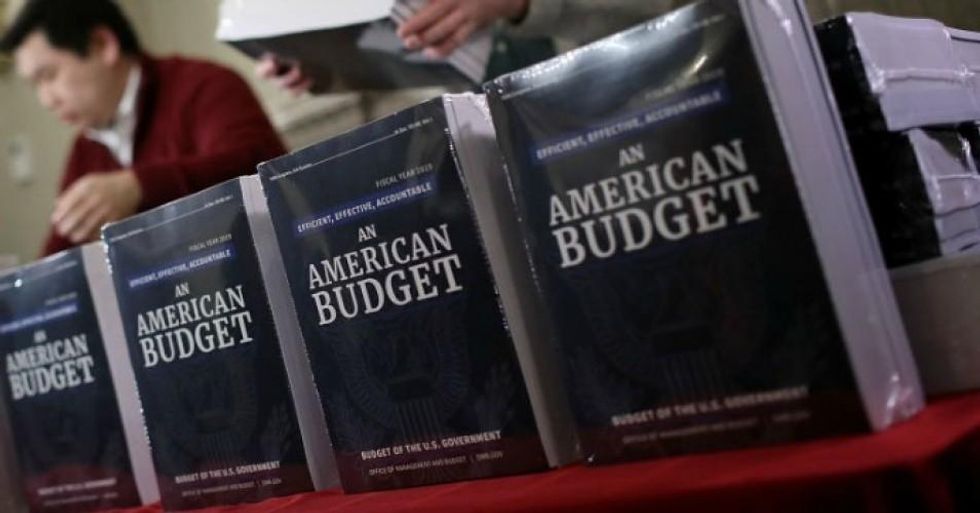
Those wondering how President Donald Trump plans to pay for the $1.5 trillion in tax cuts for the rich he signed into law last year got their answer on Monday, when the White House unveiled its 2019 budget (pdf) blueprint that calls for $1.7 trillion in cuts to crucial safety net programs over the next decade--including $237 billion in cuts to Medicare alone.
"Millions of Americans will lose access to life-saving programs because the GOP gave $1.5 trillion in tax cuts to the rich."
--Tax MarchWhile imposing "severe austerity" on domestic programs that primarily benefit poor and middle class Americans, Trump's proposal also aims to hike the Pentagon's budget to $716 billion--a seven percent increase from his 2018 request--and provide $18 billion for "the wall."
"The Trump budget is morally bankrupt and bad economic policy," Sen. Bernie Sanders (I-Vt.) wrote on Twitter Monday shortly after the White House proposal was made public.
Critics were quick to note that such severe cuts to healthcare programs that serve the elderly, the disabled, and the poor will likely come "with a body count."
"Millions of Americans will lose access to life-saving programs because the GOP gave $1.5 trillion in tax cuts to the rich," the advocacy group Tax March wrote on Twitter.
In addition to calling for potentially devastating cuts to healthcare, food stamps, and other components of America's already-withering safety net, Trump's budget also calls for large cuts to environmental programs--including $598.5 million from the Environmental Protection Agency (EPA).
"President Trump's budget is nothing short of devastating for all Americans who value clean air, safe drinking water, and protected public lands," Rhea Suh, president of the Natural Resources Defense Council, said in a statement on Monday.
Though presidential budget requests are non-binding, they are a strong indicator of the White House's goals and values, as Indivisible's senior policy manager Chad Bolt observed while analyzing the newly released document.
Trump's "budget proposal is just a proposal, but it's a clear statement of his priorities," Bolt noted. "Making deep cuts to programs families rely on has been a priority since Day 1."
Those wondering how President Donald Trump plans to pay for the $1.5 trillion in tax cuts for the rich he signed into law last year got their answer on Monday, when the White House unveiled its 2019 budget (pdf) blueprint that calls for $1.7 trillion in cuts to crucial safety net programs over the next decade--including $237 billion in cuts to Medicare alone.
"Millions of Americans will lose access to life-saving programs because the GOP gave $1.5 trillion in tax cuts to the rich."
--Tax MarchWhile imposing "severe austerity" on domestic programs that primarily benefit poor and middle class Americans, Trump's proposal also aims to hike the Pentagon's budget to $716 billion--a seven percent increase from his 2018 request--and provide $18 billion for "the wall."
"The Trump budget is morally bankrupt and bad economic policy," Sen. Bernie Sanders (I-Vt.) wrote on Twitter Monday shortly after the White House proposal was made public.
Critics were quick to note that such severe cuts to healthcare programs that serve the elderly, the disabled, and the poor will likely come "with a body count."
"Millions of Americans will lose access to life-saving programs because the GOP gave $1.5 trillion in tax cuts to the rich," the advocacy group Tax March wrote on Twitter.
In addition to calling for potentially devastating cuts to healthcare, food stamps, and other components of America's already-withering safety net, Trump's budget also calls for large cuts to environmental programs--including $598.5 million from the Environmental Protection Agency (EPA).
"President Trump's budget is nothing short of devastating for all Americans who value clean air, safe drinking water, and protected public lands," Rhea Suh, president of the Natural Resources Defense Council, said in a statement on Monday.
Though presidential budget requests are non-binding, they are a strong indicator of the White House's goals and values, as Indivisible's senior policy manager Chad Bolt observed while analyzing the newly released document.
Trump's "budget proposal is just a proposal, but it's a clear statement of his priorities," Bolt noted. "Making deep cuts to programs families rely on has been a priority since Day 1."
Those wondering how President Donald Trump plans to pay for the $1.5 trillion in tax cuts for the rich he signed into law last year got their answer on Monday, when the White House unveiled its 2019 budget (pdf) blueprint that calls for $1.7 trillion in cuts to crucial safety net programs over the next decade--including $237 billion in cuts to Medicare alone.
"Millions of Americans will lose access to life-saving programs because the GOP gave $1.5 trillion in tax cuts to the rich."
--Tax MarchWhile imposing "severe austerity" on domestic programs that primarily benefit poor and middle class Americans, Trump's proposal also aims to hike the Pentagon's budget to $716 billion--a seven percent increase from his 2018 request--and provide $18 billion for "the wall."
"The Trump budget is morally bankrupt and bad economic policy," Sen. Bernie Sanders (I-Vt.) wrote on Twitter Monday shortly after the White House proposal was made public.
Critics were quick to note that such severe cuts to healthcare programs that serve the elderly, the disabled, and the poor will likely come "with a body count."
"Millions of Americans will lose access to life-saving programs because the GOP gave $1.5 trillion in tax cuts to the rich," the advocacy group Tax March wrote on Twitter.
In addition to calling for potentially devastating cuts to healthcare, food stamps, and other components of America's already-withering safety net, Trump's budget also calls for large cuts to environmental programs--including $598.5 million from the Environmental Protection Agency (EPA).
"President Trump's budget is nothing short of devastating for all Americans who value clean air, safe drinking water, and protected public lands," Rhea Suh, president of the Natural Resources Defense Council, said in a statement on Monday.
Though presidential budget requests are non-binding, they are a strong indicator of the White House's goals and values, as Indivisible's senior policy manager Chad Bolt observed while analyzing the newly released document.
Trump's "budget proposal is just a proposal, but it's a clear statement of his priorities," Bolt noted. "Making deep cuts to programs families rely on has been a priority since Day 1."