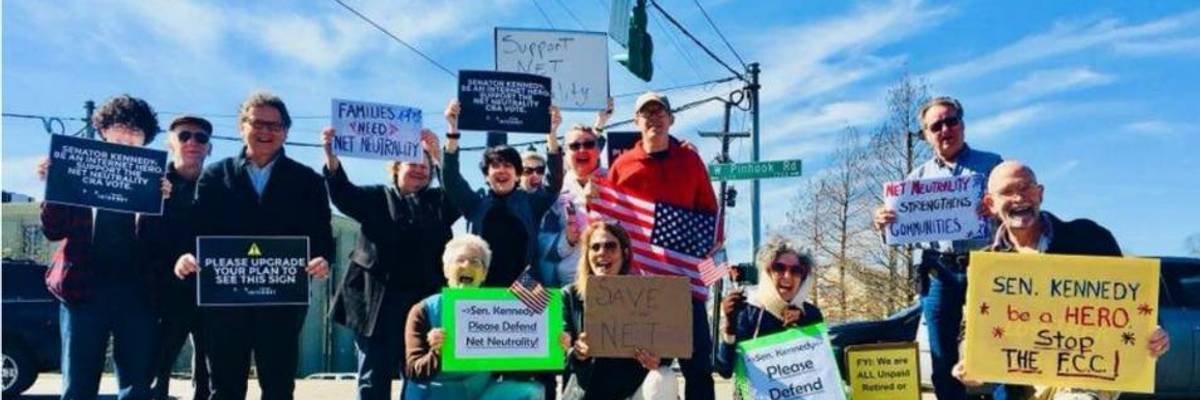
Louisiana residents congregated outside Sen. John Kennedy's (R-La.) office on Thursdau to urge him to back a CRA resolution to nullify the FCC's recent decision to repeal net neutrality protections. (Photo: Free Press)
With FCC's Order Sent to Senate, Internet Defenders Inch Toward Vote to Restore Net Neutrality
With one more vote needed to reverse panel's unpopular vote, internet freedom groups are putting pressure on Republican senators
Open Internet advocates and lawmakers were urging supporters on Friday to help secure one last vote in the Senate in favor of reversing the Federal Communications Commission's (FCC) unpopular net neutrality decision.
The FCC sent its official order to roll back net neutrality protections on Friday, following its vote in December.
With the Republican-led panel's 3-2 decision along party lines, internet service providers (ISPs) like Verizon and Comcast will be free to give preferential treatment to wealthy internet companies that can afford to pay for faster service--essentially creating "fast lanes" and "slow lanes" for the internet.
Immediately after the vote--which was opposed by 83 percent of Americans, according to a University of Maryland poll--Sen. Ed Markey (D-Mass.) announced his plan to introduce a Congressional Review Act (CRA) resolution under which the Senate could vote to reverse the FCC's decision.
With the order now officially on Capitol Hill, it only needs to be sent to the House and published in the Federal Register, after which Market will have 60 days to gather enough support for a vote to nullify the decision.
The 50 senators who have said they would vote to restore net neutrality include one Republican--Sen. Susan Collins (R-Maine)--as well as all 47 Democratic senators and both Independents.
On Thursday, Louisiana constituents joined advocacy groups Fight for the Future and Free Press to deliver 6,000 petition signatures to the office of Sen. John Kennedy (R-La.), urging him to throw his support behind the CRA.
"The internet has become an invaluable tool for many people who work from home or have their own businesses," said Jas Duplessis, a Louisiana resident who protested outside Kennedy's office. "Restricting it minimizes the opportunity people have to make their own place in the world financially, destroys a large aspect of the free market and takes away from the American dream."
We are at a crossroads
This country and this world are at a monumental crossroads. In a few short weeks, US voters will have an opportunity to beat back the forces of fascism and confront the billionaires who are rigging the economy, our media system, and our democracy, making it increasingly impossible for ordinary people to get by. We’re not just talking about the election. We’re talking about what must be done once these fascist elements are vanquished from power. We need a bolder set of solutions than what either major party has so far been willing to offer and a working-class movement ready to fight like hell for it. Trump didn't emerge from nowhere. The conditions that fueled MAGA authoritarianism were created by decades of radical neoliberal economic policies and a corrupt political system dominated by corporate interests. They slashed taxes on the super-rich, promising that the benefits would trickle down. They said giveaways to the corporate titans would make life more affordable for the rest of us. It was all bullshit. And when a bitter, betrayed populace searches for someone to blame, right-wing demagogues have little trouble finding scapegoats. People know when they're being lied to, but you won't hear any of this from the corporate media. Only independent journalism—powered and funded by people who believe in building a better world—can deliver truly trustworthy daily news. Our Fall Campaign is underway, and we need your help. To power our newsroom through the rest of the year, we need to raise $125,000 by midnight on October 31. So if you share our vision, please contribute whatever you can to sustain our work. |
Open Internet advocates and lawmakers were urging supporters on Friday to help secure one last vote in the Senate in favor of reversing the Federal Communications Commission's (FCC) unpopular net neutrality decision.
The FCC sent its official order to roll back net neutrality protections on Friday, following its vote in December.
With the Republican-led panel's 3-2 decision along party lines, internet service providers (ISPs) like Verizon and Comcast will be free to give preferential treatment to wealthy internet companies that can afford to pay for faster service--essentially creating "fast lanes" and "slow lanes" for the internet.
Immediately after the vote--which was opposed by 83 percent of Americans, according to a University of Maryland poll--Sen. Ed Markey (D-Mass.) announced his plan to introduce a Congressional Review Act (CRA) resolution under which the Senate could vote to reverse the FCC's decision.
With the order now officially on Capitol Hill, it only needs to be sent to the House and published in the Federal Register, after which Market will have 60 days to gather enough support for a vote to nullify the decision.
The 50 senators who have said they would vote to restore net neutrality include one Republican--Sen. Susan Collins (R-Maine)--as well as all 47 Democratic senators and both Independents.
On Thursday, Louisiana constituents joined advocacy groups Fight for the Future and Free Press to deliver 6,000 petition signatures to the office of Sen. John Kennedy (R-La.), urging him to throw his support behind the CRA.
"The internet has become an invaluable tool for many people who work from home or have their own businesses," said Jas Duplessis, a Louisiana resident who protested outside Kennedy's office. "Restricting it minimizes the opportunity people have to make their own place in the world financially, destroys a large aspect of the free market and takes away from the American dream."
Open Internet advocates and lawmakers were urging supporters on Friday to help secure one last vote in the Senate in favor of reversing the Federal Communications Commission's (FCC) unpopular net neutrality decision.
The FCC sent its official order to roll back net neutrality protections on Friday, following its vote in December.
With the Republican-led panel's 3-2 decision along party lines, internet service providers (ISPs) like Verizon and Comcast will be free to give preferential treatment to wealthy internet companies that can afford to pay for faster service--essentially creating "fast lanes" and "slow lanes" for the internet.
Immediately after the vote--which was opposed by 83 percent of Americans, according to a University of Maryland poll--Sen. Ed Markey (D-Mass.) announced his plan to introduce a Congressional Review Act (CRA) resolution under which the Senate could vote to reverse the FCC's decision.
With the order now officially on Capitol Hill, it only needs to be sent to the House and published in the Federal Register, after which Market will have 60 days to gather enough support for a vote to nullify the decision.
The 50 senators who have said they would vote to restore net neutrality include one Republican--Sen. Susan Collins (R-Maine)--as well as all 47 Democratic senators and both Independents.
On Thursday, Louisiana constituents joined advocacy groups Fight for the Future and Free Press to deliver 6,000 petition signatures to the office of Sen. John Kennedy (R-La.), urging him to throw his support behind the CRA.
"The internet has become an invaluable tool for many people who work from home or have their own businesses," said Jas Duplessis, a Louisiana resident who protested outside Kennedy's office. "Restricting it minimizes the opportunity people have to make their own place in the world financially, destroys a large aspect of the free market and takes away from the American dream."