SUBSCRIBE TO OUR FREE NEWSLETTER
Daily news & progressive opinion—funded by the people, not the corporations—delivered straight to your inbox.
5
#000000
#FFFFFF
To donate by check, phone, or other method, see our More Ways to Give page.
Daily news & progressive opinion—funded by the people, not the corporations—delivered straight to your inbox.
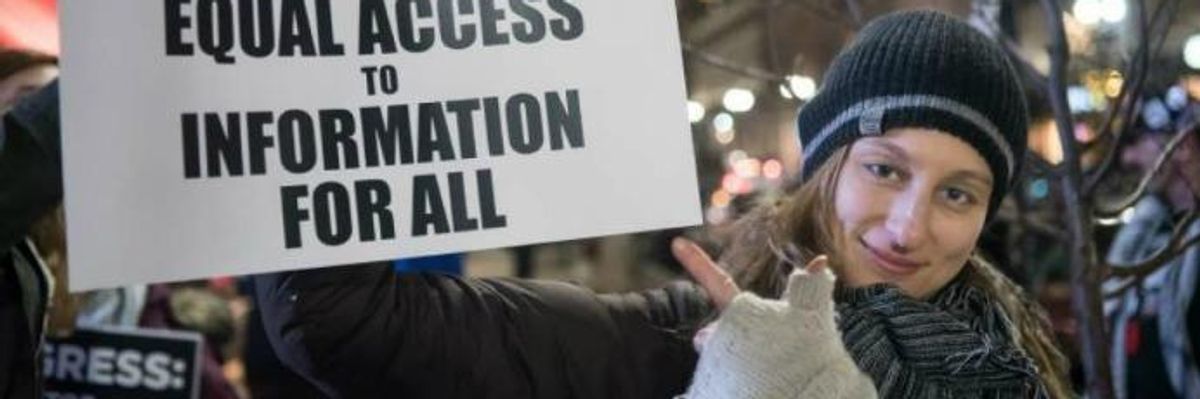
The Federal Communication Commission's December decision to roll back net neutrality rules provoked widespread protests. (Photo: Tim Carter/Flickr/cc)
A coalition of 22 state attorneys general came together on Tuesday to keep their promise to file a lawsuit challenging the Federal Communications Commission's (FCC) recent move to roll back net neutrality consumer protections.
"The repeal of net neutrality would turn internet service providers into gatekeepers--allowing them to put profits over consumers while controlling what we see, what we do, and what we say online."
--Eric Schneiderman, New York Attorney General
Last month, the FCC--led by industry insider Ajit Pai--voted along party lines to repeal rules that banned internet service providers from charging more for or blocking access to particular content.
Leading this latest effort "to stop the FCC's illegal rollback of net neutrality" is New York Attorney General Eric Schneiderman, who said in a statement, "An open internet--and the free exchange of ideas it allows--is critical to our democratic process."
"The repeal of net neutrality would turn internet service providers into gatekeepers--allowing them to put profits over consumers while controlling what we see, what we do, and what we say online," Schneiderman added. "This would be a disaster for New York consumers and businesses, and for everyone who cares about a free and open internet."
The other attorneys general who joined Schneiderman in filing the suit represent California, Connecticut, Delaware, Hawaii, Illinois, Iowa, Kentucky, Maine, Maryland, Massachusetts, Minnesota, Mississippi, New Mexico, North Carolina, Oregon, Pennsylvania, Rhode Island, Vermont, Virginia, Washington, and the District of Columbia.
Their petition (pdf) claims the FCC order rolling back net neutrality protections "is arbitrary, capricious, and an abuse of discretion" under the Administrative Procedure Act; violates the U.S. Constitution and the Communications Act of 1934; and "conflicts with the notice-and-rulemaking requirements" established by federal law.
The lawsuit comes as federal lawmakers, led by Sen. Ed Markey (D-Mass.), are working to use the Congressional Review Act (CRA) to pass a "resolution of disapproval" that would overrule the FCC order. In response to intense public pressure, Democrats have slowly signed on to the legislation, which is now reportedly only one Republican vote shy of the simple majority support that's required to pass the proposal.
The legislation would also need to be voted on by the Republican-controlled House of Representatives. Rep. Mike Doyle (D-Pa.) on Tuesday shared the names of 81 members of the House who have pledged their support for the proposal so far, and vowed to continue seeking co-sponsors.
"There's overwhelming public support for preserving net neutrality, so it's no surprise that there's strong support in Congress as well," Doyle said. "I'm confident that if there's enough public pressure, Congress will overturn the FCC's order killing net neutrality."
Public opposition to the FCC decision is widespread and defies party lines. A poll published last month, just as the FCC was repealing the consumer protections, revealed more than 80 percent of Americans--75 percent of Republicans, 89 percent of Democrats, and 86 percent of Independents--opposed Pai's plan to roll back net neutrality rules.
Dear Common Dreams reader, It’s been nearly 30 years since I co-founded Common Dreams with my late wife, Lina Newhouser. We had the radical notion that journalism should serve the public good, not corporate profits. It was clear to us from the outset what it would take to build such a project. No paid advertisements. No corporate sponsors. No millionaire publisher telling us what to think or do. Many people said we wouldn't last a year, but we proved those doubters wrong. Together with a tremendous team of journalists and dedicated staff, we built an independent media outlet free from the constraints of profits and corporate control. Our mission has always been simple: To inform. To inspire. To ignite change for the common good. Building Common Dreams was not easy. Our survival was never guaranteed. When you take on the most powerful forces—Wall Street greed, fossil fuel industry destruction, Big Tech lobbyists, and uber-rich oligarchs who have spent billions upon billions rigging the economy and democracy in their favor—the only bulwark you have is supporters who believe in your work. But here’s the urgent message from me today. It's never been this bad out there. And it's never been this hard to keep us going. At the very moment Common Dreams is most needed, the threats we face are intensifying. We need your support now more than ever. We don't accept corporate advertising and never will. We don't have a paywall because we don't think people should be blocked from critical news based on their ability to pay. Everything we do is funded by the donations of readers like you. When everyone does the little they can afford, we are strong. But if that support retreats or dries up, so do we. Will you donate now to make sure Common Dreams not only survives but thrives? —Craig Brown, Co-founder |
A coalition of 22 state attorneys general came together on Tuesday to keep their promise to file a lawsuit challenging the Federal Communications Commission's (FCC) recent move to roll back net neutrality consumer protections.
"The repeal of net neutrality would turn internet service providers into gatekeepers--allowing them to put profits over consumers while controlling what we see, what we do, and what we say online."
--Eric Schneiderman, New York Attorney General
Last month, the FCC--led by industry insider Ajit Pai--voted along party lines to repeal rules that banned internet service providers from charging more for or blocking access to particular content.
Leading this latest effort "to stop the FCC's illegal rollback of net neutrality" is New York Attorney General Eric Schneiderman, who said in a statement, "An open internet--and the free exchange of ideas it allows--is critical to our democratic process."
"The repeal of net neutrality would turn internet service providers into gatekeepers--allowing them to put profits over consumers while controlling what we see, what we do, and what we say online," Schneiderman added. "This would be a disaster for New York consumers and businesses, and for everyone who cares about a free and open internet."
The other attorneys general who joined Schneiderman in filing the suit represent California, Connecticut, Delaware, Hawaii, Illinois, Iowa, Kentucky, Maine, Maryland, Massachusetts, Minnesota, Mississippi, New Mexico, North Carolina, Oregon, Pennsylvania, Rhode Island, Vermont, Virginia, Washington, and the District of Columbia.
Their petition (pdf) claims the FCC order rolling back net neutrality protections "is arbitrary, capricious, and an abuse of discretion" under the Administrative Procedure Act; violates the U.S. Constitution and the Communications Act of 1934; and "conflicts with the notice-and-rulemaking requirements" established by federal law.
The lawsuit comes as federal lawmakers, led by Sen. Ed Markey (D-Mass.), are working to use the Congressional Review Act (CRA) to pass a "resolution of disapproval" that would overrule the FCC order. In response to intense public pressure, Democrats have slowly signed on to the legislation, which is now reportedly only one Republican vote shy of the simple majority support that's required to pass the proposal.
The legislation would also need to be voted on by the Republican-controlled House of Representatives. Rep. Mike Doyle (D-Pa.) on Tuesday shared the names of 81 members of the House who have pledged their support for the proposal so far, and vowed to continue seeking co-sponsors.
"There's overwhelming public support for preserving net neutrality, so it's no surprise that there's strong support in Congress as well," Doyle said. "I'm confident that if there's enough public pressure, Congress will overturn the FCC's order killing net neutrality."
Public opposition to the FCC decision is widespread and defies party lines. A poll published last month, just as the FCC was repealing the consumer protections, revealed more than 80 percent of Americans--75 percent of Republicans, 89 percent of Democrats, and 86 percent of Independents--opposed Pai's plan to roll back net neutrality rules.
A coalition of 22 state attorneys general came together on Tuesday to keep their promise to file a lawsuit challenging the Federal Communications Commission's (FCC) recent move to roll back net neutrality consumer protections.
"The repeal of net neutrality would turn internet service providers into gatekeepers--allowing them to put profits over consumers while controlling what we see, what we do, and what we say online."
--Eric Schneiderman, New York Attorney General
Last month, the FCC--led by industry insider Ajit Pai--voted along party lines to repeal rules that banned internet service providers from charging more for or blocking access to particular content.
Leading this latest effort "to stop the FCC's illegal rollback of net neutrality" is New York Attorney General Eric Schneiderman, who said in a statement, "An open internet--and the free exchange of ideas it allows--is critical to our democratic process."
"The repeal of net neutrality would turn internet service providers into gatekeepers--allowing them to put profits over consumers while controlling what we see, what we do, and what we say online," Schneiderman added. "This would be a disaster for New York consumers and businesses, and for everyone who cares about a free and open internet."
The other attorneys general who joined Schneiderman in filing the suit represent California, Connecticut, Delaware, Hawaii, Illinois, Iowa, Kentucky, Maine, Maryland, Massachusetts, Minnesota, Mississippi, New Mexico, North Carolina, Oregon, Pennsylvania, Rhode Island, Vermont, Virginia, Washington, and the District of Columbia.
Their petition (pdf) claims the FCC order rolling back net neutrality protections "is arbitrary, capricious, and an abuse of discretion" under the Administrative Procedure Act; violates the U.S. Constitution and the Communications Act of 1934; and "conflicts with the notice-and-rulemaking requirements" established by federal law.
The lawsuit comes as federal lawmakers, led by Sen. Ed Markey (D-Mass.), are working to use the Congressional Review Act (CRA) to pass a "resolution of disapproval" that would overrule the FCC order. In response to intense public pressure, Democrats have slowly signed on to the legislation, which is now reportedly only one Republican vote shy of the simple majority support that's required to pass the proposal.
The legislation would also need to be voted on by the Republican-controlled House of Representatives. Rep. Mike Doyle (D-Pa.) on Tuesday shared the names of 81 members of the House who have pledged their support for the proposal so far, and vowed to continue seeking co-sponsors.
"There's overwhelming public support for preserving net neutrality, so it's no surprise that there's strong support in Congress as well," Doyle said. "I'm confident that if there's enough public pressure, Congress will overturn the FCC's order killing net neutrality."
Public opposition to the FCC decision is widespread and defies party lines. A poll published last month, just as the FCC was repealing the consumer protections, revealed more than 80 percent of Americans--75 percent of Republicans, 89 percent of Democrats, and 86 percent of Independents--opposed Pai's plan to roll back net neutrality rules.