
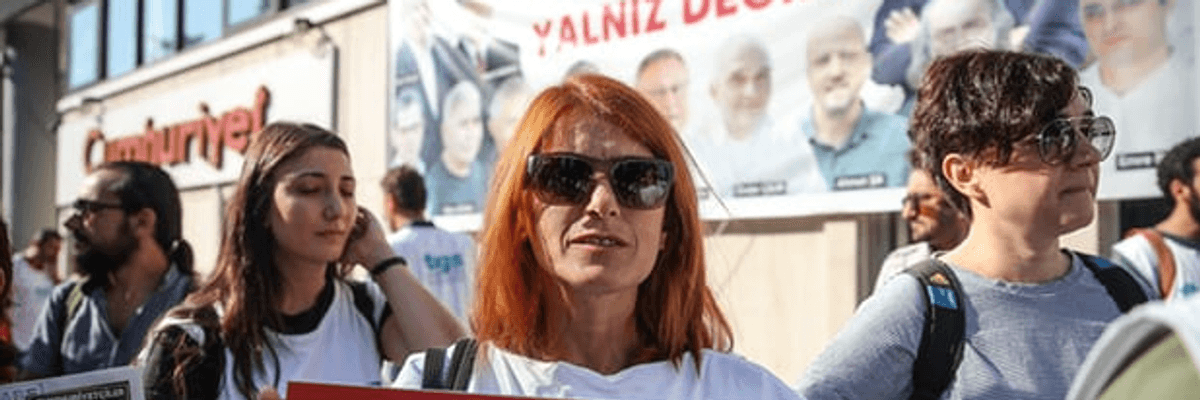
A record 262 journalists were behind bars around the world for reporting on news events as of December 1, according to a new report by the Committee to Protect Journalists. (Photo: PamBQ)
Report Links Trump's Anti-Press Rhetoric to Record Number of Jailed Journalists
The president's fixation on "fake news" appears to have been embraced by authoritarian leaders around the world
Exacerbated by President Donald Trump's anti-press rhetoric, a record number of journalists worldwide are currently behind bars for reporting or commenting on news events according to an annual survey by the Committee to Protect Journalists (CPJ). The numbers reflect not only a "bleak climate" for journalists around the globe, but also a "dismal failure" by countries including the U.S. to address the ongoing crisis.
Turkey, China, and Egypt were the three worst offenders in CPJ's report, jailing a combined 134 journalists out of the total 262 who are currently imprisoned worldwide. Trump, the report noted, has expressed admiration for Turkish President Recep Tayyip Erdogan and Chinese President Xi Jinping, both of whom have been criticized for their authoritarian leanings, and has praised Egypt's President Abdel Fattah Al-Sisi, saying they both "agree on so many things."
"Far from isolating repressive countries for their authoritarian behavior, the United States, in particular, has cozied up to strongmen," said the CPJ.
When the president visited Xi in November, he made no public mention of human rights abuses in China, despite a crackdown which has led to the jailing of 41 journalists there, up from 38 in 2016. Trump has also hosted Erdogan at the White House in May, weeks after 19 reporters were sent to jail for a second time for their alleged involvement in 2016's coup attempt, after a court ordered their release. The judges who had demanded they be set free were suspended.
In addition to Trump's friendships with leaders who swiftly arrest journalists on "anti-state" charges, said the CPJ, the president's "nationalistic rhetoric, fixation on Islamic extremism, and insistence on labeling critical media 'fake news' serves to reinforce the framework of accusations and legal charges that allow such leaders to preside over the jailing of journalists."
The president's favored phrase, employed frequently when news outlets report on his low poll numbers and other negative news coverage of his administration, has taken off in repressive countries this year. A record 21 journalists are currently behind bars for spreading "false news," according to the CPJ.
In Myanmar, where Amnesty International accuses the military of waging a genocidal campaign against the Rohingya minority group, a security official recently told the New York Times, "There is no such thing as Rohingya. It is fake news." Two Reuters journalists who were reporting on the issue were detained there on Wednesday, and human rights groups claim local reporters have been abducted in recent weeks by the military.
Meanwhile, Chinese state media on Tuesday joined Trump in turning the phrase against the Western media.
"If the President of the United States claims that his nation's leading media outlets are a stain on America, then negative news about China and other countries should be taken with a grain of salt since it is likely that bias and political agendas are distorting the real picture," read an op-ed in the People's Daily.
On social media, journalists and free press advocates drew attention to the widespread imprisonment of members of the press, as well as Trump's contributions to an increasingly hostile environment for the news media.
An Urgent Message From Our Co-Founder
Dear Common Dreams reader, It’s been nearly 30 years since I co-founded Common Dreams with my late wife, Lina Newhouser. We had the radical notion that journalism should serve the public good, not corporate profits. It was clear to us from the outset what it would take to build such a project. No paid advertisements. No corporate sponsors. No millionaire publisher telling us what to think or do. Many people said we wouldn't last a year, but we proved those doubters wrong. Together with a tremendous team of journalists and dedicated staff, we built an independent media outlet free from the constraints of profits and corporate control. Our mission has always been simple: To inform. To inspire. To ignite change for the common good. Building Common Dreams was not easy. Our survival was never guaranteed. When you take on the most powerful forces—Wall Street greed, fossil fuel industry destruction, Big Tech lobbyists, and uber-rich oligarchs who have spent billions upon billions rigging the economy and democracy in their favor—the only bulwark you have is supporters who believe in your work. But here’s the urgent message from me today. It's never been this bad out there. And it's never been this hard to keep us going. At the very moment Common Dreams is most needed, the threats we face are intensifying. We need your support now more than ever. We don't accept corporate advertising and never will. We don't have a paywall because we don't think people should be blocked from critical news based on their ability to pay. Everything we do is funded by the donations of readers like you. When everyone does the little they can afford, we are strong. But if that support retreats or dries up, so do we. Will you donate now to make sure Common Dreams not only survives but thrives? —Craig Brown, Co-founder |
Exacerbated by President Donald Trump's anti-press rhetoric, a record number of journalists worldwide are currently behind bars for reporting or commenting on news events according to an annual survey by the Committee to Protect Journalists (CPJ). The numbers reflect not only a "bleak climate" for journalists around the globe, but also a "dismal failure" by countries including the U.S. to address the ongoing crisis.
Turkey, China, and Egypt were the three worst offenders in CPJ's report, jailing a combined 134 journalists out of the total 262 who are currently imprisoned worldwide. Trump, the report noted, has expressed admiration for Turkish President Recep Tayyip Erdogan and Chinese President Xi Jinping, both of whom have been criticized for their authoritarian leanings, and has praised Egypt's President Abdel Fattah Al-Sisi, saying they both "agree on so many things."
"Far from isolating repressive countries for their authoritarian behavior, the United States, in particular, has cozied up to strongmen," said the CPJ.
When the president visited Xi in November, he made no public mention of human rights abuses in China, despite a crackdown which has led to the jailing of 41 journalists there, up from 38 in 2016. Trump has also hosted Erdogan at the White House in May, weeks after 19 reporters were sent to jail for a second time for their alleged involvement in 2016's coup attempt, after a court ordered their release. The judges who had demanded they be set free were suspended.
In addition to Trump's friendships with leaders who swiftly arrest journalists on "anti-state" charges, said the CPJ, the president's "nationalistic rhetoric, fixation on Islamic extremism, and insistence on labeling critical media 'fake news' serves to reinforce the framework of accusations and legal charges that allow such leaders to preside over the jailing of journalists."
The president's favored phrase, employed frequently when news outlets report on his low poll numbers and other negative news coverage of his administration, has taken off in repressive countries this year. A record 21 journalists are currently behind bars for spreading "false news," according to the CPJ.
In Myanmar, where Amnesty International accuses the military of waging a genocidal campaign against the Rohingya minority group, a security official recently told the New York Times, "There is no such thing as Rohingya. It is fake news." Two Reuters journalists who were reporting on the issue were detained there on Wednesday, and human rights groups claim local reporters have been abducted in recent weeks by the military.
Meanwhile, Chinese state media on Tuesday joined Trump in turning the phrase against the Western media.
"If the President of the United States claims that his nation's leading media outlets are a stain on America, then negative news about China and other countries should be taken with a grain of salt since it is likely that bias and political agendas are distorting the real picture," read an op-ed in the People's Daily.
On social media, journalists and free press advocates drew attention to the widespread imprisonment of members of the press, as well as Trump's contributions to an increasingly hostile environment for the news media.
Exacerbated by President Donald Trump's anti-press rhetoric, a record number of journalists worldwide are currently behind bars for reporting or commenting on news events according to an annual survey by the Committee to Protect Journalists (CPJ). The numbers reflect not only a "bleak climate" for journalists around the globe, but also a "dismal failure" by countries including the U.S. to address the ongoing crisis.
Turkey, China, and Egypt were the three worst offenders in CPJ's report, jailing a combined 134 journalists out of the total 262 who are currently imprisoned worldwide. Trump, the report noted, has expressed admiration for Turkish President Recep Tayyip Erdogan and Chinese President Xi Jinping, both of whom have been criticized for their authoritarian leanings, and has praised Egypt's President Abdel Fattah Al-Sisi, saying they both "agree on so many things."
"Far from isolating repressive countries for their authoritarian behavior, the United States, in particular, has cozied up to strongmen," said the CPJ.
When the president visited Xi in November, he made no public mention of human rights abuses in China, despite a crackdown which has led to the jailing of 41 journalists there, up from 38 in 2016. Trump has also hosted Erdogan at the White House in May, weeks after 19 reporters were sent to jail for a second time for their alleged involvement in 2016's coup attempt, after a court ordered their release. The judges who had demanded they be set free were suspended.
In addition to Trump's friendships with leaders who swiftly arrest journalists on "anti-state" charges, said the CPJ, the president's "nationalistic rhetoric, fixation on Islamic extremism, and insistence on labeling critical media 'fake news' serves to reinforce the framework of accusations and legal charges that allow such leaders to preside over the jailing of journalists."
The president's favored phrase, employed frequently when news outlets report on his low poll numbers and other negative news coverage of his administration, has taken off in repressive countries this year. A record 21 journalists are currently behind bars for spreading "false news," according to the CPJ.
In Myanmar, where Amnesty International accuses the military of waging a genocidal campaign against the Rohingya minority group, a security official recently told the New York Times, "There is no such thing as Rohingya. It is fake news." Two Reuters journalists who were reporting on the issue were detained there on Wednesday, and human rights groups claim local reporters have been abducted in recent weeks by the military.
Meanwhile, Chinese state media on Tuesday joined Trump in turning the phrase against the Western media.
"If the President of the United States claims that his nation's leading media outlets are a stain on America, then negative news about China and other countries should be taken with a grain of salt since it is likely that bias and political agendas are distorting the real picture," read an op-ed in the People's Daily.
On social media, journalists and free press advocates drew attention to the widespread imprisonment of members of the press, as well as Trump's contributions to an increasingly hostile environment for the news media.