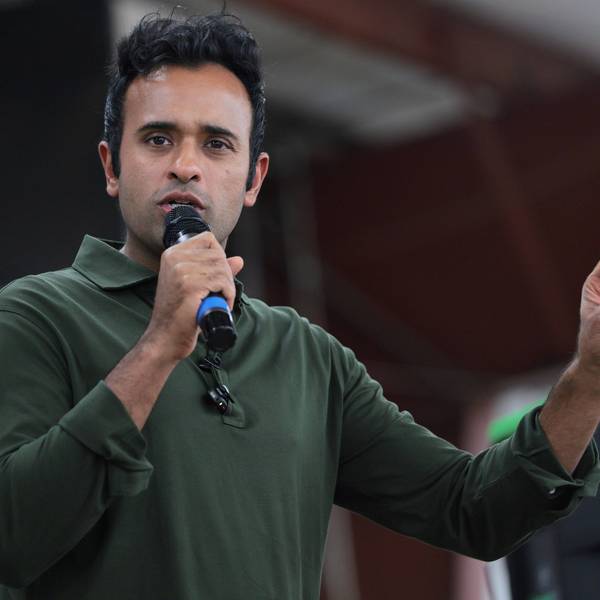


Sen. Bernie Sanders (I-Vt.) spoke at a #ReplaceNAFTA Day of Action event in Washington, D.C. on December 13, 2017. (Photo: Anthony Torres/@avtorres4/Twitter)
Lawmakers and 70+ Advocacy Groups Call on North American Leaders to #ReplaceNAFTA
"We have to stand strong for a trade policy that lifts up workers, safeguards human rights, and protects the environment, not one that simply hands more power and profit to massive corporations."
While this year's final renegotiation talks for the North American Free Trade Agreement (NAFTA) continued behind closed doors on Wednesday, members of more than 70 advocacy groups and multiple lawmakers hosted an event on Capitol Hill and launched a social media campaign as part of the #ReplaceNAFTA Day of Action.
"Americans have had enough with trade deals that make it easier to outsource jobs to wherever workers are the most exploited and environmental regulations are the weakest."
--Arthur Stamoulis, Citizens Trade Campaign
"Americans have had enough with trade deals that make it easier to outsource jobs to wherever workers are the most exploited and environmental regulations are the weakest," said Arthur Stamoulis, executive director of the Citizens Trade Campaign, one of the groups that helped organize the event in D.C.
"It's time to replace NAFTA with a new agreement that prioritizes the creation of good-paying jobs, the protection of human rights, and increased wages for all working people," he said.
Activists with labor, environmental, faith, consumer, family farm, and other advocacy groups came together to demand that through the renegotiation, the United States, Mexico, and Canada--the three nations party to the agreement--end NAFTA's outsourcing incentives and craft "labor and environmental provisions that are based on fundamental international standards and include swift and certain enforcement," Stamoulis said.
However, corporations oppose cutting the treaty's job outsourcing incentives, and also reject U.S. proposals to incorporate a Buy American waiver--which would limit Chinese content in NAFTA goods--and to add a five-year review.
"The corporate lobby is urging Mexico and Canada not to engage on U.S. proposals to improve NAFTA, which increases the prospects that talks deadlock and President [Donald] Trump withdraws," warned Lori Wallach, director of Public Citizen's Global Trade Watch. If the president decides to withdraw and NAFTA completely collapses, foreign policy and trade experts fear the move would jeopardize tourism, agriculture, automotive, and national security interests.
Although Trump the candidate touted trade policies that would benefit American workers and bragged about how he would "drain the swamp" if elected, his willingness to cater to industries' wishes and stock the government with lobbyists and corporate insiders during his first year as president has raised concerns that he will prioritize the corporate agenda in NAFTA talks.
"People will not stand by and let Donald Trump trade away their jobs, wages, climate, air, and water to the highest corporate bidder," said Ben Beachy, director of the Sierra Club's Responsible Trade Program.
"When Donald Trump campaigned for president, he promised that he was going to stop corporations from shifting American jobs to Mexico," said Sen. Bernie Sanders (I-Vt.), who spoke at the event alongside Reps. Keith Ellison (D-Minn.) and Rosa DeLauro (D-Conn.). Addressing the president directly, Sanders added: "For once in your life, keep your promises."
Watch:
On Twitter Wednesday, Sanders acknowledged the corporate forces hard at work to block proposed changes to the treaty that would favor workers instead of big businesses.
"We cannot let corporate special interests write the rules once again and rig this trade agreement against workers," DeLauro warned.
"This is an opportunity to learn from what hasn't worked and come up with an approach to trade that serves the common good," Ellison said. "We have to stand strong for a trade policy that lifts up workers, safeguards human rights, and protects the environment, not one that simply hands more power and profit to massive corporations."
Several activists and groups that helped organize the D.C. event and support renegotiating the treaty turned to Twitter on Wednesday to document their demands:
We are at a crossroads
This country and this world are at a monumental crossroads. In a few short weeks, US voters will have an opportunity to beat back the forces of fascism and confront the billionaires who are rigging the economy, our media system, and our democracy, making it increasingly impossible for ordinary people to get by. We’re not just talking about the election. We’re talking about what must be done once these fascist elements are vanquished from power. We need a bolder set of solutions than what either major party has so far been willing to offer and a working-class movement ready to fight like hell for it. Trump didn't emerge from nowhere. The conditions that fueled MAGA authoritarianism were created by decades of radical neoliberal economic policies and a corrupt political system dominated by corporate interests. They slashed taxes on the super-rich, promising that the benefits would trickle down. They said giveaways to the corporate titans would make life more affordable for the rest of us. It was all bullshit. And when a bitter, betrayed populace searches for someone to blame, right-wing demagogues have little trouble finding scapegoats. People know when they're being lied to, but you won't hear any of this from the corporate media. Only independent journalism—powered and funded by people who believe in building a better world—can deliver truly trustworthy daily news. Our Fall Campaign is underway, and we need your help. To power our newsroom through the rest of the year, we need to raise $125,000 by midnight on October 31. So if you share our vision, please contribute whatever you can to sustain our work. |
While this year's final renegotiation talks for the North American Free Trade Agreement (NAFTA) continued behind closed doors on Wednesday, members of more than 70 advocacy groups and multiple lawmakers hosted an event on Capitol Hill and launched a social media campaign as part of the #ReplaceNAFTA Day of Action.
"Americans have had enough with trade deals that make it easier to outsource jobs to wherever workers are the most exploited and environmental regulations are the weakest."
--Arthur Stamoulis, Citizens Trade Campaign
"Americans have had enough with trade deals that make it easier to outsource jobs to wherever workers are the most exploited and environmental regulations are the weakest," said Arthur Stamoulis, executive director of the Citizens Trade Campaign, one of the groups that helped organize the event in D.C.
"It's time to replace NAFTA with a new agreement that prioritizes the creation of good-paying jobs, the protection of human rights, and increased wages for all working people," he said.
Activists with labor, environmental, faith, consumer, family farm, and other advocacy groups came together to demand that through the renegotiation, the United States, Mexico, and Canada--the three nations party to the agreement--end NAFTA's outsourcing incentives and craft "labor and environmental provisions that are based on fundamental international standards and include swift and certain enforcement," Stamoulis said.
However, corporations oppose cutting the treaty's job outsourcing incentives, and also reject U.S. proposals to incorporate a Buy American waiver--which would limit Chinese content in NAFTA goods--and to add a five-year review.
"The corporate lobby is urging Mexico and Canada not to engage on U.S. proposals to improve NAFTA, which increases the prospects that talks deadlock and President [Donald] Trump withdraws," warned Lori Wallach, director of Public Citizen's Global Trade Watch. If the president decides to withdraw and NAFTA completely collapses, foreign policy and trade experts fear the move would jeopardize tourism, agriculture, automotive, and national security interests.
Although Trump the candidate touted trade policies that would benefit American workers and bragged about how he would "drain the swamp" if elected, his willingness to cater to industries' wishes and stock the government with lobbyists and corporate insiders during his first year as president has raised concerns that he will prioritize the corporate agenda in NAFTA talks.
"People will not stand by and let Donald Trump trade away their jobs, wages, climate, air, and water to the highest corporate bidder," said Ben Beachy, director of the Sierra Club's Responsible Trade Program.
"When Donald Trump campaigned for president, he promised that he was going to stop corporations from shifting American jobs to Mexico," said Sen. Bernie Sanders (I-Vt.), who spoke at the event alongside Reps. Keith Ellison (D-Minn.) and Rosa DeLauro (D-Conn.). Addressing the president directly, Sanders added: "For once in your life, keep your promises."
Watch:
On Twitter Wednesday, Sanders acknowledged the corporate forces hard at work to block proposed changes to the treaty that would favor workers instead of big businesses.
"We cannot let corporate special interests write the rules once again and rig this trade agreement against workers," DeLauro warned.
"This is an opportunity to learn from what hasn't worked and come up with an approach to trade that serves the common good," Ellison said. "We have to stand strong for a trade policy that lifts up workers, safeguards human rights, and protects the environment, not one that simply hands more power and profit to massive corporations."
Several activists and groups that helped organize the D.C. event and support renegotiating the treaty turned to Twitter on Wednesday to document their demands:
While this year's final renegotiation talks for the North American Free Trade Agreement (NAFTA) continued behind closed doors on Wednesday, members of more than 70 advocacy groups and multiple lawmakers hosted an event on Capitol Hill and launched a social media campaign as part of the #ReplaceNAFTA Day of Action.
"Americans have had enough with trade deals that make it easier to outsource jobs to wherever workers are the most exploited and environmental regulations are the weakest."
--Arthur Stamoulis, Citizens Trade Campaign
"Americans have had enough with trade deals that make it easier to outsource jobs to wherever workers are the most exploited and environmental regulations are the weakest," said Arthur Stamoulis, executive director of the Citizens Trade Campaign, one of the groups that helped organize the event in D.C.
"It's time to replace NAFTA with a new agreement that prioritizes the creation of good-paying jobs, the protection of human rights, and increased wages for all working people," he said.
Activists with labor, environmental, faith, consumer, family farm, and other advocacy groups came together to demand that through the renegotiation, the United States, Mexico, and Canada--the three nations party to the agreement--end NAFTA's outsourcing incentives and craft "labor and environmental provisions that are based on fundamental international standards and include swift and certain enforcement," Stamoulis said.
However, corporations oppose cutting the treaty's job outsourcing incentives, and also reject U.S. proposals to incorporate a Buy American waiver--which would limit Chinese content in NAFTA goods--and to add a five-year review.
"The corporate lobby is urging Mexico and Canada not to engage on U.S. proposals to improve NAFTA, which increases the prospects that talks deadlock and President [Donald] Trump withdraws," warned Lori Wallach, director of Public Citizen's Global Trade Watch. If the president decides to withdraw and NAFTA completely collapses, foreign policy and trade experts fear the move would jeopardize tourism, agriculture, automotive, and national security interests.
Although Trump the candidate touted trade policies that would benefit American workers and bragged about how he would "drain the swamp" if elected, his willingness to cater to industries' wishes and stock the government with lobbyists and corporate insiders during his first year as president has raised concerns that he will prioritize the corporate agenda in NAFTA talks.
"People will not stand by and let Donald Trump trade away their jobs, wages, climate, air, and water to the highest corporate bidder," said Ben Beachy, director of the Sierra Club's Responsible Trade Program.
"When Donald Trump campaigned for president, he promised that he was going to stop corporations from shifting American jobs to Mexico," said Sen. Bernie Sanders (I-Vt.), who spoke at the event alongside Reps. Keith Ellison (D-Minn.) and Rosa DeLauro (D-Conn.). Addressing the president directly, Sanders added: "For once in your life, keep your promises."
Watch:
On Twitter Wednesday, Sanders acknowledged the corporate forces hard at work to block proposed changes to the treaty that would favor workers instead of big businesses.
"We cannot let corporate special interests write the rules once again and rig this trade agreement against workers," DeLauro warned.
"This is an opportunity to learn from what hasn't worked and come up with an approach to trade that serves the common good," Ellison said. "We have to stand strong for a trade policy that lifts up workers, safeguards human rights, and protects the environment, not one that simply hands more power and profit to massive corporations."
Several activists and groups that helped organize the D.C. event and support renegotiating the treaty turned to Twitter on Wednesday to document their demands: