

SUBSCRIBE TO OUR FREE NEWSLETTER
Daily news & progressive opinion—funded by the people, not the corporations—delivered straight to your inbox.
5
#000000
#FFFFFF
To donate by check, phone, or other method, see our More Ways to Give page.
Daily news & progressive opinion—funded by the people, not the corporations—delivered straight to your inbox.
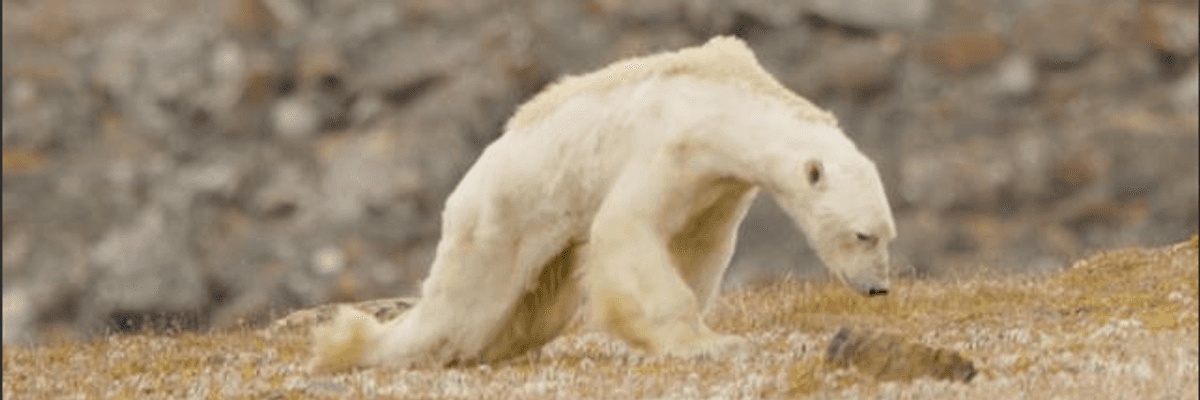
A video of an emaciated polar bear on Baffin Island was shared on social media this week. Warmer temperatures have led to longer ice-free periods throughout the year in the Arctic, increasing the risk of starvation for the animals. (Photo: @mitrasites2016/Twitter)
A video of a starving polar bear led to calls for climate change denialists to confront the real-world effects of global warming this week. Taken by a Canadian conservationist and photographer and posted to social media, the video offered a stark visual of the drastic impacts of climate change that have already begun taking root.
"When scientists say bears are going extinct, I want people to realize what it looks like. Bears are going to starve to death. This is what a starving bear looks like."--Paul Nicklen, photographer
Paul Nicklen was traveling with the conservation group Sea Legacy in Canada's Baffin Island, located in the Arctic, when he spotted the emaciated animal struggling to walk across the dry land--historically covered with ice in December and home to seals that polar bears rely on for food. The bear searched in vain for sustenance in a trashcan before collapsing.
"When scientists say bears are going extinct, I want people to realize what it looks like," said Nicklen in an interview with National Geographic. "Bears are going to starve to death. This is what a starving bear looks like."
Im so sorry angel
This polar bear is starving to death, to the point where it's hard for him to even get up/move around. If this hurts to see, then take a step back and acknowledge that if you consume animals you're contributing to this polar bears suffering- pic.twitter.com/SqLQj5Ogci-- (@figsoverpigs) December 7, 2017
Nicklen received some criticism for filming the bear instead of feeding it, but he argued that sharing the image of the impact of global warming with the largest audience possible would be more productive than intervening by ending the animal's life or feeding it a small amount of food.
"There is no band aid solution. There was no saving this individual bear," he wrote on Instagram where he orginally posted the video.
In his interview with National Geographic, Nicklen added, "it's not like I walk around with a tranquilizer gun or 400 pounds of seal meat."
Polar bears have officially been considered a threatened species since 2008, under the Endangered Species Act, due to the ongoing loss of their icy habitats in Arctic regions.
The bears are accustomed to going without food in summer months when ice dries up, but unusually warm temperatures have caused them to fast for unhealthy periods of time and potentially starving to death.
The U.S. Geological Survey reported earlier this year that the increasingly rapid rate of melting sea ice in the Arctic is an existential threat to polar bears.
On social media, viewers of Nicklen's video called for political leaders like President Donald Trump, who has refused to take part in global efforts to minimize the warming of the Earth by reducing carbon emissions, to reconsider their climate-wrecking actions.
Dear Common Dreams reader, It’s been nearly 30 years since I co-founded Common Dreams with my late wife, Lina Newhouser. We had the radical notion that journalism should serve the public good, not corporate profits. It was clear to us from the outset what it would take to build such a project. No paid advertisements. No corporate sponsors. No millionaire publisher telling us what to think or do. Many people said we wouldn't last a year, but we proved those doubters wrong. Together with a tremendous team of journalists and dedicated staff, we built an independent media outlet free from the constraints of profits and corporate control. Our mission has always been simple: To inform. To inspire. To ignite change for the common good. Building Common Dreams was not easy. Our survival was never guaranteed. When you take on the most powerful forces—Wall Street greed, fossil fuel industry destruction, Big Tech lobbyists, and uber-rich oligarchs who have spent billions upon billions rigging the economy and democracy in their favor—the only bulwark you have is supporters who believe in your work. But here’s the urgent message from me today. It's never been this bad out there. And it's never been this hard to keep us going. At the very moment Common Dreams is most needed, the threats we face are intensifying. We need your support now more than ever. We don't accept corporate advertising and never will. We don't have a paywall because we don't think people should be blocked from critical news based on their ability to pay. Everything we do is funded by the donations of readers like you. When everyone does the little they can afford, we are strong. But if that support retreats or dries up, so do we. Will you donate now to make sure Common Dreams not only survives but thrives? —Craig Brown, Co-founder |
A video of a starving polar bear led to calls for climate change denialists to confront the real-world effects of global warming this week. Taken by a Canadian conservationist and photographer and posted to social media, the video offered a stark visual of the drastic impacts of climate change that have already begun taking root.
"When scientists say bears are going extinct, I want people to realize what it looks like. Bears are going to starve to death. This is what a starving bear looks like."--Paul Nicklen, photographer
Paul Nicklen was traveling with the conservation group Sea Legacy in Canada's Baffin Island, located in the Arctic, when he spotted the emaciated animal struggling to walk across the dry land--historically covered with ice in December and home to seals that polar bears rely on for food. The bear searched in vain for sustenance in a trashcan before collapsing.
"When scientists say bears are going extinct, I want people to realize what it looks like," said Nicklen in an interview with National Geographic. "Bears are going to starve to death. This is what a starving bear looks like."
Im so sorry angel
This polar bear is starving to death, to the point where it's hard for him to even get up/move around. If this hurts to see, then take a step back and acknowledge that if you consume animals you're contributing to this polar bears suffering- pic.twitter.com/SqLQj5Ogci-- (@figsoverpigs) December 7, 2017
Nicklen received some criticism for filming the bear instead of feeding it, but he argued that sharing the image of the impact of global warming with the largest audience possible would be more productive than intervening by ending the animal's life or feeding it a small amount of food.
"There is no band aid solution. There was no saving this individual bear," he wrote on Instagram where he orginally posted the video.
In his interview with National Geographic, Nicklen added, "it's not like I walk around with a tranquilizer gun or 400 pounds of seal meat."
Polar bears have officially been considered a threatened species since 2008, under the Endangered Species Act, due to the ongoing loss of their icy habitats in Arctic regions.
The bears are accustomed to going without food in summer months when ice dries up, but unusually warm temperatures have caused them to fast for unhealthy periods of time and potentially starving to death.
The U.S. Geological Survey reported earlier this year that the increasingly rapid rate of melting sea ice in the Arctic is an existential threat to polar bears.
On social media, viewers of Nicklen's video called for political leaders like President Donald Trump, who has refused to take part in global efforts to minimize the warming of the Earth by reducing carbon emissions, to reconsider their climate-wrecking actions.
A video of a starving polar bear led to calls for climate change denialists to confront the real-world effects of global warming this week. Taken by a Canadian conservationist and photographer and posted to social media, the video offered a stark visual of the drastic impacts of climate change that have already begun taking root.
"When scientists say bears are going extinct, I want people to realize what it looks like. Bears are going to starve to death. This is what a starving bear looks like."--Paul Nicklen, photographer
Paul Nicklen was traveling with the conservation group Sea Legacy in Canada's Baffin Island, located in the Arctic, when he spotted the emaciated animal struggling to walk across the dry land--historically covered with ice in December and home to seals that polar bears rely on for food. The bear searched in vain for sustenance in a trashcan before collapsing.
"When scientists say bears are going extinct, I want people to realize what it looks like," said Nicklen in an interview with National Geographic. "Bears are going to starve to death. This is what a starving bear looks like."
Im so sorry angel
This polar bear is starving to death, to the point where it's hard for him to even get up/move around. If this hurts to see, then take a step back and acknowledge that if you consume animals you're contributing to this polar bears suffering- pic.twitter.com/SqLQj5Ogci-- (@figsoverpigs) December 7, 2017
Nicklen received some criticism for filming the bear instead of feeding it, but he argued that sharing the image of the impact of global warming with the largest audience possible would be more productive than intervening by ending the animal's life or feeding it a small amount of food.
"There is no band aid solution. There was no saving this individual bear," he wrote on Instagram where he orginally posted the video.
In his interview with National Geographic, Nicklen added, "it's not like I walk around with a tranquilizer gun or 400 pounds of seal meat."
Polar bears have officially been considered a threatened species since 2008, under the Endangered Species Act, due to the ongoing loss of their icy habitats in Arctic regions.
The bears are accustomed to going without food in summer months when ice dries up, but unusually warm temperatures have caused them to fast for unhealthy periods of time and potentially starving to death.
The U.S. Geological Survey reported earlier this year that the increasingly rapid rate of melting sea ice in the Arctic is an existential threat to polar bears.
On social media, viewers of Nicklen's video called for political leaders like President Donald Trump, who has refused to take part in global efforts to minimize the warming of the Earth by reducing carbon emissions, to reconsider their climate-wrecking actions.

