SUBSCRIBE TO OUR FREE NEWSLETTER
Daily news & progressive opinion—funded by the people, not the corporations—delivered straight to your inbox.
5
#000000
#FFFFFF
To donate by check, phone, or other method, see our More Ways to Give page.
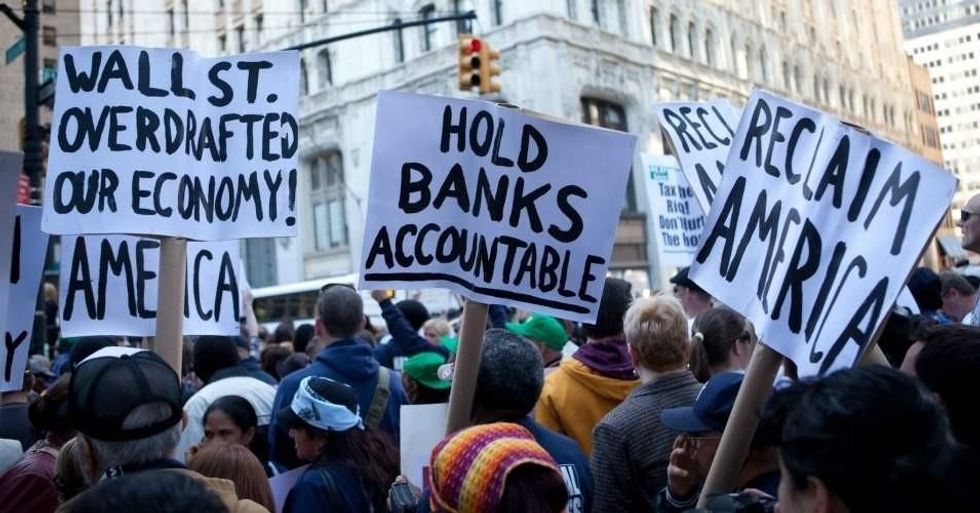
Wall Street banks are raking in record profits, but that's not stopping Senate Republicans--with the help of nine of their Democratic colleagues--from attempting to ram through an "insane" piece of legislation that would scrap a number of key post-financial crisis regulations, "line the pockets of bank executives," and leave consumers more vulnerable to predatory corporations.
"A bunch of senators--including some Democrats--are trying to roll back the rules for big banks that sucked down nearly $50 billion in taxpayer-funded bailouts a few years ago." --Sen. Elizabeth Warren (D-Mass.)In a hearing on Tuesday, the Senate Banking Commitee debated Sen. Mike Crapo's (R-Idaho) "Orwellian-named" Economic Growth, Regulatory Relief, and Consumer Protection Act, legislation that has been forcefully denounced by progressive lawmakers, labor unions, and consumer protection advocates as a major gift to massive financial institutions that could increase the risk of another financial meltdown.
"A bunch of senators--including some Democrats--are trying to roll back the rules for big banks that sucked down nearly $50 billion in taxpayer-funded bailouts a few years ago," Sen. Elizabeth Warren (D-Mass.) wrote on Facebook ahead of the hearing.
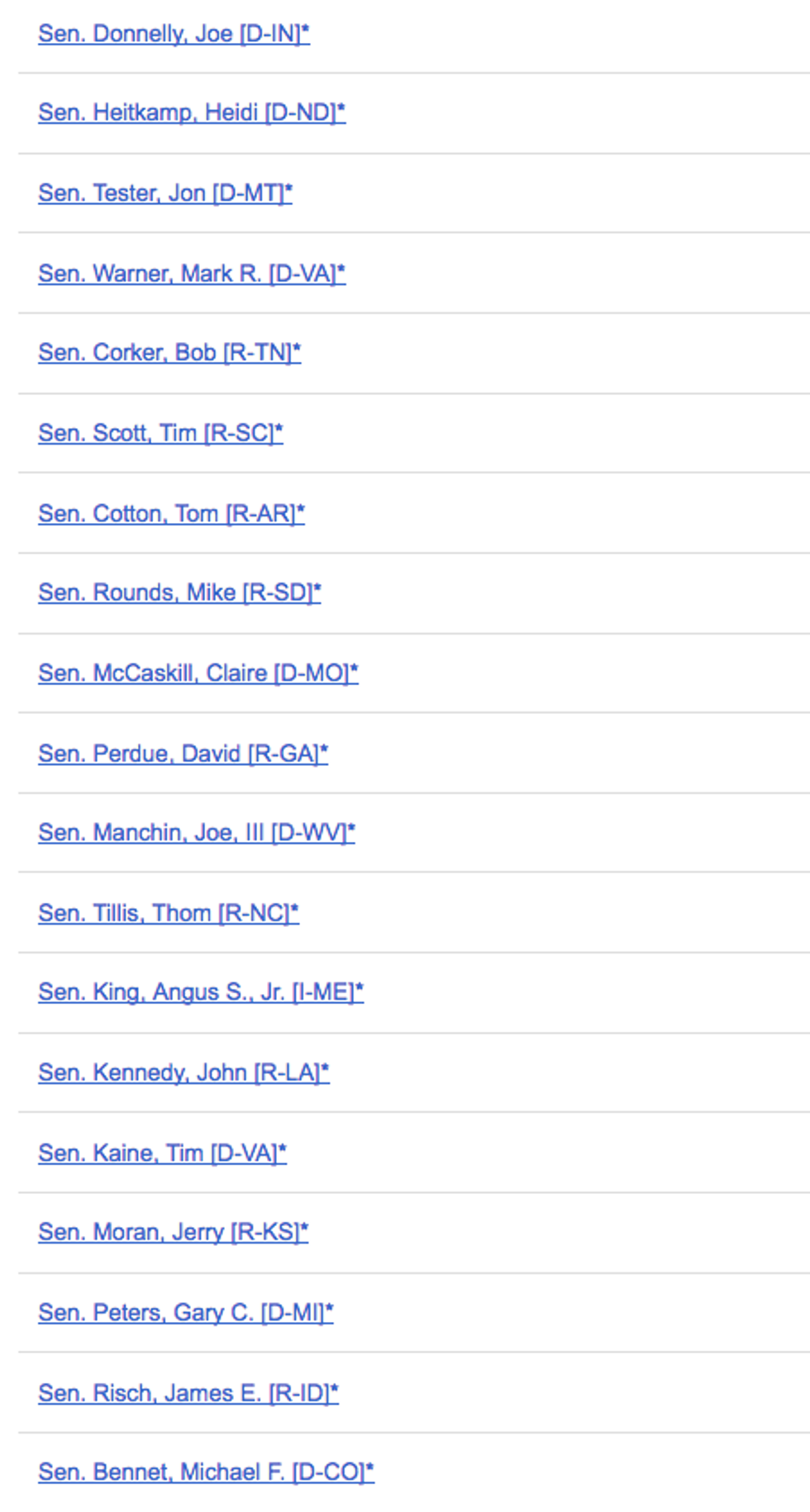
In addition to Sen. Angus King (I-Maine), who typically votes with the caucus, the nine Democratic co-sponsors of Crapo's bill are: Joe Donnelly (Ind.), Heidi Heitkamp (N.D.), John Tester (Mont.), Mark Warner (Va.), Claire McCaskill (Mo.), Joe Manchin (W.Va.), Tim Kaine (Va.), Gary Peters (Mich.), and Michael Bennet (Colo.).
As Tuesday's committee meeting progressed, Warren put forward amendments aimed at making the bill more consumer-friendly, including provisions to protect seniors from financial exploitation and empower students to fight back against loan companies engaging in criminal behavior.
One-by-one, the amendments fell to defeat--and each time, Democrats helped kill them.
As David Dayen noted in a piece for The Intercept, these amendments give progressives a golden opportunity to "name and shame Democrats who support this giveaway to big banks," particularly after they spent "the last week railing against Republicans for waging class warfare on low-income Americans."
In his opening statement at Tuesday's hearing, Sen. Sherrod Brown (D-Ohio)--an opponent of Crapo's bill--connected the effort of Republicans and pro-Wall Street Democrats to deregulate the financial sector to the GOP push to deliver tax cuts to the wealthiest Americans and argued that they are both part of a broad effort to transfer wealth upward.
"Last week, the Senate passed a tax bill that helps pass-throughs, corporations and the wealthiest Americans. I guess the idea behind it is that adding to their wealth will trickle down to working people in America," Brown said. "This week, we seem to be applying the same theory to the banking industry."
"This bill, like the tax bill last week and the healthcare bill before it, sends the message that this Congress is not very interested in helping hardworking middle class Americans," Brown added. "It's Christmas for the C-suite, and crumbs for the Cratchits."
Arguing that the bill places the needs of the banking industry over those of homeowners and consumers, Brown proceeded to rattle off some of the legislation's most egregious components:
Public Citizen--has joined progressive lawmakers in denouncing Crapo's bill, which the group called "dangerous" in a letter (pdf) delivered to the Senate Banking Commitee last week.
"At a time when the likes of Wells Fargo and Equifax demonstrate that Wall Street needs stronger reforms, Senate banking leaders are proposing to grind holes in key existing safeguards," Bartlett Naylor, financial policy advocate for Public Citizen, said in a statement. "Bill sponsors claim this will promote economic growth, but ignore both current record profits at banks as well as the millions of Americans who lost their homes, jobs, and savings when inadequate rules and supervision led to the 2008 crash."
Below are all of the co-sponsors of Crapo's legislation:
Wall Street banks are raking in record profits, but that's not stopping Senate Republicans--with the help of nine of their Democratic colleagues--from attempting to ram through an "insane" piece of legislation that would scrap a number of key post-financial crisis regulations, "line the pockets of bank executives," and leave consumers more vulnerable to predatory corporations.
"A bunch of senators--including some Democrats--are trying to roll back the rules for big banks that sucked down nearly $50 billion in taxpayer-funded bailouts a few years ago." --Sen. Elizabeth Warren (D-Mass.)In a hearing on Tuesday, the Senate Banking Commitee debated Sen. Mike Crapo's (R-Idaho) "Orwellian-named" Economic Growth, Regulatory Relief, and Consumer Protection Act, legislation that has been forcefully denounced by progressive lawmakers, labor unions, and consumer protection advocates as a major gift to massive financial institutions that could increase the risk of another financial meltdown.
"A bunch of senators--including some Democrats--are trying to roll back the rules for big banks that sucked down nearly $50 billion in taxpayer-funded bailouts a few years ago," Sen. Elizabeth Warren (D-Mass.) wrote on Facebook ahead of the hearing.
In addition to Sen. Angus King (I-Maine), who typically votes with the caucus, the nine Democratic co-sponsors of Crapo's bill are: Joe Donnelly (Ind.), Heidi Heitkamp (N.D.), John Tester (Mont.), Mark Warner (Va.), Claire McCaskill (Mo.), Joe Manchin (W.Va.), Tim Kaine (Va.), Gary Peters (Mich.), and Michael Bennet (Colo.).
As Tuesday's committee meeting progressed, Warren put forward amendments aimed at making the bill more consumer-friendly, including provisions to protect seniors from financial exploitation and empower students to fight back against loan companies engaging in criminal behavior.
One-by-one, the amendments fell to defeat--and each time, Democrats helped kill them.
As David Dayen noted in a piece for The Intercept, these amendments give progressives a golden opportunity to "name and shame Democrats who support this giveaway to big banks," particularly after they spent "the last week railing against Republicans for waging class warfare on low-income Americans."
In his opening statement at Tuesday's hearing, Sen. Sherrod Brown (D-Ohio)--an opponent of Crapo's bill--connected the effort of Republicans and pro-Wall Street Democrats to deregulate the financial sector to the GOP push to deliver tax cuts to the wealthiest Americans and argued that they are both part of a broad effort to transfer wealth upward.
"Last week, the Senate passed a tax bill that helps pass-throughs, corporations and the wealthiest Americans. I guess the idea behind it is that adding to their wealth will trickle down to working people in America," Brown said. "This week, we seem to be applying the same theory to the banking industry."
"This bill, like the tax bill last week and the healthcare bill before it, sends the message that this Congress is not very interested in helping hardworking middle class Americans," Brown added. "It's Christmas for the C-suite, and crumbs for the Cratchits."
Arguing that the bill places the needs of the banking industry over those of homeowners and consumers, Brown proceeded to rattle off some of the legislation's most egregious components:
Public Citizen--has joined progressive lawmakers in denouncing Crapo's bill, which the group called "dangerous" in a letter (pdf) delivered to the Senate Banking Commitee last week.
"At a time when the likes of Wells Fargo and Equifax demonstrate that Wall Street needs stronger reforms, Senate banking leaders are proposing to grind holes in key existing safeguards," Bartlett Naylor, financial policy advocate for Public Citizen, said in a statement. "Bill sponsors claim this will promote economic growth, but ignore both current record profits at banks as well as the millions of Americans who lost their homes, jobs, and savings when inadequate rules and supervision led to the 2008 crash."
Below are all of the co-sponsors of Crapo's legislation:
Wall Street banks are raking in record profits, but that's not stopping Senate Republicans--with the help of nine of their Democratic colleagues--from attempting to ram through an "insane" piece of legislation that would scrap a number of key post-financial crisis regulations, "line the pockets of bank executives," and leave consumers more vulnerable to predatory corporations.
"A bunch of senators--including some Democrats--are trying to roll back the rules for big banks that sucked down nearly $50 billion in taxpayer-funded bailouts a few years ago." --Sen. Elizabeth Warren (D-Mass.)In a hearing on Tuesday, the Senate Banking Commitee debated Sen. Mike Crapo's (R-Idaho) "Orwellian-named" Economic Growth, Regulatory Relief, and Consumer Protection Act, legislation that has been forcefully denounced by progressive lawmakers, labor unions, and consumer protection advocates as a major gift to massive financial institutions that could increase the risk of another financial meltdown.
"A bunch of senators--including some Democrats--are trying to roll back the rules for big banks that sucked down nearly $50 billion in taxpayer-funded bailouts a few years ago," Sen. Elizabeth Warren (D-Mass.) wrote on Facebook ahead of the hearing.
In addition to Sen. Angus King (I-Maine), who typically votes with the caucus, the nine Democratic co-sponsors of Crapo's bill are: Joe Donnelly (Ind.), Heidi Heitkamp (N.D.), John Tester (Mont.), Mark Warner (Va.), Claire McCaskill (Mo.), Joe Manchin (W.Va.), Tim Kaine (Va.), Gary Peters (Mich.), and Michael Bennet (Colo.).
As Tuesday's committee meeting progressed, Warren put forward amendments aimed at making the bill more consumer-friendly, including provisions to protect seniors from financial exploitation and empower students to fight back against loan companies engaging in criminal behavior.
One-by-one, the amendments fell to defeat--and each time, Democrats helped kill them.
As David Dayen noted in a piece for The Intercept, these amendments give progressives a golden opportunity to "name and shame Democrats who support this giveaway to big banks," particularly after they spent "the last week railing against Republicans for waging class warfare on low-income Americans."
In his opening statement at Tuesday's hearing, Sen. Sherrod Brown (D-Ohio)--an opponent of Crapo's bill--connected the effort of Republicans and pro-Wall Street Democrats to deregulate the financial sector to the GOP push to deliver tax cuts to the wealthiest Americans and argued that they are both part of a broad effort to transfer wealth upward.
"Last week, the Senate passed a tax bill that helps pass-throughs, corporations and the wealthiest Americans. I guess the idea behind it is that adding to their wealth will trickle down to working people in America," Brown said. "This week, we seem to be applying the same theory to the banking industry."
"This bill, like the tax bill last week and the healthcare bill before it, sends the message that this Congress is not very interested in helping hardworking middle class Americans," Brown added. "It's Christmas for the C-suite, and crumbs for the Cratchits."
Arguing that the bill places the needs of the banking industry over those of homeowners and consumers, Brown proceeded to rattle off some of the legislation's most egregious components:
Public Citizen--has joined progressive lawmakers in denouncing Crapo's bill, which the group called "dangerous" in a letter (pdf) delivered to the Senate Banking Commitee last week.
"At a time when the likes of Wells Fargo and Equifax demonstrate that Wall Street needs stronger reforms, Senate banking leaders are proposing to grind holes in key existing safeguards," Bartlett Naylor, financial policy advocate for Public Citizen, said in a statement. "Bill sponsors claim this will promote economic growth, but ignore both current record profits at banks as well as the millions of Americans who lost their homes, jobs, and savings when inadequate rules and supervision led to the 2008 crash."
Below are all of the co-sponsors of Crapo's legislation: