SUBSCRIBE TO OUR FREE NEWSLETTER
Daily news & progressive opinion—funded by the people, not the corporations—delivered straight to your inbox.
5
#000000
#FFFFFF
To donate by check, phone, or other method, see our More Ways to Give page.
Daily news & progressive opinion—funded by the people, not the corporations—delivered straight to your inbox.
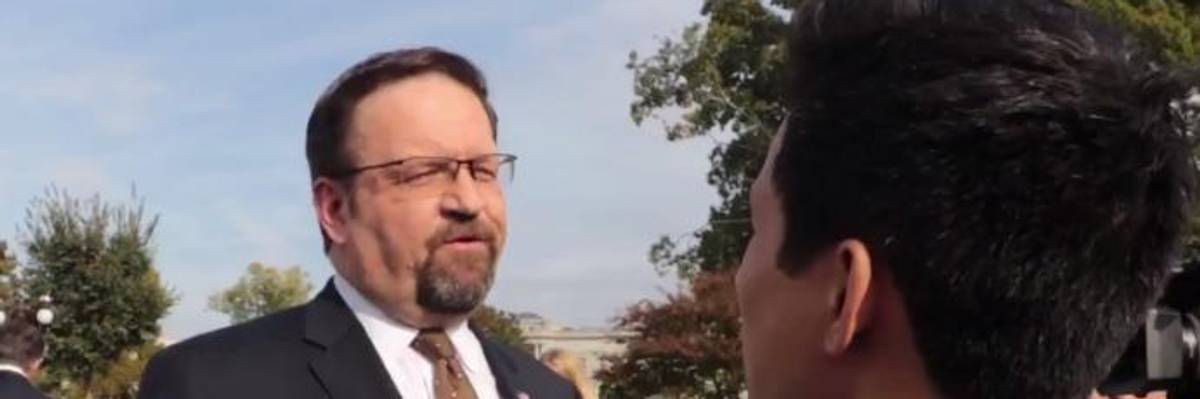
Sebastian Gorka, former advisor to President Donald Trump, refused to answer questions from The Intercept's Lee Fang in Washington, D.C. this week because he thinks the news outlet is "bad for democracy." (Photo: Sceenshot/@lhFang)
Former White House advisor Sebastian Gorka doesn't want to talk to reporters from The Intercept about domestic U.S. policy because he views the outlet as "bad for democracy" and he doesn't like their "attitude." Also, he said, they're "a joke."
That was the result when journalist Lee Fang attempted to ask Gorka--back in the news this week after Fox News stirred controversy for hiring the right-wing firebrand as a contributor--if he would answer a few questions in Washington D.C. on Wednesday.
Watch:
While The Intercept--founded in late 2014 by journalists Laura Poitras, Glenn Greenwald, and Jeremy Scahill--continues to provide breaking and in-depth coverage of both domestic and global issues with a team of award-winning investigative journalists and outspoken editorial writers, the charges were especially curious coming from a man like Gorka--known for "shady ties to racist groups" and making outlandish Islamaphobic and xenophobic proclamations.
As Addy Baird wrote for ThinkProgress on Wednesday, the new gig at Fox for Gorka--"reportedly a sworn member of a Nazi-allied party in Hungary"--is hardly surprising, but troubling nonetheless. Baird reports:
Gorka left the White House in August, not long after his closest ally, former White House Chief Strategist Steve Bannon. Gorka has repeatedly said he resigned, but a White House official told a pool reporter that Gorka "did not resign" but "no longer works at the White House."
During his time working for Trump, Gorka defended the White House's silence on a bombing at a mosque because, according to Gorka, it might have been faked by liberals. Gorka also drew criticism for saying people should stop criticizing white supremacists so much.
When Gorka left the White House, he complained the administration wasn't Islamophobic enough.
As free press advocate Tim Karr declared in response to the video posted of Gorka, "I can't imagine a more ringing endorsement of [The Intercept's] good and essential work."
Dear Common Dreams reader, It’s been nearly 30 years since I co-founded Common Dreams with my late wife, Lina Newhouser. We had the radical notion that journalism should serve the public good, not corporate profits. It was clear to us from the outset what it would take to build such a project. No paid advertisements. No corporate sponsors. No millionaire publisher telling us what to think or do. Many people said we wouldn't last a year, but we proved those doubters wrong. Together with a tremendous team of journalists and dedicated staff, we built an independent media outlet free from the constraints of profits and corporate control. Our mission has always been simple: To inform. To inspire. To ignite change for the common good. Building Common Dreams was not easy. Our survival was never guaranteed. When you take on the most powerful forces—Wall Street greed, fossil fuel industry destruction, Big Tech lobbyists, and uber-rich oligarchs who have spent billions upon billions rigging the economy and democracy in their favor—the only bulwark you have is supporters who believe in your work. But here’s the urgent message from me today. It's never been this bad out there. And it's never been this hard to keep us going. At the very moment Common Dreams is most needed, the threats we face are intensifying. We need your support now more than ever. We don't accept corporate advertising and never will. We don't have a paywall because we don't think people should be blocked from critical news based on their ability to pay. Everything we do is funded by the donations of readers like you. When everyone does the little they can afford, we are strong. But if that support retreats or dries up, so do we. Will you donate now to make sure Common Dreams not only survives but thrives? —Craig Brown, Co-founder |
Former White House advisor Sebastian Gorka doesn't want to talk to reporters from The Intercept about domestic U.S. policy because he views the outlet as "bad for democracy" and he doesn't like their "attitude." Also, he said, they're "a joke."
That was the result when journalist Lee Fang attempted to ask Gorka--back in the news this week after Fox News stirred controversy for hiring the right-wing firebrand as a contributor--if he would answer a few questions in Washington D.C. on Wednesday.
Watch:
While The Intercept--founded in late 2014 by journalists Laura Poitras, Glenn Greenwald, and Jeremy Scahill--continues to provide breaking and in-depth coverage of both domestic and global issues with a team of award-winning investigative journalists and outspoken editorial writers, the charges were especially curious coming from a man like Gorka--known for "shady ties to racist groups" and making outlandish Islamaphobic and xenophobic proclamations.
As Addy Baird wrote for ThinkProgress on Wednesday, the new gig at Fox for Gorka--"reportedly a sworn member of a Nazi-allied party in Hungary"--is hardly surprising, but troubling nonetheless. Baird reports:
Gorka left the White House in August, not long after his closest ally, former White House Chief Strategist Steve Bannon. Gorka has repeatedly said he resigned, but a White House official told a pool reporter that Gorka "did not resign" but "no longer works at the White House."
During his time working for Trump, Gorka defended the White House's silence on a bombing at a mosque because, according to Gorka, it might have been faked by liberals. Gorka also drew criticism for saying people should stop criticizing white supremacists so much.
When Gorka left the White House, he complained the administration wasn't Islamophobic enough.
As free press advocate Tim Karr declared in response to the video posted of Gorka, "I can't imagine a more ringing endorsement of [The Intercept's] good and essential work."
Former White House advisor Sebastian Gorka doesn't want to talk to reporters from The Intercept about domestic U.S. policy because he views the outlet as "bad for democracy" and he doesn't like their "attitude." Also, he said, they're "a joke."
That was the result when journalist Lee Fang attempted to ask Gorka--back in the news this week after Fox News stirred controversy for hiring the right-wing firebrand as a contributor--if he would answer a few questions in Washington D.C. on Wednesday.
Watch:
While The Intercept--founded in late 2014 by journalists Laura Poitras, Glenn Greenwald, and Jeremy Scahill--continues to provide breaking and in-depth coverage of both domestic and global issues with a team of award-winning investigative journalists and outspoken editorial writers, the charges were especially curious coming from a man like Gorka--known for "shady ties to racist groups" and making outlandish Islamaphobic and xenophobic proclamations.
As Addy Baird wrote for ThinkProgress on Wednesday, the new gig at Fox for Gorka--"reportedly a sworn member of a Nazi-allied party in Hungary"--is hardly surprising, but troubling nonetheless. Baird reports:
Gorka left the White House in August, not long after his closest ally, former White House Chief Strategist Steve Bannon. Gorka has repeatedly said he resigned, but a White House official told a pool reporter that Gorka "did not resign" but "no longer works at the White House."
During his time working for Trump, Gorka defended the White House's silence on a bombing at a mosque because, according to Gorka, it might have been faked by liberals. Gorka also drew criticism for saying people should stop criticizing white supremacists so much.
When Gorka left the White House, he complained the administration wasn't Islamophobic enough.
As free press advocate Tim Karr declared in response to the video posted of Gorka, "I can't imagine a more ringing endorsement of [The Intercept's] good and essential work."