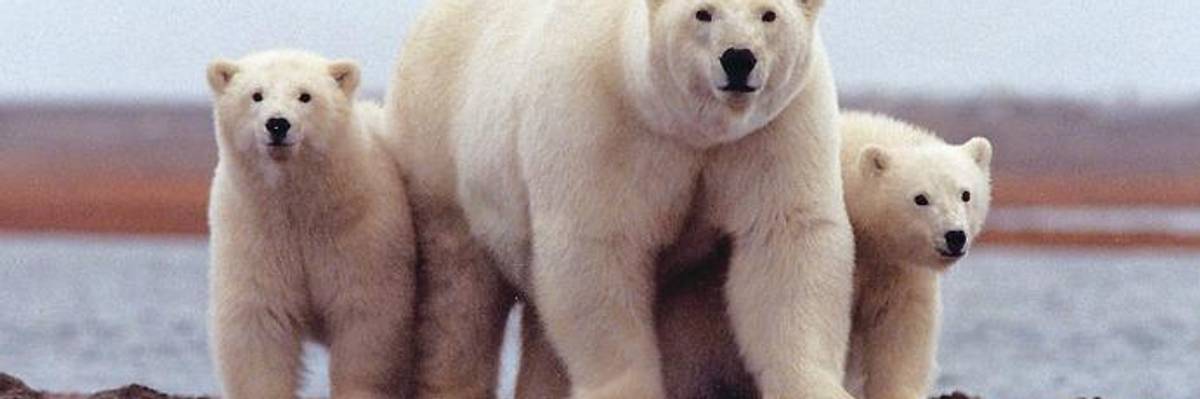
A polar bear keeps close to her young along the Beaufort Sea coast in Arctic National Wildlife Refuge. (Photo: Susanne Miller/USFWS/Flickr)
Alaska Senator Denounced for 'Deplorable' Attempt to Force Drilling in Arctic Wildlife Refuge
Environmentalists sharply rebuked Sen. Lisa Murkowski's (R-Alaska) proposal to force the sale of drilling rights contracts for public land in Alaska
Environmentalists denounced as "deplorable," "immoral," and "toxic" a move by Sen. Lisa Murkowski (R-Alaska) to force drilling for oil and natural gas on federally protected public lands in Alaska.
"This toxic legislation would turn vital wildlife habitat into an oil field. It's pure politics and bad science."
--Jamie Rappaport Clark, Defenders of Wildlife
After Senate Republicans--and one Democrat--last month thwarted efforts by a group of Democratic senators and conservationists to protect the Arctic National Wildlife Refuge (ANWR) from the fossil fuel industry, Murkowski proposed legislation on Wednesday that would require the Interior Department to approve at least two sales for drilling rights leases within a decade. And because the measure is part of the budget resolution process, it could pass by a simple majority.
While Murkowski--with support from Alaska's governor and other members of Congress--touted her legislation as "a tremendous opportunity" that would "put Alaska and the entire nation on a path toward greater prosperity," local and national environmentalists warned of the consequences of her proposal to open up 1.5 million acres of ANWR's coastal plain to drilling.
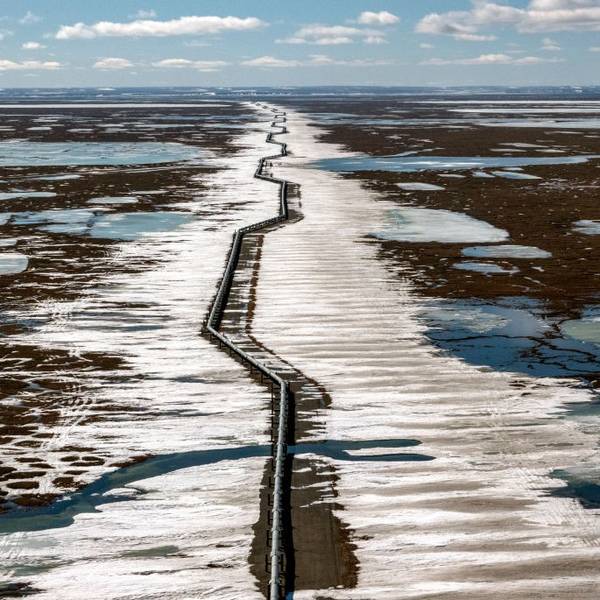
"What this bill would do is turn America's last great wilderness into a lost wilderness," said Adam Kolton, executive director of Alaska Wilderness League. "It would allow roads, pipelines, gravel mines, and well pads to be erected across the entire birthing grounds of the Coastal Plain, where caribou calve and where polar bear mothers den."
"It's deplorable that a backdoor budget maneuver is being used to ram Arctic drilling through without a full, fair and open debate," Kolton continued. "It's immoral that this bill would risk the subsistence culture of the Gwich'in for a fool's gold of exaggerated money and jobs. And it's wrong to pretend to offer a tax cut with one hand and rob our children and grandchildren of their rightful heritage with the other."
"This toxic legislation would turn vital wildlife habitat into an oil field. It's pure politics and bad science," said Jamie Rappaport Clark, president and CEO of Defenders of Wildlife. "With this proposal, Senator Murkowski's long-standing wish to shove aside polar bears, caribou, wolves, and environmental protections, and give away the Arctic refuge to the fossil fuel industry is a frightening step closer to reality. Despite Senator Murkowski's spin, industrializing the biological heart of the Arctic Refuge will never be compatible with protecting its world class wildlife values."
Although the possibility of ANWR drilling has been hotly debated in Washington for decades, the current discussions have been spurred by a budget requirement that would force the Senate Energy and Natural Gas Committee--which Murkowski chairs--to generate $1 billion in revenue over the next 10 years.
"Drilling in this sensitive ecological area remains as terrible an idea today as it was 12 years ago, when Congress blocked a similar effort," the Seattle Times argued in a recent editorial. "Congress should resist. This $1 billion is minuscule compared to the $1.5 trillion Republicans would add to the federal deficit with their tax-cut plan."
Critics--including Sen. Maria Cantwell (D-Wash.), the top Democrat on the Senate energy committee who helped lead the failed effort to protect ANWR last month--condemned the legislation on Twitter:
We are at a crossroads
This country and this world are at a monumental crossroads. In a few short weeks, US voters will have an opportunity to beat back the forces of fascism and confront the billionaires who are rigging the economy, our media system, and our democracy, making it increasingly impossible for ordinary people to get by. We’re not just talking about the election. We’re talking about what must be done once these fascist elements are vanquished from power. We need a bolder set of solutions than what either major party has so far been willing to offer and a working-class movement ready to fight like hell for it. Trump didn't emerge from nowhere. The conditions that fueled MAGA authoritarianism were created by decades of radical neoliberal economic policies and a corrupt political system dominated by corporate interests. They slashed taxes on the super-rich, promising that the benefits would trickle down. They said giveaways to the corporate titans would make life more affordable for the rest of us. It was all bullshit. And when a bitter, betrayed populace searches for someone to blame, right-wing demagogues have little trouble finding scapegoats. People know when they're being lied to, but you won't hear any of this from the corporate media. Only independent journalism—powered and funded by people who believe in building a better world—can deliver truly trustworthy daily news. Our Fall Campaign is underway, and we need your help. To power our newsroom through the rest of the year, we need to raise $125,000 by midnight on October 31. So if you share our vision, please contribute whatever you can to sustain our work. |
Environmentalists denounced as "deplorable," "immoral," and "toxic" a move by Sen. Lisa Murkowski (R-Alaska) to force drilling for oil and natural gas on federally protected public lands in Alaska.
"This toxic legislation would turn vital wildlife habitat into an oil field. It's pure politics and bad science."
--Jamie Rappaport Clark, Defenders of Wildlife
After Senate Republicans--and one Democrat--last month thwarted efforts by a group of Democratic senators and conservationists to protect the Arctic National Wildlife Refuge (ANWR) from the fossil fuel industry, Murkowski proposed legislation on Wednesday that would require the Interior Department to approve at least two sales for drilling rights leases within a decade. And because the measure is part of the budget resolution process, it could pass by a simple majority.
While Murkowski--with support from Alaska's governor and other members of Congress--touted her legislation as "a tremendous opportunity" that would "put Alaska and the entire nation on a path toward greater prosperity," local and national environmentalists warned of the consequences of her proposal to open up 1.5 million acres of ANWR's coastal plain to drilling.
"What this bill would do is turn America's last great wilderness into a lost wilderness," said Adam Kolton, executive director of Alaska Wilderness League. "It would allow roads, pipelines, gravel mines, and well pads to be erected across the entire birthing grounds of the Coastal Plain, where caribou calve and where polar bear mothers den."
"It's deplorable that a backdoor budget maneuver is being used to ram Arctic drilling through without a full, fair and open debate," Kolton continued. "It's immoral that this bill would risk the subsistence culture of the Gwich'in for a fool's gold of exaggerated money and jobs. And it's wrong to pretend to offer a tax cut with one hand and rob our children and grandchildren of their rightful heritage with the other."
"This toxic legislation would turn vital wildlife habitat into an oil field. It's pure politics and bad science," said Jamie Rappaport Clark, president and CEO of Defenders of Wildlife. "With this proposal, Senator Murkowski's long-standing wish to shove aside polar bears, caribou, wolves, and environmental protections, and give away the Arctic refuge to the fossil fuel industry is a frightening step closer to reality. Despite Senator Murkowski's spin, industrializing the biological heart of the Arctic Refuge will never be compatible with protecting its world class wildlife values."
Although the possibility of ANWR drilling has been hotly debated in Washington for decades, the current discussions have been spurred by a budget requirement that would force the Senate Energy and Natural Gas Committee--which Murkowski chairs--to generate $1 billion in revenue over the next 10 years.
"Drilling in this sensitive ecological area remains as terrible an idea today as it was 12 years ago, when Congress blocked a similar effort," the Seattle Times argued in a recent editorial. "Congress should resist. This $1 billion is minuscule compared to the $1.5 trillion Republicans would add to the federal deficit with their tax-cut plan."
Critics--including Sen. Maria Cantwell (D-Wash.), the top Democrat on the Senate energy committee who helped lead the failed effort to protect ANWR last month--condemned the legislation on Twitter:
Environmentalists denounced as "deplorable," "immoral," and "toxic" a move by Sen. Lisa Murkowski (R-Alaska) to force drilling for oil and natural gas on federally protected public lands in Alaska.
"This toxic legislation would turn vital wildlife habitat into an oil field. It's pure politics and bad science."
--Jamie Rappaport Clark, Defenders of Wildlife
After Senate Republicans--and one Democrat--last month thwarted efforts by a group of Democratic senators and conservationists to protect the Arctic National Wildlife Refuge (ANWR) from the fossil fuel industry, Murkowski proposed legislation on Wednesday that would require the Interior Department to approve at least two sales for drilling rights leases within a decade. And because the measure is part of the budget resolution process, it could pass by a simple majority.
While Murkowski--with support from Alaska's governor and other members of Congress--touted her legislation as "a tremendous opportunity" that would "put Alaska and the entire nation on a path toward greater prosperity," local and national environmentalists warned of the consequences of her proposal to open up 1.5 million acres of ANWR's coastal plain to drilling.
"What this bill would do is turn America's last great wilderness into a lost wilderness," said Adam Kolton, executive director of Alaska Wilderness League. "It would allow roads, pipelines, gravel mines, and well pads to be erected across the entire birthing grounds of the Coastal Plain, where caribou calve and where polar bear mothers den."
"It's deplorable that a backdoor budget maneuver is being used to ram Arctic drilling through without a full, fair and open debate," Kolton continued. "It's immoral that this bill would risk the subsistence culture of the Gwich'in for a fool's gold of exaggerated money and jobs. And it's wrong to pretend to offer a tax cut with one hand and rob our children and grandchildren of their rightful heritage with the other."
"This toxic legislation would turn vital wildlife habitat into an oil field. It's pure politics and bad science," said Jamie Rappaport Clark, president and CEO of Defenders of Wildlife. "With this proposal, Senator Murkowski's long-standing wish to shove aside polar bears, caribou, wolves, and environmental protections, and give away the Arctic refuge to the fossil fuel industry is a frightening step closer to reality. Despite Senator Murkowski's spin, industrializing the biological heart of the Arctic Refuge will never be compatible with protecting its world class wildlife values."
Although the possibility of ANWR drilling has been hotly debated in Washington for decades, the current discussions have been spurred by a budget requirement that would force the Senate Energy and Natural Gas Committee--which Murkowski chairs--to generate $1 billion in revenue over the next 10 years.
"Drilling in this sensitive ecological area remains as terrible an idea today as it was 12 years ago, when Congress blocked a similar effort," the Seattle Times argued in a recent editorial. "Congress should resist. This $1 billion is minuscule compared to the $1.5 trillion Republicans would add to the federal deficit with their tax-cut plan."
Critics--including Sen. Maria Cantwell (D-Wash.), the top Democrat on the Senate energy committee who helped lead the failed effort to protect ANWR last month--condemned the legislation on Twitter: