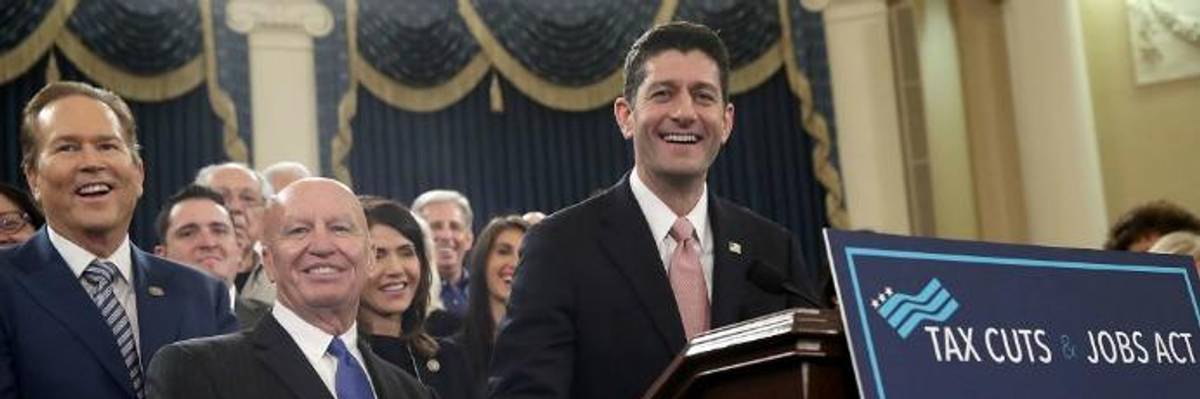
House Way and Means Chairman Kevin Brady (R-Texas) and Speaker of the House Paul Ryan (R-Wis.), joined by members of the House Republican leadership, introduce tax reform legislation November 2, 2017 in Washington, D.C. (Photo: Win McNamee/Getty Images)
CBO: Republican Tax Scam Would Blow $1.7 Trillion Hole in the National Debt
The Congressional Budget Office analysis exposes party's expressed concerns about "fiscal responsibility" as a sham
As House Republicans are reportedly preparing to bring their deeply unpopular tax bill to the floor for a vote as early as next week, an analysis (pdf) by the Congressional Budget Office (CBO) published Wednesday found that the legislation in its current form would blow a $1.7 trillion hole in the national debt--exceeding the $1.5 trillion the GOP had initially budgeted for and putting the lie to the party's expressed concerns about "fiscal responsibility."
"What we are incurring is immense debt at immense cost to the American people just to benefit a handful of people at the top and some multinational corporations."
--Rep. Lloyd Doggett
The Republican plan would also raise the public debt-to-GDP ratio to 97.1 percent by 2027, nearly six percent higher than projected under the existing system, the CBO found. As Chuck Marr of the Center on Budget and Policy Priorities notes, this would bring the debt-to-GDP ratio to its highest point since 1946.
"Like the Bush tax cut, the current GOP plan is a costly, regressive tax cut. What is different, and getting too little attention, is the fiscal situation is so different," Marr adds, pointing to the fact that the Bush tax cuts were rammed through at a time when the government was running a surplus and the debt was "relatively low."
"A new package of unfinanced tax cuts skewed to the rich would be even less defensible now than in the Bush era," Marr argued in a recent blog post.
The CBO's report is just the latest in a slew of analyses that have emerged in recent days that run directly counter to the GOP's presentation of their tax proposals as "fiscally responsible" and pro-middle class.
Far from primarily favoring low- and middle-income Americans, the House GOP plan would raise taxes on many middle class families while delivering huge gains to the top one percent--which already controls 38.5 percent of America's wealth.
According to a New York Times analysis published Monday, 45 percent of middle class Americans will pay more in taxes by 2027--a finding that contradicts Senate Majority Leader Mitch McConnell's (R-Ky.) assertion over the weekend that "nobody in the middle class is going to get a tax increase" under the Republican plan.
"What we are incurring is immense debt at immense cost to the American people just to benefit a handful of people at the top and some multinational corporations that don't believe in paying their taxes," concluded Rep. Lloyd Doggett (D-Texas) during a House Ways and Means Committee hearing on Tuesday.
We are at a crossroads
This country and this world are at a monumental crossroads. In a few short weeks, US voters will have an opportunity to beat back the forces of fascism and confront the billionaires who are rigging the economy, our media system, and our democracy, making it increasingly impossible for ordinary people to get by. We’re not just talking about the election. We’re talking about what must be done once these fascist elements are vanquished from power. We need a bolder set of solutions than what either major party has so far been willing to offer and a working-class movement ready to fight like hell for it. Trump didn't emerge from nowhere. The conditions that fueled MAGA authoritarianism were created by decades of radical neoliberal economic policies and a corrupt political system dominated by corporate interests. They slashed taxes on the super-rich, promising that the benefits would trickle down. They said giveaways to the corporate titans would make life more affordable for the rest of us. It was all bullshit. And when a bitter, betrayed populace searches for someone to blame, right-wing demagogues have little trouble finding scapegoats. People know when they're being lied to, but you won't hear any of this from the corporate media. Only independent journalism—powered and funded by people who believe in building a better world—can deliver truly trustworthy daily news. Our Fall Campaign is underway, and we need your help. To power our newsroom through the rest of the year, we need to raise $125,000 by midnight on October 31. So if you share our vision, please contribute whatever you can to sustain our work. |
As House Republicans are reportedly preparing to bring their deeply unpopular tax bill to the floor for a vote as early as next week, an analysis (pdf) by the Congressional Budget Office (CBO) published Wednesday found that the legislation in its current form would blow a $1.7 trillion hole in the national debt--exceeding the $1.5 trillion the GOP had initially budgeted for and putting the lie to the party's expressed concerns about "fiscal responsibility."
"What we are incurring is immense debt at immense cost to the American people just to benefit a handful of people at the top and some multinational corporations."
--Rep. Lloyd Doggett
The Republican plan would also raise the public debt-to-GDP ratio to 97.1 percent by 2027, nearly six percent higher than projected under the existing system, the CBO found. As Chuck Marr of the Center on Budget and Policy Priorities notes, this would bring the debt-to-GDP ratio to its highest point since 1946.
"Like the Bush tax cut, the current GOP plan is a costly, regressive tax cut. What is different, and getting too little attention, is the fiscal situation is so different," Marr adds, pointing to the fact that the Bush tax cuts were rammed through at a time when the government was running a surplus and the debt was "relatively low."
"A new package of unfinanced tax cuts skewed to the rich would be even less defensible now than in the Bush era," Marr argued in a recent blog post.
The CBO's report is just the latest in a slew of analyses that have emerged in recent days that run directly counter to the GOP's presentation of their tax proposals as "fiscally responsible" and pro-middle class.
Far from primarily favoring low- and middle-income Americans, the House GOP plan would raise taxes on many middle class families while delivering huge gains to the top one percent--which already controls 38.5 percent of America's wealth.
According to a New York Times analysis published Monday, 45 percent of middle class Americans will pay more in taxes by 2027--a finding that contradicts Senate Majority Leader Mitch McConnell's (R-Ky.) assertion over the weekend that "nobody in the middle class is going to get a tax increase" under the Republican plan.
"What we are incurring is immense debt at immense cost to the American people just to benefit a handful of people at the top and some multinational corporations that don't believe in paying their taxes," concluded Rep. Lloyd Doggett (D-Texas) during a House Ways and Means Committee hearing on Tuesday.
As House Republicans are reportedly preparing to bring their deeply unpopular tax bill to the floor for a vote as early as next week, an analysis (pdf) by the Congressional Budget Office (CBO) published Wednesday found that the legislation in its current form would blow a $1.7 trillion hole in the national debt--exceeding the $1.5 trillion the GOP had initially budgeted for and putting the lie to the party's expressed concerns about "fiscal responsibility."
"What we are incurring is immense debt at immense cost to the American people just to benefit a handful of people at the top and some multinational corporations."
--Rep. Lloyd Doggett
The Republican plan would also raise the public debt-to-GDP ratio to 97.1 percent by 2027, nearly six percent higher than projected under the existing system, the CBO found. As Chuck Marr of the Center on Budget and Policy Priorities notes, this would bring the debt-to-GDP ratio to its highest point since 1946.
"Like the Bush tax cut, the current GOP plan is a costly, regressive tax cut. What is different, and getting too little attention, is the fiscal situation is so different," Marr adds, pointing to the fact that the Bush tax cuts were rammed through at a time when the government was running a surplus and the debt was "relatively low."
"A new package of unfinanced tax cuts skewed to the rich would be even less defensible now than in the Bush era," Marr argued in a recent blog post.
The CBO's report is just the latest in a slew of analyses that have emerged in recent days that run directly counter to the GOP's presentation of their tax proposals as "fiscally responsible" and pro-middle class.
Far from primarily favoring low- and middle-income Americans, the House GOP plan would raise taxes on many middle class families while delivering huge gains to the top one percent--which already controls 38.5 percent of America's wealth.
According to a New York Times analysis published Monday, 45 percent of middle class Americans will pay more in taxes by 2027--a finding that contradicts Senate Majority Leader Mitch McConnell's (R-Ky.) assertion over the weekend that "nobody in the middle class is going to get a tax increase" under the Republican plan.
"What we are incurring is immense debt at immense cost to the American people just to benefit a handful of people at the top and some multinational corporations that don't believe in paying their taxes," concluded Rep. Lloyd Doggett (D-Texas) during a House Ways and Means Committee hearing on Tuesday.