SUBSCRIBE TO OUR FREE NEWSLETTER
Daily news & progressive opinion—funded by the people, not the corporations—delivered straight to your inbox.
5
#000000
#FFFFFF
To donate by check, phone, or other method, see our More Ways to Give page.
Daily news & progressive opinion—funded by the people, not the corporations—delivered straight to your inbox.
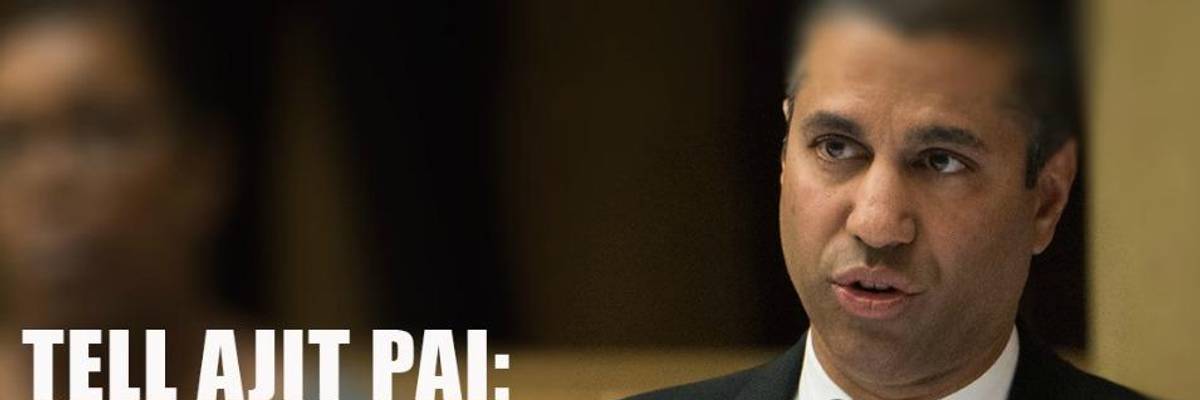
For remaining silent amid threats by President Donald Trump against press freedoms, advocacy groups and Democratic lawmakers are calling on FCC Chairman Ajit Pai to speak out. (Image: via Free Press)
While advocates of press freedom condemned the comments and lawmakers urged the Federal Communication Commission to specifically rebuke them, FCC Chairman Ajit Pai has so far refused to denounce President Donald Trump's threats to strip news outlets of their "licenses"--something he himself doesn't have the power to do but which critics say speaks directly to his "authoritarian" tendencies.
But while members from both parties condemned the implications of Trump's remarks--and other FCC commissions assured the public that they would stand in the way of such attempts--many said that Pai's strategic "silence" on the issue is cause for deep concern of its own.
As The Nation's John Nichols said in response to Pai's refusal to speak out: "Worry."
"When it comes to defending press freedom from this president's threats, " Nichols wrote in a column on Wednesday, "this is mission critical for those who take seriously their duty to defend the First Amendment that Donald Trump so casually disregards."
And Bloomberg's Todd Shields notes how "the presidential threat evoked memories of intimidation by President Richard Nixon, who urged his lieutenants to interfere with the renewal of the Washington Post's licenses for Florida TV stations in 1972."
And so why Democrats on Thursday called for hearings over Trump's veiled threats about media licenses, advocacy groups like Free Press did their best to turn up the heat on Pai:
Dear Common Dreams reader, It’s been nearly 30 years since I co-founded Common Dreams with my late wife, Lina Newhouser. We had the radical notion that journalism should serve the public good, not corporate profits. It was clear to us from the outset what it would take to build such a project. No paid advertisements. No corporate sponsors. No millionaire publisher telling us what to think or do. Many people said we wouldn't last a year, but we proved those doubters wrong. Together with a tremendous team of journalists and dedicated staff, we built an independent media outlet free from the constraints of profits and corporate control. Our mission has always been simple: To inform. To inspire. To ignite change for the common good. Building Common Dreams was not easy. Our survival was never guaranteed. When you take on the most powerful forces—Wall Street greed, fossil fuel industry destruction, Big Tech lobbyists, and uber-rich oligarchs who have spent billions upon billions rigging the economy and democracy in their favor—the only bulwark you have is supporters who believe in your work. But here’s the urgent message from me today. It's never been this bad out there. And it's never been this hard to keep us going. At the very moment Common Dreams is most needed, the threats we face are intensifying. We need your support now more than ever. We don't accept corporate advertising and never will. We don't have a paywall because we don't think people should be blocked from critical news based on their ability to pay. Everything we do is funded by the donations of readers like you. When everyone does the little they can afford, we are strong. But if that support retreats or dries up, so do we. Will you donate now to make sure Common Dreams not only survives but thrives? —Craig Brown, Co-founder |
While advocates of press freedom condemned the comments and lawmakers urged the Federal Communication Commission to specifically rebuke them, FCC Chairman Ajit Pai has so far refused to denounce President Donald Trump's threats to strip news outlets of their "licenses"--something he himself doesn't have the power to do but which critics say speaks directly to his "authoritarian" tendencies.
But while members from both parties condemned the implications of Trump's remarks--and other FCC commissions assured the public that they would stand in the way of such attempts--many said that Pai's strategic "silence" on the issue is cause for deep concern of its own.
As The Nation's John Nichols said in response to Pai's refusal to speak out: "Worry."
"When it comes to defending press freedom from this president's threats, " Nichols wrote in a column on Wednesday, "this is mission critical for those who take seriously their duty to defend the First Amendment that Donald Trump so casually disregards."
And Bloomberg's Todd Shields notes how "the presidential threat evoked memories of intimidation by President Richard Nixon, who urged his lieutenants to interfere with the renewal of the Washington Post's licenses for Florida TV stations in 1972."
And so why Democrats on Thursday called for hearings over Trump's veiled threats about media licenses, advocacy groups like Free Press did their best to turn up the heat on Pai:
While advocates of press freedom condemned the comments and lawmakers urged the Federal Communication Commission to specifically rebuke them, FCC Chairman Ajit Pai has so far refused to denounce President Donald Trump's threats to strip news outlets of their "licenses"--something he himself doesn't have the power to do but which critics say speaks directly to his "authoritarian" tendencies.
But while members from both parties condemned the implications of Trump's remarks--and other FCC commissions assured the public that they would stand in the way of such attempts--many said that Pai's strategic "silence" on the issue is cause for deep concern of its own.
As The Nation's John Nichols said in response to Pai's refusal to speak out: "Worry."
"When it comes to defending press freedom from this president's threats, " Nichols wrote in a column on Wednesday, "this is mission critical for those who take seriously their duty to defend the First Amendment that Donald Trump so casually disregards."
And Bloomberg's Todd Shields notes how "the presidential threat evoked memories of intimidation by President Richard Nixon, who urged his lieutenants to interfere with the renewal of the Washington Post's licenses for Florida TV stations in 1972."
And so why Democrats on Thursday called for hearings over Trump's veiled threats about media licenses, advocacy groups like Free Press did their best to turn up the heat on Pai: