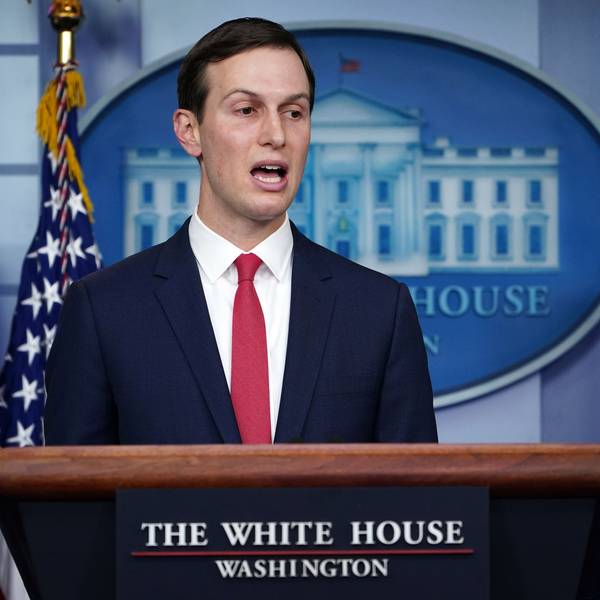

Jared Kushner has reportedly communicated with other high-level administration officials using a private email account, potentially breaching the Presidential Records Act. (Photo: Chairman of the Joint Chiefs of Staff/Flickr/cc)
Critics Call for Investigation Into Jared Kushner's Use of Private Email Server
President's son-in-law and top advisor set up a private email server during the Trump campaign's transition to power
Senior presidential advisor Jared Kushner is under new scrutiny following reports that he has used a private email account since his father-in-law, President Donald Trump, took office in January--the same thing Hillary Clinton was attacked for during the 2016 campaign.
According to a Politico report, Kushner set up a private email server during the Trump campaign's transition to power, and he's sent messages regarding Trump and the administration using his private email address. Former White House chief of staff Reince Priebus, former chief strategist Steve Bannon, and economic advisor Gary Cohn have all corresponded with Kushner via his private account.
The Presidental Records Act dictates that all emails and records related to the president's activities be archived, and use of private email accounts runs the risk of disobeying that rule.
Kushner is not the first Trump advisor to come under scrutiny for his email habits. Aides have reportedly communicated using encryption apps including Signal and Confide--software favored by some journalists and their sources because they delete messages after they are read.
Kushner's attorney, Abbe Lowell, defended his use of the private email server on Sunday. "Mr. Kushner uses his White House email address to conduct White House business," he said. "Fewer than 100 emails from January through August were either sent to or returned by Mr. Kushner to colleagues in the White House from his personal email account."
"There is no indication that Kushner has shared any sensitive or classified material on his private account," according to Politico. Still, critics expressed shock on Monday that a high-level member of the Trump administration has engaged in the same behavior that led to an FBI investigation of Clinton's email server in the midst of her presidential campaign--particularly after Kushner has been embroiled in the ongoing inquiry into the Trump administration's ties to Russia. Kushner denied colluding with Russia after his closed-door talks with the Senate Intelligence Committee in July regarding his meetings with Russian officials during the Trump team's transition.
Trump critics and journalists spoke out about Kushner's private email account on Twitter, and called on him to make the correspondence public as Hillary Clinton did during the campaign.
Urgent. It's never been this bad.
Dear Common Dreams reader, It’s been nearly 30 years since I co-founded Common Dreams with my late wife, Lina Newhouser. We had the radical notion that journalism should serve the public good, not corporate profits. It was clear to us from the outset what it would take to build such a project. No paid advertisements. No corporate sponsors. No millionaire publisher telling us what to think or do. Many people said we wouldn't last a year, but we proved those doubters wrong. Together with a tremendous team of journalists and dedicated staff, we built an independent media outlet free from the constraints of profits and corporate control. Our mission from the outset was simple. To inform. To inspire. To ignite change for the common good. Building Common Dreams was not easy. Our survival was never guaranteed. When you take on the most powerful forces—Wall Street greed, fossil fuel industry destruction, Big Tech lobbyists, and uber-rich oligarchs who have spent billions upon billions rigging the economy and democracy in their favor—the only bulwark you have is supporters who believe in your work. But here’s the urgent message from me today. It’s never been this bad out there. And it’s never been this hard to keep us going. At the very moment Common Dreams is most needed and doing some of its best and most important work, the threats we face are intensifying. Right now, with just three days to go in our Spring Campaign, we're falling short of our make-or-break goal. When everyone does the little they can afford, we are strong. But if that support retreats or dries up, so do we. Can you make a gift right now to make sure Common Dreams not only survives but thrives? There is no backup plan or rainy day fund. There is only you. —Craig Brown, Co-founder |
Senior presidential advisor Jared Kushner is under new scrutiny following reports that he has used a private email account since his father-in-law, President Donald Trump, took office in January--the same thing Hillary Clinton was attacked for during the 2016 campaign.
According to a Politico report, Kushner set up a private email server during the Trump campaign's transition to power, and he's sent messages regarding Trump and the administration using his private email address. Former White House chief of staff Reince Priebus, former chief strategist Steve Bannon, and economic advisor Gary Cohn have all corresponded with Kushner via his private account.
The Presidental Records Act dictates that all emails and records related to the president's activities be archived, and use of private email accounts runs the risk of disobeying that rule.
Kushner is not the first Trump advisor to come under scrutiny for his email habits. Aides have reportedly communicated using encryption apps including Signal and Confide--software favored by some journalists and their sources because they delete messages after they are read.
Kushner's attorney, Abbe Lowell, defended his use of the private email server on Sunday. "Mr. Kushner uses his White House email address to conduct White House business," he said. "Fewer than 100 emails from January through August were either sent to or returned by Mr. Kushner to colleagues in the White House from his personal email account."
"There is no indication that Kushner has shared any sensitive or classified material on his private account," according to Politico. Still, critics expressed shock on Monday that a high-level member of the Trump administration has engaged in the same behavior that led to an FBI investigation of Clinton's email server in the midst of her presidential campaign--particularly after Kushner has been embroiled in the ongoing inquiry into the Trump administration's ties to Russia. Kushner denied colluding with Russia after his closed-door talks with the Senate Intelligence Committee in July regarding his meetings with Russian officials during the Trump team's transition.
Trump critics and journalists spoke out about Kushner's private email account on Twitter, and called on him to make the correspondence public as Hillary Clinton did during the campaign.
Senior presidential advisor Jared Kushner is under new scrutiny following reports that he has used a private email account since his father-in-law, President Donald Trump, took office in January--the same thing Hillary Clinton was attacked for during the 2016 campaign.
According to a Politico report, Kushner set up a private email server during the Trump campaign's transition to power, and he's sent messages regarding Trump and the administration using his private email address. Former White House chief of staff Reince Priebus, former chief strategist Steve Bannon, and economic advisor Gary Cohn have all corresponded with Kushner via his private account.
The Presidental Records Act dictates that all emails and records related to the president's activities be archived, and use of private email accounts runs the risk of disobeying that rule.
Kushner is not the first Trump advisor to come under scrutiny for his email habits. Aides have reportedly communicated using encryption apps including Signal and Confide--software favored by some journalists and their sources because they delete messages after they are read.
Kushner's attorney, Abbe Lowell, defended his use of the private email server on Sunday. "Mr. Kushner uses his White House email address to conduct White House business," he said. "Fewer than 100 emails from January through August were either sent to or returned by Mr. Kushner to colleagues in the White House from his personal email account."
"There is no indication that Kushner has shared any sensitive or classified material on his private account," according to Politico. Still, critics expressed shock on Monday that a high-level member of the Trump administration has engaged in the same behavior that led to an FBI investigation of Clinton's email server in the midst of her presidential campaign--particularly after Kushner has been embroiled in the ongoing inquiry into the Trump administration's ties to Russia. Kushner denied colluding with Russia after his closed-door talks with the Senate Intelligence Committee in July regarding his meetings with Russian officials during the Trump team's transition.
Trump critics and journalists spoke out about Kushner's private email account on Twitter, and called on him to make the correspondence public as Hillary Clinton did during the campaign.